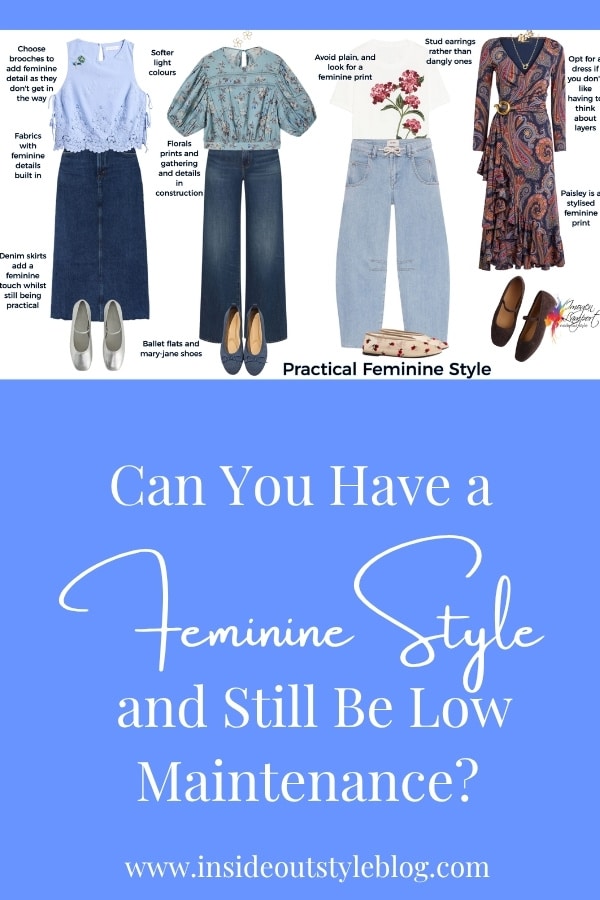








There’s a quiet assumption that trips a lot of women up – that feminine style and low-maintenance style sit at opposite ends of the spectrum. That if you love softness, detail, or a more romantic feel, you’re signing yourself up for effort, upkeep, and complexity.
But that’s not actually what’s going on.
What’s really happening is a mismatch between how feminine style is often presented and how you personally want to live. So you assume that having a feminine style will take too much time, energy and maintenance, and end up in the relaxed style rut, not feeling like yourself. I’m here to let you know that you can have a feminine personal style and it can still be low maintenance and easy.

Why Feminine Style Often Feels “High Maintenance”
When most people think of feminine or romantic style, they picture very specific visual cues such as frills, floaty fabrics, delicate details, and intricate outfits. And often, those garments do come with a higher level of care or coordination.
But that’s only one interpretation of femininity. It’s a narrow version that the fashion industry tends to promote because it photographs well and signals a clear aesthetic.
The problem is, it quietly sets up an expectation: that to look feminine, you have to invest more time, more effort, and more attention. And if that doesn’t fit your lifestyle, you start to feel like the style itself isn’t for you.
Which is why so many women default back to simpler, plainer clothes, not because they don’t like feminine style, but because it feels impractical.
This is where understanding your own version of “low maintenance” becomes the turning point.
What Does Low Maintenance Actually Mean for You?
Low maintenance sounds simple, but it’s surprisingly nuanced. And unless you define it clearly, you end up making style decisions based on assumptions rather than reality.
For some women, low maintenance is about fabric care. They don’t want to iron, don’t want to dry clean or handwash, and don’t want clothes that require special handling or storage.
For others, it’s about outfit complexity; they don’t want to think about coordinating multiple pieces or layering.
And for some, it’s about accessories; they don’t want to finish an outfit with “flappy scarves,” “annoying necklaces,” or other jewellery or additional details that might get in their way.
Each of these creates a different constraint. And once you know which one applies to you, your choices become much more precise.
This is often where the frustration behind wardrobe overwhelm really starts to ease. Because instead of trying to follow general advice, you’re working within a system that actually reflects how you live.
So when you think about your version of “low maintenance” what does this really mean for you and your style? How much effort are you willing to put in? Are you happy to steam or iron? Have you got a washing machine that has a gentle cycle that allows you to wear “handwash” only garments? Are there specific accessories you don’t enjoy wearing, but other’s you’re more than happy to? Maybe you prefer a scarf over a necklace. Or earrings or brooch instead of a necklace. There are many options available to you.
Building Feminine Style Into the Garment Itself
If you don’t want to rely on accessories or complex styling, the simplest shift is to choose garments that already contain the detail you’re looking for.
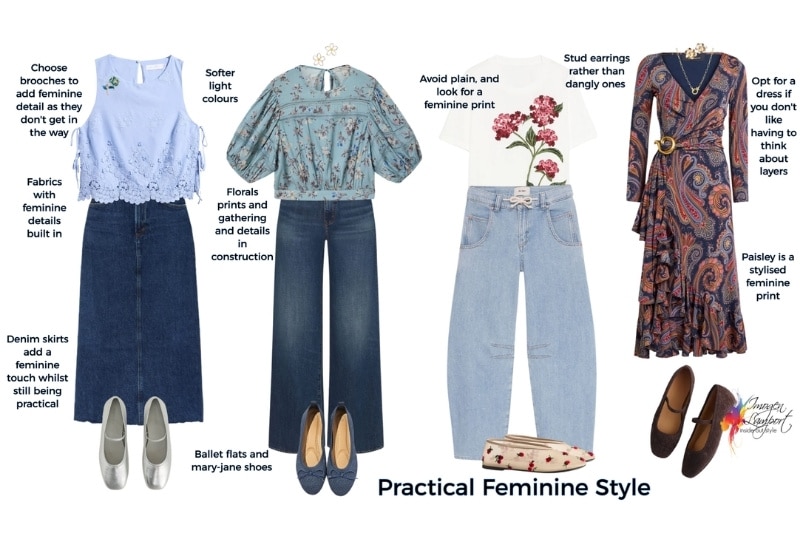
This might be as subtle as a softly gathered shoulder, a shaped neckline, or a fabric with a gentle drape. It might be a feminine print, such as a floral, paisley or polka dot, that adds interest without requiring additional pieces. Or a colour that carries a sense of softness or femininity on its own. For example, this more classic style shirt becomes a little more feminine with the addition of the bows on the sleeves. Wearing it with a skirt (rather than pants) and a brooch completes the outfit to make it both feminine and practical.
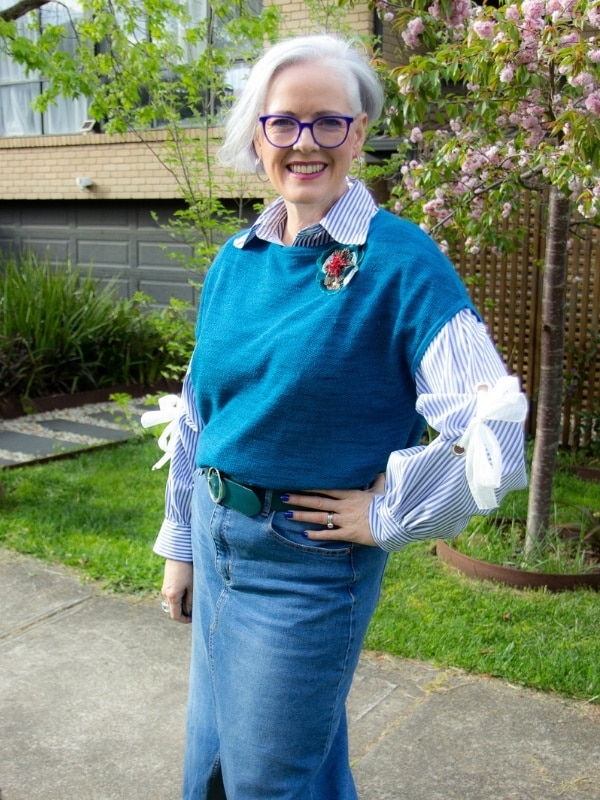
What’s interesting here is that the garment’s *function* changes. It’s no longer just a basic piece that needs styling; it becomes a complete expression in itself.
And when that happens, cognitive load decreases. You’re no longer thinking, “What do I add to make this work?” The garment has already done that work for you.
This is one of the simplest ways to resolve the tension behind why you keep wearing the same outfits. Not because you lack options, but because only a small number of pieces actually feel finished without extra effort.
Even when you’re doing house chores or gardening, you can still express your femininity. That practical tee that you wear may have a floral pattern rather than being plain (which is what most people automatically reach for, when a print can take a plain and relaxed outfit and give it some personality. You might choose a flat mary-jane style shoe instead of sneakers to wear to the supermarket. Still practical and comfortable, but more feminine.
The Power of Dresses
If your version of low maintenance includes not wanting to coordinate outfits, then dresses become incredibly powerful.
Not only because they are inherently more feminine, but also because they reduce decision-making to a single step.
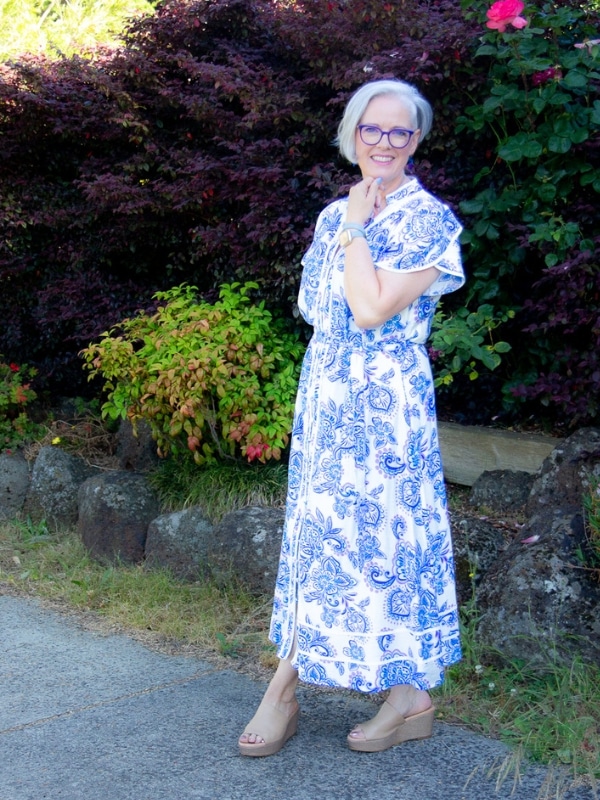
A dress like the one above is comfortable and easy to wear, which makes it practical for many aspects of life. The pattern makes it more practical because nobody will notice a tiny stain like they may on a solid coloured or neutral garment. Plus you’re no longer balancing tops and bottoms, proportions, or combinations. You’re simply choosing one piece and putting it on. And that simplicity has a direct impact on decision fatigue.
But again, it’s not about any dress. It’s about finding styles that align with your other low-maintenance preferences, fabrics that don’t require ironing, shapes that create harmony with your body, and details that feel like you.
When those elements come together, the dress becomes both expressive and effortless.
You Prefer Denim over Dresses

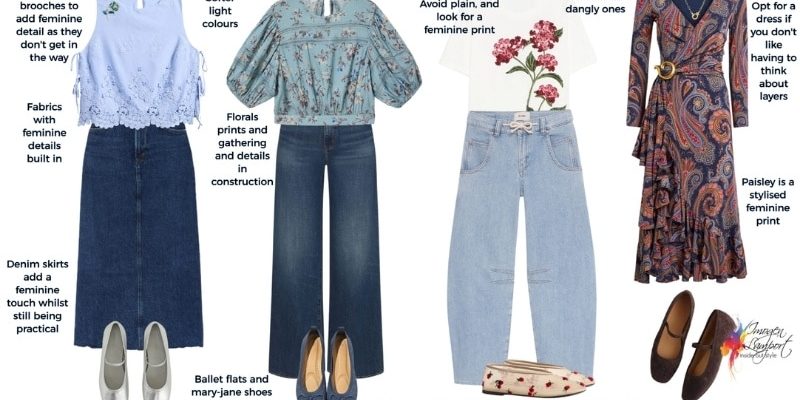
And that’s completely OK. You can still have a feminine style in a pair of jeans or a denim skirt. Think about the shoes, try a ballet flat or mary-jane instead of sneakers. Think about your top, a floral print, or some gathering in the construction rather than something completely plain. Crochet, broderie anglaise and lace are all feminine textures without being fussy. Think about the fabric weight too, try a chiffon or other floaty fabric, rather than a crisp cotton. A satin blouse over a cotton or linen button-up.
There are lots of ways you can add femininity to a relaxed, practical and comfortable outfit.
 Fabric Choices That Support Your Lifestyle
This is the part that often gets overlooked, but it’s where a lot of low-maintenance success is determined.
If you dislike ironing, then fabric composition matters. Blends that include synthetics tend to hold their shape better and require less upkeep. If you’re open to steaming but not ironing, that expands your options. And if you want completely fuss-free care, then wash-and-wear fabrics become essential.
These decisions aren’t about lowering your standards. They’re about aligning your wardrobe with your actual behaviour.
Because when there’s a mismatch between what your clothes require and what you’re willing to do, the clothes lose. Every time.
This is often the hidden reason behind how to make your current wardrobe more stylish. It’s not about adding more – it’s about removing friction.
Where This Becomes a System, Not a Guess
What you might be starting to notice is that this isn’t really about feminine style versus low-maintenance, relaxed style. It’s about understanding the variables that influence your choices, fabric, construction, coordination, detail, and using them intentionally.
And this is where many women realise they’ve been trying to solve the wrong problem. They’ve been looking for the “right” clothes, when what they actually need is a framework for making decisions.
This is often the point where a more structured approach becomes useful. Inside 7 Steps to Style, this is exactly what we break down – how to identify what works for you across multiple factors, so you’re not relying on trial and error every time you shop or get dressed.
Because once you understand the system, the process becomes significantly easier. Decision fatigue reduces. Confidence increases. And your wardrobe starts to function as a cohesive whole, rather than a collection of individual pieces.
Bringing It Back to You
At the end of the day, feminine style isn’t defined by effort. It’s defined by expression.
And low maintenance isn’t about doing less for the sake of it. It’s about doing what aligns with your energy, your preferences, and your life.
When those two things are working together, the tension disappears. You’re no longer trying to force yourself into a version of style that doesn’t fit. You’re creating one that does.
And that’s usually the moment where things start to feel easier. Not because your wardrobe has changed dramatically, but because your decisions have.
Related Reading