








The Wardrobe Problem Nobody Warned You About
Nobody tells you, when you are building a career, that you will spend a significant portion of your professional life trying to solve a problem that has no official name. It sits somewhere between “what should I wear to work?” and something considerably more complicated, something closer to: how do I show up as competent, credible, and authoritative, without disappearing in the process? How do I fit in enough to be taken seriously, while standing out enough to be remembered? How do I dress for the career I want without feeling like I am wearing a costume to play a role that was never written with me in mind?
According to various studies (ClosetMaid in the US, UK corporate uniform store Simon Jersey, and Totaljobs.com), women spend on average 5-6 months of their working life deciding what to wear each morning for work. And 45% of women described figuring out what to wear to work as “stressful”. 76% of women constantly find it difficult to decide what is appropriate. Women are more likely to be impacted by the ambiguity around dress codes and face unnecessary stress and comments from colleagues, as over 28% of women have received unwanted comments about their appearance at work.
This is a professional style problem. And it has intensified considerably in the past two decades, as dress codes have collapsed, “business casual” has become a near-meaningless instruction, and the old rules that at least provided a framework, however imperfect, have been replaced by an ambiguity that many women find more stressful than the rules ever were.
Given this data, what to wear to work and building a professional yet stylish work wardrobe that creates some ease, instead of stress, in your day, is a worthy endeavour and not to be ignored.

The Collapse of the Dress Code
For most of the twentieth century, professional dress operated within relatively clear parameters. Formal business attire, with its suits and structured separates, communicated seriousness and competence through a broadly shared visual vocabulary. The rules were limiting, often uncomfortably so, but they were legible. You knew what was expected. You knew what the uniform was.
I remember back in the mid-1990s talking to my neighbour who worked in an accounting firm where women were still required to wear skirts (trousers were not allowed). I never worked anywhere with such a strict dress code, but I did tend to wear suits and suit separates to work until around 1999, when I started working for a global IT company in a UK-based data centre, where the work dress code was business casual, and suits were considered “too uptight” and I was always told to let potential visitors know not to wear a tie. Though it wasn’t officially a jeans-and-casual environment, the HR department was constantly complaining about how some of the programmers would turn up in clothes so casual and sloppy that they would have to send people home to change.
The gradual erosion of formal dress codes, accelerating through the 1990s and 2000s and effectively completing during the remote-work shift of 2020 and beyond, has produced something that looks like freedom but frequently functions as anxiety. Research by Sonia Kang and colleagues on “covering” in professional environments found that the removal of explicit dress codes does not eliminate the pressure to conform; it simply makes that pressure implicit, making it harder to navigate. When the rules are unwritten, the cost of misreading them feels higher.
The instruction “business casual,” which now governs a significant proportion of professional environments, is particularly problematic. Studies of workplace dress code comprehension have found remarkable inconsistency in how the term is interpreted, even within the same organisation. What reads as appropriately casual to one person reads as underdressed to another. And then what may feel appropriately professional to one person reads as overdressed to another. The instruction communicates almost nothing concrete, while implying that its meaning should be self-evident.
I can tell you that, as an image consultant, the most common reason to be called into a workplace is to address dress code and define what business casual means in that environment. Sometimes denim is OK, and sometimes it’s not. Each individual business needs to make those decisions and then spell their requirements out to employees in a clear way; otherwise, it will always be an ongoing issue.
The result, for many professional women, is a daily exercise in reading invisible signals and hoping you have read them correctly.
Why the Power Suit Gave Women a Costume Instead of a Voice
The 1980s offered professional women a solution to the problem of workplace visibility and credibility: dress like the men, or at least approximate their visual language closely enough to borrow some of its authority. The power suit, with its broad shoulders, structured silhouette, and deliberate rejection of anything that might read as decorative or feminine, was the garment of its moment. Remember the power suit Melanie Griffiths wore in the movie Working Girl (1988), it had the widest shoulders, that took up so much space. It was highly structured and neutral, like the men she was competing with for authority.
What’s interesting is that the early suffragettes also wore a power shoulder, in the form of a puffed sleeve and often a wide collar (that extended past the shoulder), still feminine but shoulder-broadening, allowing them to take up more space in a practical way that the crinoline skirt did not.
The reason that more structured clothing, like suits, indicates a more powerful presence is to do with how we read line and design elements. Yang (more authoritative) design details include vertical straight lines, darker colours, higher value contrast and smooth fabrics – the kinds of design elements you’d see in a professional crisp collared shirt and suit outfit. Yin design elements (more approachable and friendly) include softer fabrics, lighter colours, lower contrast, and curved lines (things we think about as typical of more feminine clothing). The way we read line and design in clothing expands to all forms of visual communication, from art to architecture.
Research on the relationship between clothing and perceived authority, including early studies on what came to be called “enclothed cognition,” supported the idea that more formal, structured clothing was associated with higher perceived competence and status. Women who adopted the power suit vocabulary were, in many professional environments, taken more seriously than those who did not because they were speaking the silent language of Yang (authority), rather than the softer, more feminine language of Yin (approachableness).
But the cost of entry was considerable. The power suit asked women to achieve visibility through a form of visual assimilation, to earn credibility by suppressing rather than expressing their identity. The message, barely beneath the surface, was: your natural self is not professional enough because it isn’t male.
This is not empowerment. It is a more sophisticated version of the same message women had always received in professional contexts: that their authentic presence required modification before being admitted to the room.
The power suit era did not solve the professional woman’s style problem. It offered a workaround and charged a significant identity tax in exchange.
What the Research Actually Shows About Professional Dress
The research on professional dress and its effects is richer and more nuanced than the simple “dress formally to be taken seriously” narrative that dominated professional advice for decades.
The enclothed cognition research of Adam and Galinsky, which we explored here, established that clothing affects not just how others perceive us but how we perceive ourselves, changing our cognitive performance, our confidence, and our behaviour. This has meaningful implications for professional dressing: the question is not just “how will this be read by others?” but “how will this make me feel, think, and perform?”
The Harvard Business School research by Silvia Bellezza and colleagues on the“red sneakers effect” found that deliberate, confident non-conformity in professional dress, wearing something unexpected within an appropriate professional context, was associated with higher perceived status and competence, not lower. The assumption observers made was that someone with the confidence to deviate from the expected norm must have the social capital to afford that deviation. Conformity, in other words, signals that you are playing by someone else’s rules. Confident non-conformity signals that you have earned the right to set your own.
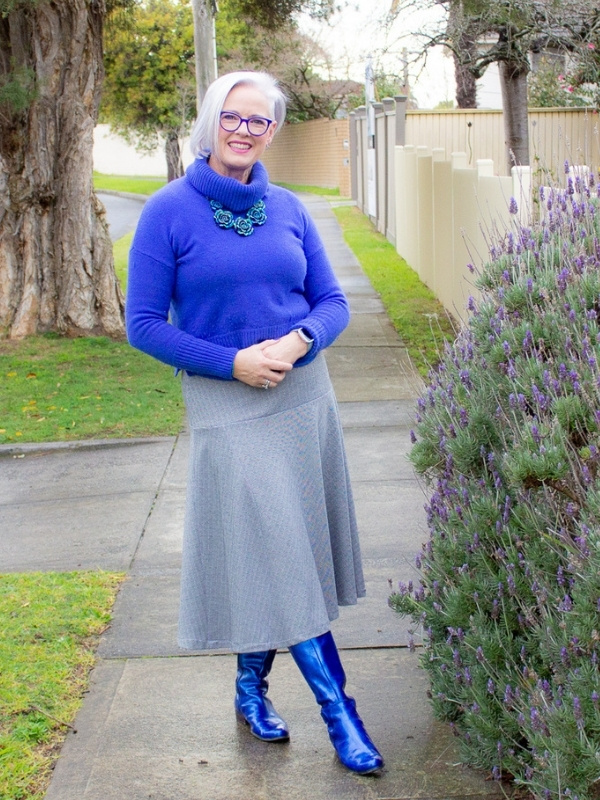
These cobalt boots are an example of the “Red Shoe Effect”, as every time I wear them, I get stopped and complimented, and they are a way of starting a conversation. I’m seen as more confident because I’m wearing an unusual and noticeable coloured shoe.
Research on gender and professional dress has identified persistent double standards worth naming clearly. Men’s professional dress operates within a relatively narrow, stable vocabulary, and deviations from it are read primarily as a signal of competence. Women’s professional dress operates within a much more contested space, where choices are read simultaneously through lenses of competence, femininity, sexuality, and social conformity, often in ways that are contradictory and impossible to fully satisfy. A woman who dresses too formally is cold. Too casually, not serious. Too attractively, not credible. Too plainly, not confident.
Depending on where you are in the business hierarchy, it may mean conforming to expected dress codes to a certain level, and then, as you pass that, nonconformity becomes a superpower and makes you stand out in a positive way. This is why Mark Zuckerberg can wear a t-shirt and jeans: he founded the company and is already at the top of the hierarchy, not working his way up. Though if you’ve seen footage of him giving evidence in US Senate hearings, he also knows that in that situation, a suit and tie is suitable attire.
There is no universally correct answer to this set of contradictions. But there is a more intelligent way to navigate it.
The Visibility Paradox
One of the patterns I observe most consistently in my work with professional women is what I think of as the visibility paradox: the women who are most anxious about their professional dress are often the ones who have made themselves most invisible, and the invisibility itself has become a professional liability.
The logic of invisibility is understandable. If professional dress is a minefield, the safest strategy seems to be minimising the target. Navy, grey, black. Nothing memorable. Nothing that draws attention. Nothing that could be read wrong.
But invisibility has costs that are rarely acknowledged in conventional professional style advice. If you are not memorable, you are not top of mind. If you are not top of mind, you are not considered for opportunities, assignments, promotions, and speaking engagements in the way that more visible colleagues are. In professional environments that require you to build a reputation, generate trust, and be recognised as an authority in your field, being visually forgettable is not a neutral strategy. It is a handicap.
Colour makes you memorable (in fact, 70% more memorable) than neutrals, so even adding some colour to every outfit will make you stand out in the corporate sea of navy, beige and black.
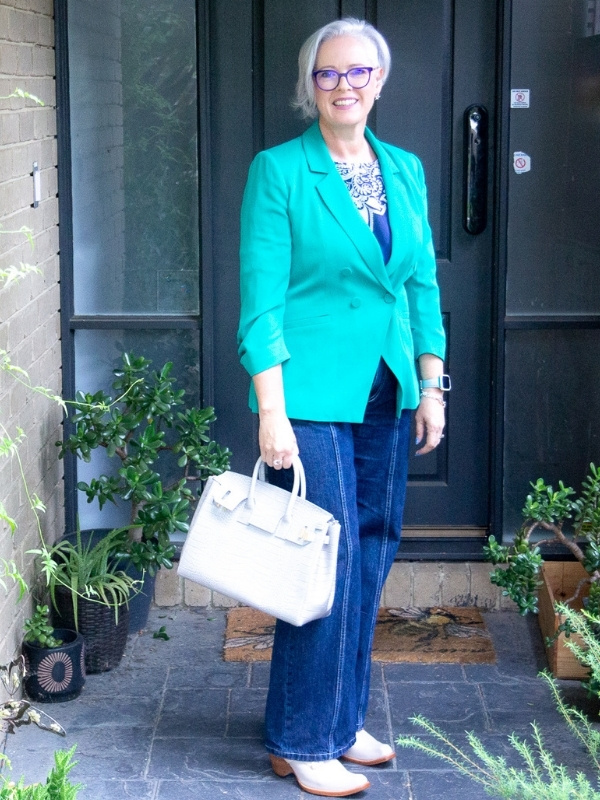
Instead of wearing all neutrals, which is so common in many workplaces, why not start adding some colour to your outfits?
Research on the psychology of professional visibility consistently finds that people who are perceived as confident and self-assured, qualities that are communicated as much through appearance as through behaviour, are attributed higher competence, are more readily trusted with responsibility, and advance more quickly in their careers. This is not fair. It is, however, consistent.
The answer is not to dress loudly or to pretend confidence you don’t feel. The answer is to develop a professional style that is genuinely yours, that communicates your specific expertise and values, and that makes you recognisable and memorable in ways that serve your professional goals.
Navigating Business Casual With Intelligence
Since “business casual” is the instruction most professional women are actually working with, it is worth developing a more intelligent framework for navigating it than the term itself provides.
I think about professional dress along two axes: formality and expression of personality. Formality is relatively context-dependent, shifting based on the specific environment, industry, and occasion. Personality expression is relatively stable, reflecting who you are rather than where you are.
The mistake most women make with business casual is treating it as a rule about formality only and defaulting to a middle-ground formality that belongs to no one. The opportunity it actually presents is to find a formality level appropriate to your specific context while maximising personality expression within that level.
This means understanding your industry’s specific visual culture. Creative industries have different formality norms from financial services, which differ from education, which differ from healthcare. Within those broad industry norms, there are organisation-specific cultures, team-specific cultures, and role-specific expectations. Reading these accurately is a form of professional intelligence.
It also means understanding the difference between occasions within your professional life. A presentation to senior stakeholders and a working session with your own team may both qualify as “business casual” environments, but they are different communication occasions that warrant different calibrations of the same personal style vocabulary.
And it means developing a professional wardrobe that has range, pieces that can be adjusted in formality through layering, styling, and accessory choices, without requiring a completely separate wardrobe for each occasion level.
Dressing for the Career You Want
There is an old piece of professional advice that has survived because it contains a genuine insight: dress for the job you want, not the job you have.
The insight is real. The advice, as usually delivered, is incomplete.
Dressing for the career you want is not about mimicking the visual vocabulary of people above you in the hierarchy. It is about understanding what your professional goals require of your appearance and developing a style that serves those goals, while remaining authentically yours.
If you want to be perceived as a leader, your appearance needs to communicate leadership qualities: confidence, authority, decisiveness, and a degree of intentionality that signals you are someone who thinks carefully about how you show up. These qualities can be communicated through a wide range of aesthetics. They do not require a particular colour palette or a particular silhouette. They require coherence, intention, and fit.
If you want to be perceived as a creative, your appearance needs to communicate creativity: originality, curiosity, and a willingness to make unexpected connections. Again, these qualities can be expressed through many different visual languages. What they require is authenticity, a genuine reflection of how you actually think, rather than a performed aesthetic borrowed from someone else’s idea of what creativity looks like.
The common thread across all professional goals is authenticity. Research consistently finds that people are more persuasive, more trusted, and more effective when their appearance is congruent with their behaviour and their expertise. The cognitive dissonance created by an appearance that doesn’t match the person inside it is felt by others, even when they cannot articulate it.
Dress for who you actually are, in service of where you actually want to go. That is the more complete version of the advice.
Building a Work Wardrobe That Reflects Your Expertise
A professional wardrobe that works is not built around trends, around what is currently in fashion, or around a generic list of “workwear essentials.” It is built around a clear understanding of four things: your professional context and its specific visual culture, your personal style identity and what you want to communicate, your body’s specific requirements in terms of fit and proportion, and the practical demands of your actual working life.
From those four foundations, the specific pieces emerge. Not a prescribed list, but a coherent system of garments that work together, that span the range of occasions your professional life requires, that fit well enough to be worn with confidence, and that reflect enough of your personality to feel genuinely yours rather than borrowed.
This wardrobe will not look the same for any two women, even two women in the same profession, at the same level, in the same organisation. Because no two women are the same person. And a professional wardrobe that works is, at its core, a personal one.
Dress for the Career You Want, Without Losing the Woman You Are.
The professional style problem is real, and it is made more complicated by the genuine double standards that professional women navigate, the contradictory expectations, the contested visual territory, the persistent association of femininity with frivolity that makes every style choice in a professional context carry more weight than it should.
But the solution is not to surrender your identity to a uniform. The solution is to develop a professional style that is intelligent enough to navigate the context you are in, and authentic enough to reflect the person you actually are.
You should not have to choose between the career you want and the woman you are. A well-developed professional style does not ask you to.
If you’d like to learn more about the ways clothing and elements of design communicate, so that you can become more intentional and knowledgable about what to wear to work, I’d like to invite you inside 7 Steps to Style, as this is covered in depth in one of the steps inside the program as it gives you a really comprehensive tool to use to choose your garments and outfits with intention and wisdom, so that you get further, more easily.


Bookmarked!!! Oh my goodness, Imogen, this article is a treasure trove of wisdom for a working woman! And I can so very much relate! At the beginning of my career years, I tried to wear the “power suit” – navy blue blazer with a white vertical pinstripe, pencil skirt, white button down, hose, heels. I felt like I was in a costume. I remember being in an interview feeling so awkward, that when it was over, I ran to my car and ripped off most of that suit right while I was still parked in the parking lot (carpark, in your vernacular)! Fast forward to today, several years after my professional stylist friend gave me a full color/style analysis, I have a wardrobe that has a balance of structure and softness, in the deep, warm jewel tone colors that best work with my complexion, with outfits appropriate for work, leisure, and anything else I may need. Every morning when I get ready for work, I feel like me. That is the best form of confidence to have!
Thanks Carolyn for your lovely comment – it’s so true that clothes that don’t represent our personality *or colouring – can feel like a costume – it’s so great you have defined your personal style and it makes you confident!