






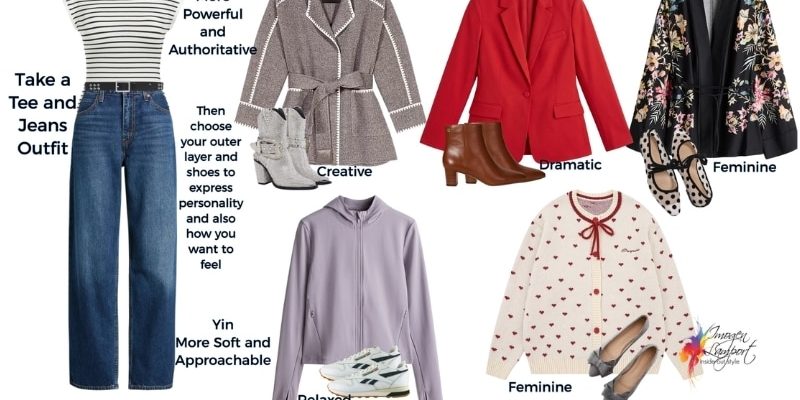




In our Top 10 Most Googled Style Questions, the next on our list is “How Can I Dress More Confidently and Powerfully?”
It’s an interesting question, as research on confidence suggests that it comes from action and building skill. This is why just following the style formula of someone else, who is not you, won’t give you the confidence in your outfits that you desire. Instead, it’s gaining the style education and knowledge and then making the choices of garments that are an expression of the best version of you that will give you the confidence you desire. Power: well, having confidence can make you feel more powerful, but there is also a language of clothing that can help you create a more powerful image, which you can read about here.
The Confidence Myth That Keeps You Stuck
There is a particular piece of advice that well-meaning people have been offering women for decades, across self-help books, motivational content, and style guides. It goes something like this: confidence comes from within. True confidence is internal. What you wear doesn’t matter if you feel good about yourself on the inside.
It sounds wise. It sounds empowering. And it is, in a specific and important way, completely wrong.

Not because confidence is unimportant. Not because inner work doesn’t matter. But it presents confidence as a prerequisite for action rather than a product of it. It suggests that you need to feel confident before you can dress confidently, which creates a circular problem for every woman who is standing in front of her wardrobe at seven in the morning feeling anything but.
The research tells a more interesting and considerably more useful story. Confidence is not a feeling you have before you engage with the world. It is a state you build through engagement with the world, and your clothing is one of the most immediate and accessible tools you have for building it.
What Enclothed Cognition Actually Means for Confidence
We explored the concept of enclothed cognition in What do your clothes say about you, in the context of how clothing affects how others perceive us. But the more personally significant dimension of Adam and Galinsky’s research is what it reveals about how clothing affects how we perceive ourselves.
Their finding, replicated and extended by subsequent research, is that clothing systematically influences the psychological processes of the person wearing it. Not just mood, though it affects mood. Not just confidence, though it affects confidence. Actual cognitive performance. Actual behaviour. Actual outcomes.
When you wear a garment that you associate with competence, authority, or capability, you do not just feel more competent. You perform more competently. You think more abstractly, make better decisions under pressure, and engage with challenges with greater persistence and creativity than you do in clothing you associate with passivity or informality.
This is not a placebo effect in the dismissive sense of that term. The placebo effect is, itself, a real psychological mechanism with measurable physical outcomes. What enclothed cognition research demonstrates is that the symbolic meaning we attach to clothing activates corresponding psychological and physiological states. The garment is a trigger. The confidence is real.
Which means that the advice “feel confident before you dress” has the sequence precisely backwards. Dress in a way that activates the psychological state of confidence, and the feeling follows.
Confidence Is a Physical State, Not a Mental One
This reframing becomes even more compelling when we consider the research on embodied cognition, the growing body of evidence that psychological states are not purely mental phenomena but are constituted, at least in part, by physical experience.
Amy Cuddy’s work on power posing, while subject to ongoing scientific debate regarding the specific hormonal claims, contributed to a broader and more robustly supported body of research on the relationship between physical posture, physical experience, and psychological state. The core insight, supported by multiple lines of evidence, is that the mind and body are not separate systems in which the mind issues instructions and the body follows. They are a single integrated system in which physical states and psychological states continuously influence each other.
Clothing is part of that physical system. The physical sensation of wearing a well-fitted, well-chosen garment, the way it sits on your body, the way it moves with you, the way it feels against your skin, is not separate from your psychological experience of wearing it. It is part of it.
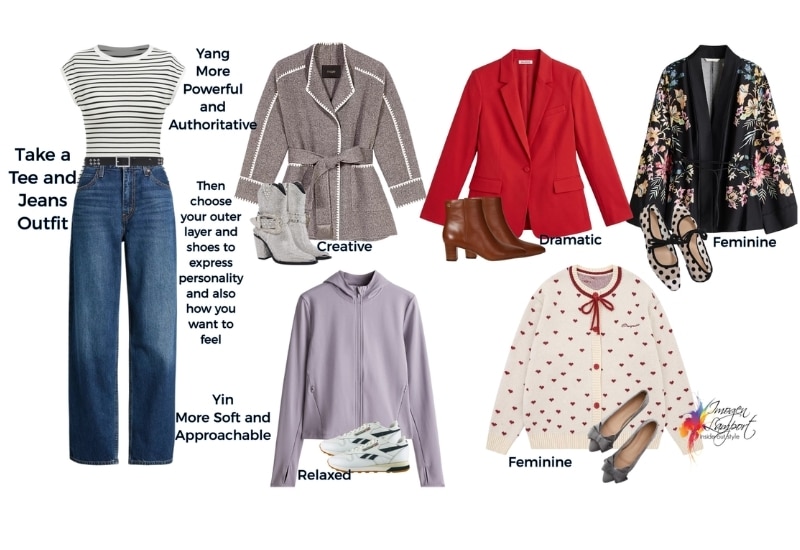
A garment that constrains you physically creates psychological constraint. A garment that allows you to move freely and comfortably creates psychological freedom. A garment that fits your body in a way that feels secure and right creates a physical sense of being held together that translates into psychological groundedness. An outfit that has more Yang elements of design, will give you a more powerful appearance which can help build your confidence. These are not metaphors. They are the predictable outcomes of a mind-body system that does not draw the boundary between physical and psychological experience, where we habitually assume it falls.
 The Invisibility Phenomenon in Midlife Women
There is a specific confidence challenge that I encounter with great regularity in my work, and that deserves direct attention: the experience of feeling increasingly invisible that many women describe as they move through their forties, fifties, and beyond.
This is not imagined. Research on age-related changes in social visibility, including work by Hurd Clarke and Griffin on the cultural politics of ageing and appearance, has documented consistent patterns of social invisibility experienced by older women, patterns rooted in cultural narratives that associate femininity, attractiveness, and social relevance with youth.
The experience of invisibility is, for many women, internalised as a personal failing rather than recognised as a cultural phenomenon. The response, frequently, is to make oneself even less visible, to dress more quietly, more carefully, more safely, as though the solution to not being seen is to take up even less space.
This is the opposite of what the research suggests actually works and what my 7 Steps to Style members have experienced for themselves and reported back to me.
Studies on the relationship between appearance investment and social engagement in midlife and older women consistently find that women who maintain an active, intentional relationship with their appearance, who continue to dress with care and self-expression rather than retreating into safe invisibility, report higher self-esteem, stronger social connections, greater life satisfaction, and a more robust sense of identity continuity through the transitions of midlife and beyond.
This is not about chasing youth or conforming to conventional beauty standards. It is about the psychological function of self-expression. When we stop expressing ourselves through our appearance, we lose one of the channels through which we communicate our identity to ourselves and to the world. And that loss has consequences that go well beyond how we look in the mirror.
From Dressing Not to Be Invisible to Dressing to Be Seen
The shift I am describing, from dressing to avoid notice to dressing to be seen, is not primarily a shift in what you wear. It is a shift in psychological orientation. And it is, I want to be clear, not necessarily about becoming louder or more conspicuous or more demanding of attention.
It is about intention. About deciding, consciously and deliberately, that you are worth seeing and that your personality should be at the core of what you choose to wear, rather than bowing to fashion trends or what everyone else around you may deem the right thing to wear, which in fact is making you invisible. That your presence in a room is something to acknowledge rather than minimise, and that you have wisdom and influence. That the woman you are right now, at whatever age and in whatever life circumstance you find yourself, deserves to be dressed with the same care and attention you might have given a younger or more conventionally visible version of yourself.
This is, for many women, a genuinely radical act. We are so well trained in the art of self-minimisation, so practised at taking up less space, asking for less attention, and making ourselves easier to overlook, that the simple decision to dress as though we matter can feel almost transgressive.
Caring about what you wear is an act of self-respect. And like all acts of self-respect, it changes not just how others see you but how you see yourself.
Taking your appearance seriously is not vanity. It is a form of self-knowledge and self-care with measurable psychological benefits. Tiggemann and Lacey’s research on clothing and body image found that women who dressed with active intention, making deliberate choices about self-presentation rather than retreating from it, reported significantly higher body satisfaction and self-esteem than those who dressed primarily to conceal or minimise. Taking your appearance seriously is not vanity. It is, the research suggests, a form of self-respect with measurable and durable psychological consequences.
 How Colour, Fit, and Style Identity Build Confidence Together
Wearing your best colours removes one of the most immediate sources of self-consciousness in the getting-dressed process. When you know that the colours you are wearing are working with your colouring rather than against it, you stop second-guessing the face looking back at you from the mirror. You arrive at appointments and meetings and social occasions without the low-level anxiety of wondering whether you look somehow diminished or unwell. That is a small and specific liberation, but it is a daily one, and daily liberations compound.
Wearing clothes that fit your actual body, rather than approximating a fit that is close enough and hoping no one notices, creates the physical groundedness described earlier. When a garment sits on your body the way it was meant to sit, it does not demand your attention. It recedes into the background and allows you to inhabit it rather than manage it.
Dressing from a clear style identity, from a genuine understanding of who you are and what you want your appearance to communicate, removes the daily negotiation between competing aesthetics, competing versions of yourself, and competing ideas of what you should be wearing. When you know your own visual language, getting dressed becomes a confirmation of identity rather than a search for it.
These three things together, right colour, right fit, right identity, are the foundation of a wardrobe that builds confidence rather than depleting it.
The Compound Effect of Intentional Dressing
One of the things I observe most consistently in clients who have done this work is a compound effect that goes well beyond what they expected when they began.
They come to me believing that a better wardrobe will make them feel better about their clothes. And it does. But what also happens, consistently and often unexpectedly, is that the shift in how they dress creates a shift in how they inhabit their lives more broadly.
Women who have found their visual language report engaging more readily in professional opportunities they would previously have declined. They initiate conversations they would previously have avoided. They take up space, physically and figuratively, in ways they had stopped thinking were available to them. They describe feeling, in various ways, more like themselves, which is perhaps the most significant outcome of all.
This is entirely consistent with what the research predicts. If clothing systematically affects psychological state, and psychological state affects behaviour, and behaviour affects outcomes, then a sustained shift in how you dress will, over time, produce a sustained shift in how you engage with your life.
Getting dressed well is not a trivial activity. It is a daily practice of self-definition. And like all practices, its effects accumulate.
Confidence Isn’t Something You Feel Before You Get Dressed. It’s Something You Build While Getting Dressed
You do not need to feel confident before you get dressed. You never did.
You need to get dressed in a way that builds confidence as you do it, that puts you in physical contact with garments that activate a sense of capability and self-possession, that confirms your identity rather than questioning it, and that communicates to the world, and to yourself, that you are someone worth taking seriously.
The confidence comes from the practice. The practice is the dressing. Start there, and the feeling follows.
Every single morning, you have an opportunity to build yourself up rather than diminish yourself, to affirm who you are rather than hide from it, to step into the day from a position of intention rather than apology.
That opportunity is hanging in your wardrobe right now. It is waiting for you to take it seriously.
If you’d love to really define and refine your style, my 7 Steps to Style program is here to give you the education in colour and style you need.




And yet another amazing post. Bookmarked!!!
Fantastic article, thanks so much Imogen. Like Carolyn said, I too need to come back and reread a number of times, so helpful and thought provoking