






I have clients with jackets in their wardrobes that seem like they should be good, but they never reach for them. Nothing is wrong with it technically. Yet when they do try it on, it’s off five minutes later, because even though it might be in fashion, it might even “fit” there is something that’s not right about it.
If you have a jacket like that too, you are not imagining the problem, and you have not done anything wrong. You have just been asking it the wrong question.
Fit and Flattering Are Two Different Questions
Most of us check a jacket the same way. Does it close? Are the sleeves the right length? Can I move my arms? Every one of those is a fair question, and every one of them is about whether the jacket technically fits.

None of them tells you whether the jacket’s shape actually works with yours. A jacket can pass every technical test and still turn you into a very well-dressed box. Or it can emphasise areas of your body that you want to camouflage.
This is why buying the next size up or down so rarely solves the problem on its own. Sometimes the issue was never the size. It was the shape or one of the other design elements like the collar, how it closes or where the pockets sit.
Before you assess the whole jacket silhouette, it is worth checking whether the jacket sits correctly through the shoulders first, since that is the foundation from which everything else hangs. If you’d like a plain-language primer on how tailors think about garment shape and construction, this overview of tailoring is a useful starting point.
 Start with the Silhouette – The Outline
Next time you try on a jacket, step back from the mirror and let your eyes blur slightly (or squint) so the details disappear. What shape is left?
Straight and rectangular. Nipped in at the waist. Broad through the shoulders. Cropped and boxy. Long and streamlined. Fitted at the top and wider at the hem. Then ask the only question that matters: does that shape relate to your body, or is it arguing with it?
There are three basic silhouettes and one of them will be the one that suits your body best (it’s not that you can’t wear another, and if you don’t care at all about body architecture harmony, then move right on, but if you feel like something is wrong, this may be the reason). Depending on your body shape, you’ll be looking for a column, a waisted column or a fit and flare shape (read all about these three silhouettes here if you’re not sure which is for you; then come back here once you’ve figured it out).
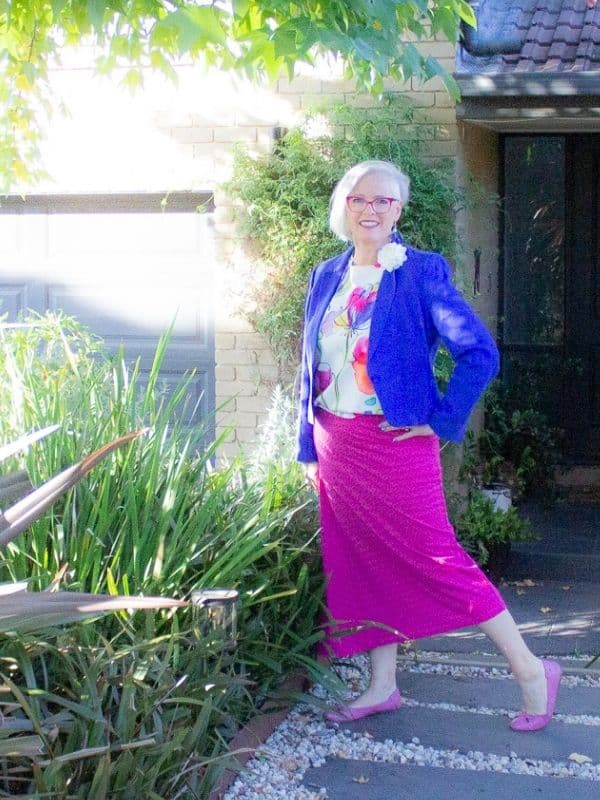
I am an H shape, which means I do not have a naturally defined waist. A jacket that pulls sharply in at the middle (fit and flare) looks like it is trying to invent a shape I don’t have, and it just highlights my lack of waist; it doesn’t “create one” where there wasn’t one. A gentle diagonal line or soft shaping does the job far better. Someone with a defined waist has the opposite problem: a straight boyfriend style jacket can hide her shape completely, while princess seams or a curved front repeat and enhance it. This is why “just buy a blazer” is close to useless advice. Which blazer, on which body?
The Four Jacket Silhouettes Worth Knowing
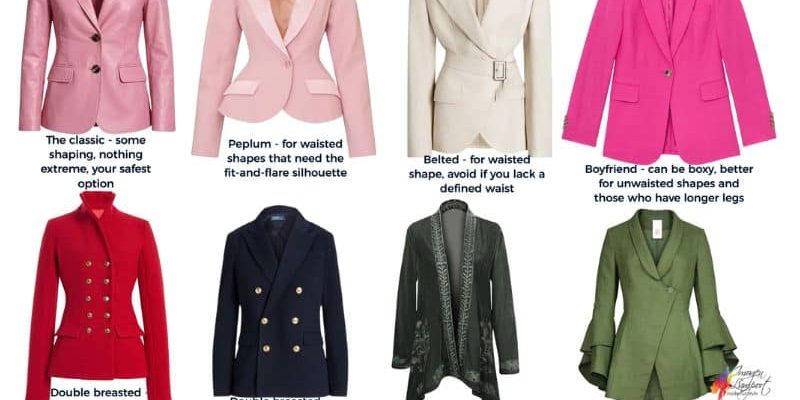
A straight masculine style blazer falls from the shoulder with little waist shaping. It reads modern and clean, and suits straighter shapes and anyone who prefers understated over emphasised. On a strongly waisted body, though, it can swallow her shape whole and end up looking bigger than it is. It’s best for H, O and I shapes; V shapes can also get away with it if there isn’t too much shoulder padding.
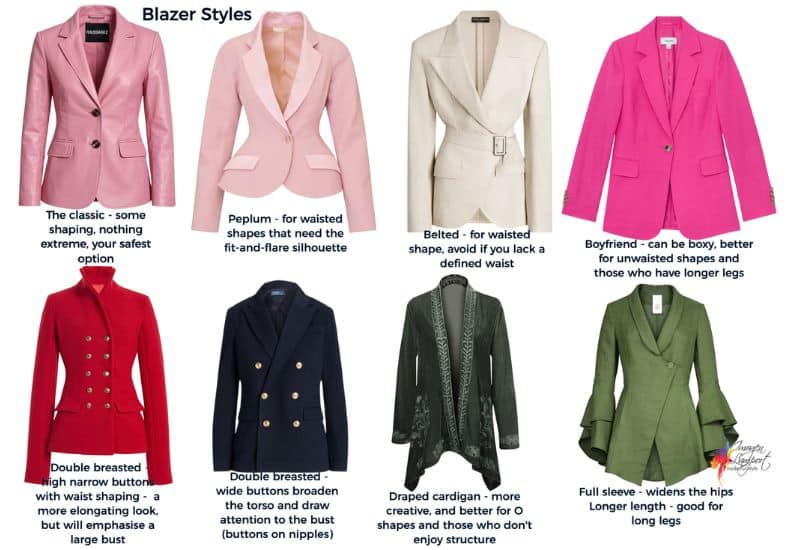
A shaped jacket uses darts, princess seams or curved panels to define the torso. It suits bodies with visible waist definition and anyone who wants a more polished, traditionally tailored look. The amount of shaping matters here: gentle shaping follows the body, and can be worn by all body shapes, whilst extreme shaping such as a peplum shape is ideal for those who suit the fit-and-flare silhouette or the waisted column – X, A and 8 shapes, I shapes can use this to create the illusion of more curves.
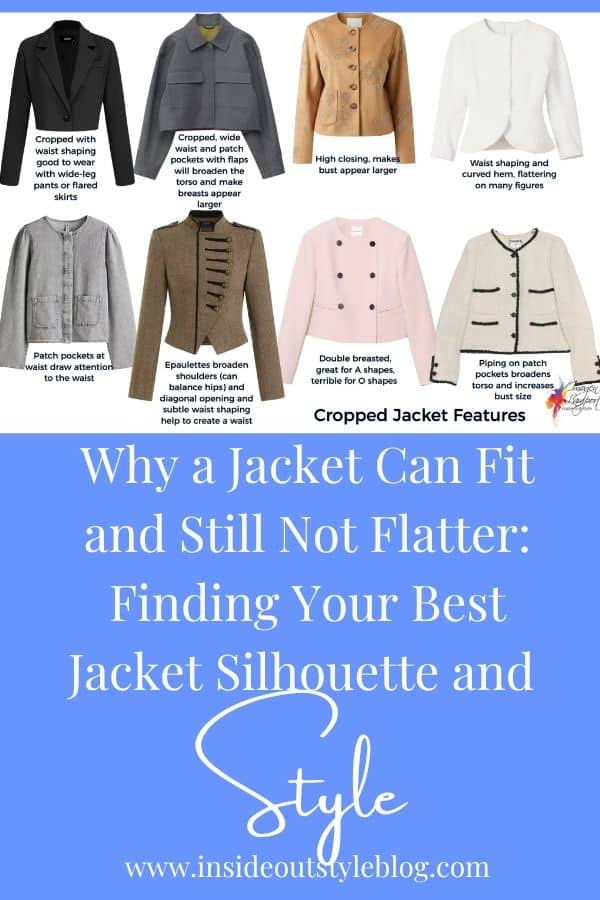
A short, Chanel-style boxy jacket has a squarer silhouette and is cropped at the waist, providing no waist shaping. It works best on waisted shapes such as the X or A shape, when worn with a flared skirt or wide-leg pants. This combination creates a fit and flare shape. Its cropped length is balanced by the wider, flared bottom half. The I shape can wear it well with a straight skirt (think the traditional Chanel suit).
A draped jacket uses softer fabric and looser construction. It suits anyone who wants ease of movement over structure; softer body shapes such as O and H shapes find these more flattering, and more relaxed or creative personal styles may also like their less structured feel. Drape needs enough fabric weight to fall cleanly; too light, and it collapses; too heavy, and you get more volume than you asked for.
Notice What the Jacket Is Emphasising
Every design choice is doing something visually. Shoulder pads, wide lapels and horizontal pocket flaps add width. Long lapels and vertical front edges lengthen. Curved seams soften. Diagonal lines create movement. I go into this in more depth in my piece on choosing a flattering puffer jacket or coat, where wide horizontal quilting acts like a fence across the body while narrower vertical lines lengthen instead.
Pockets are also something to consider when making a jacket purchase. What’s the shape, the style, how much attention do they draw? Patch pockets that are surrounded by alternate coloured piping will be much more obvious than a discreet welt pocket. Pocket flaps on a thick tweed will stand out from the body and add bulk. Breast pockets will add volume to the bust. Pockets at the waist will draw attention there.
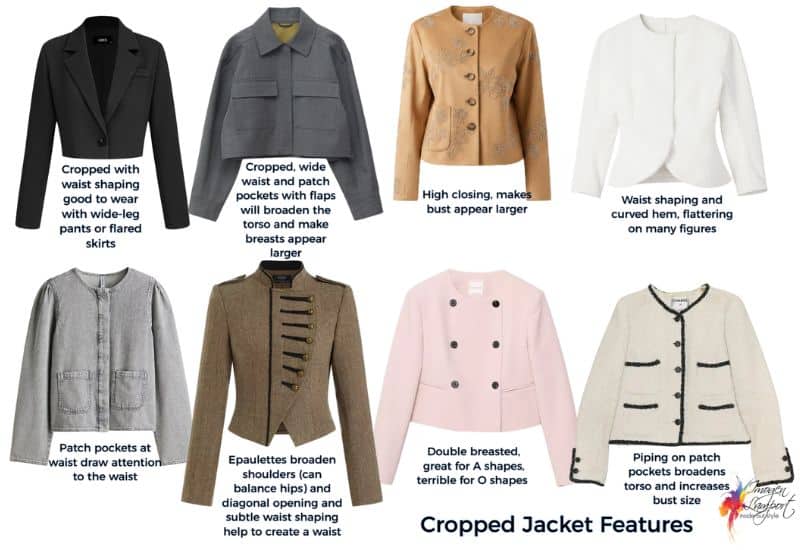 So when you’re standing in front of the mirror, ask where your eye goes first, whether the jacket adds width to your shoulders, waist, or hips, and whether that width is helping you or working against you. There is no line that is universally flattering. A wide lapel that balances an A shape beautifully can add unwanted width to a V shape.
Where the Jacket Ends Matters More Than You’d Think
The hem creates a horizontal line, and wherever that line lands, it draws the eye. Finish a jacket at the widest part of your hips, and that’s the part people notice first. Move the hem an inch either way and the whole proportion can shift. Read up about my 3 rules of horizontal lines; once you see their impact, you can never go back, and it makes decisions so much easier.
Put the jacket on with the trousers or skirt you’d actually wear it with, stand back far enough to see your whole body, then fold the hem under to imagine it shorter and compare. Your ideal length depends on your body proportions, not just your height or body shape. I’ve written more on that in what shape top hem to wear with your jackets and blazers, and sleeve length gets the same treatment for how long jacket sleeves should be.
Open or Closed Changes Everything
Some jackets are built to look their best buttoned; a double-breasted blazer should always be worn closed. Others look great open and create elongating verticals that add height. A jacket that looks beautifully shaped closed can turn into a plain rectangle the second you open it, and a jacket that pulls when fastened can look relaxed and elegant left open. Judge it the way you’ll actually wear it, not the way the designer photographed it.
If you tend to wear jackets open, look for a front edge that hangs cleanly, lapels that lie flat, a hem that doesn’t swing forward, and enough shaping through the side seams to hold its line without the button doing the work. If you have a defined waist, princess seams or curved fronts will preserve that shape even when the jacket is open, which I cover in my piece on wearing open jackets with a waisted body shape. Worn open, what’s underneath does more work too; see what to wear under a jacket for options.
Shape of the hem matters too, particularly when a jacket ends somewhere near your thighs; a curved hem at the front removes that pesky horizontal line cutting you across a wider part of your body. Sharp, square hems are great on short cropped jackets on waisted shapes, and work well on longer blazers on V shapes, but tend to be less desirable on X and A shapes.
Also consider how high up it buttons (if you plan to wear it closed). This relates to the size of your bust; if you have a larger one, a high-buttoning jacket (such as a mandarin collar style) will make your torso and bust appear even larger. Look instead for a jacket with lapels that open up to a V shape and start buttoning no higher than your bust (or below it).
Something as Simple as the Collar and Lapel
Even a simple collar can make a difference to how it looks on you. Lower sitting collars will draw attention down, higher collars draw attention up.
Large scale collars are great on those with dramatic personalities or who are tall and larger in scale. But overwhelm those who are average or smaller, or have small facial features
One of my least favourite design details in a jacket is a low, longish notched collar, as it draws the eye down (find if you have a small bust, not great if you have a large one), adding volume over the bust and moving the eye away from the face.
Scale and Personality Finish the Job
A jacket can have exactly the right shape and still be the wrong scale. Large lapels and heavy buttons carry visual weight and will overwhelm someone with smaller facial features or an overall smaller scale; finer details carry less weight and look great on those with smaller facial features, but will look childish on someone who is tall and larger in scale. Someone with a smaller frame can genuinely disappear inside oversized lapels and pockets, while someone with a larger scale can find delicate details read as insignificant rather than refined.
And then there’s the part no measurement can solve. A jacket can fit your body perfectly and still feel wrong on you, because it’s too formal, too severe, or simply not you. That’s personality coming into play. I’ve had clients happily edit out of their wardrobes beautifully cut blazers because it just didn’t feel like them (once they understood their personality style), and reach instead for a soft cardigan jacket that was in harmony with them as a person. That’s not a failure of styling logic. That’s the whole point of it: a flattering silhouette should say something true about your body, and something true about you.
Alter, Restyle or Release?
Before you buy another jacket, it’s worth working through the ones already hanging there unworn. A quick way to sort them:
- Alter when the fix is small: shortened sleeves, a moved button, minor waist shaping, replacement shoulder pads. Ask a tailor whether the change will preserve the jacket’s proportions before you commit.
- Restyle when the jacket is right, but the outfit around it isn’t: a more streamlined underlayer, wearing it open instead of closed, a column of colour underneath, shoes with enough visual weight to balance it.
- Release when the basic silhouette is wrong, the fabric no longer holds its shape, or every attempt to style it has felt like hard work. That’s not a jacket that failed you. That’s a jacket that failed its job interview.
Choose one neglected jacket from your wardrobe today. Put it on, ignore the size label, and step back from the mirror to read its jacket silhouette honestly. Is it working for you, or have you been working far too hard for it? If you’d like help answering that for your whole wardrobe, not just one jacket, that’s exactly what we build together inside 7 Steps to Style.
Further Reading