







Go and look in your wardrobe right now. I’ll wait.
You almost certainly own a jacket you’ve stopped wearing, not because you dislike it, but because it never quite feels right. You couldn’t tell me exactly why. It just sits there looking a little off, until eventually it gets pushed to the back and replaced with another layering piece. Before you decide that jacket is a lost cause, there is one quick jacket shoulder fit check worth running, because the problem is often smaller than you think.
It usually starts with one seam, not a whole new size.
Myth: If It Does Up and You Can Get Your Arms In, It Fits
Most women check a jacket for exactly two things. Does it button? Does it fit over my upper arms? That’s a bit like judging whether a house is well built by checking that the front door opens.

A jacket can close without pulling and still be too broad through the shoulders, too wide through the waist, or too long in the sleeve. It can fit over your arms and still restrict your movement or make your torso appear larger. It can be your correctly labelled size and still have proportions that have nothing to do with your body.
On a traditionally tailored jacket with a set-in sleeve, the shoulder seam is the very first thing I check on a client, before I even look at the buttons. It’s the foundation everything else hangs from, and when it’s wrong, the rest of the jacket spends the whole day trying to compensate.
 How to Run the Jacket Shoulder Fit Check
Put the jacket on and stand in front of a mirror. Find the seam where the top of the sleeve joins the body. On a conventional set-in sleeve, it should sit close to the edge of your natural shoulder bone. From there, you’re looking for one of four things.
If the seam falls down your upper arm, the jacket is likely too broad through the shoulders. You’ll usually see fabric collapsing around the upper arm, folds across the upper back, or sleeves that look too low even when the length is technically correct. Before you write it off, check whether that dropped shoulder is intentional; plenty of relaxed, oversized styles are built this way on purpose. But if it has a shoulder pad and is more structured, the jacket wasn’t designed to have a dropped shoulder.
If the seam sits inside your natural shoulder, the jacket is probably too narrow. Watch for tight diagonal wrinkles, pulling across the upper back, restriction when you reach forward, or the jacket lifting when you move. A bigger size might help, but only if the rest of the proportions still work; sometimes the size is fine, and the pattern simply isn’t built for your shoulders.
If the seam sits correctly but the sleeve twists or spirals around your arm, the sleeve may not be set at the right angle for your posture, which can happen when your arms naturally sit a little more forward or back than the pattern assumes. It’s sometimes alterable, though resetting a sleeve is a bigger job than a simple hem. If sleeves are the only issue and you truly love everything about the jacket – the fabric, colour, design details, my piece on how long jacket sleeves should be is worth a look before you write the whole jacket off.
And if there’s a dent or hollow at the shoulder, that can mean the jacket is too broad, the shoulder pad has shifted or collapsed, the fabric is too soft for the structure it’s trying to hold, or it’s simply been stored badly. A well-fitting shoulder sits smoothly and lets the sleeve fall cleanly from it, with nothing pooling or hollowing out.
You can also tell if a jacket is too broad by getting a look at the back. If vertical folds happen across the back of the garment, the shoulders are too broad for your body. The back of a jacket should sit smoothly with no horizontal pulls (too small) or vertical folds (too large).
Not Every Jacket Has a Traditional Shoulder Seam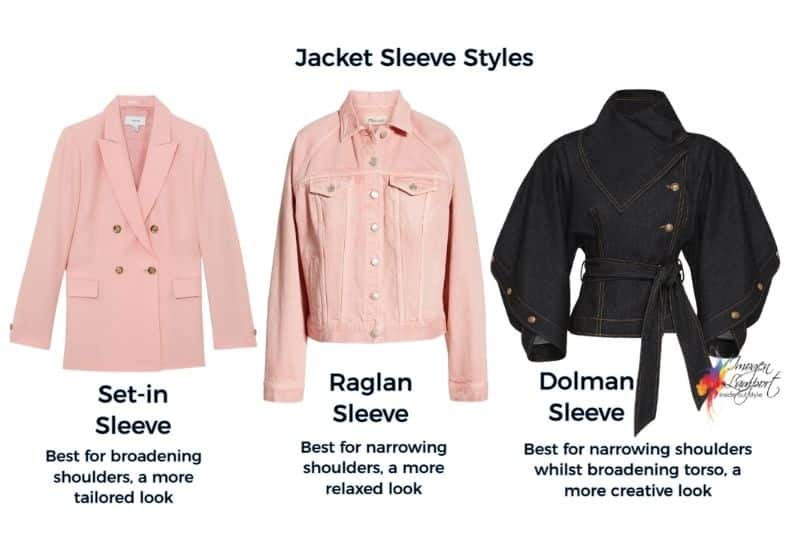
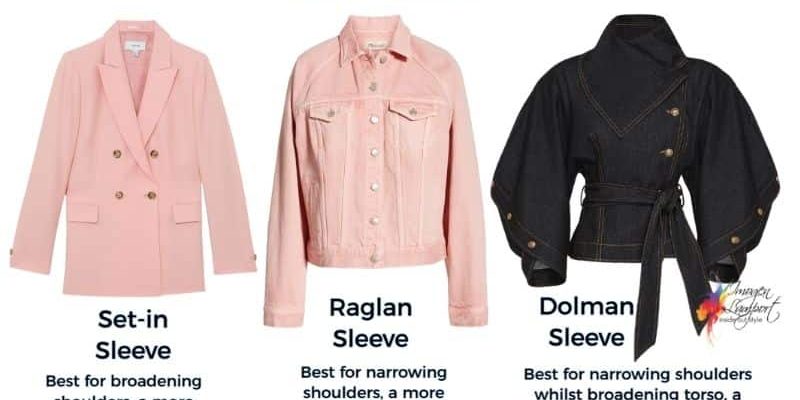
The jacket shoulder fit check applies most clearly to set-in sleeves. It doesn’t work the same way on raglan sleeves, which run diagonally from the neckline, dolman sleeves are cut from the same cloth as the front of the jacket, they make your shoulders appear narrower and less defined (great for V shapes) but often add more broadness to your torso as to allow for movement, the armholes are cut deeper, just as kimono sleeves cut as part of the body, deliberately dropped-shoulder designs, or soft cardigan jackets. In those styles, a seam sitting beyond your shoulder doesn’t automatically mean the jacket is too big. I’ve shared three ways to wear one of these softer styles in 3 Ways to Style a Softly Structured Jacket if that’s more your everyday jacket than tailoring.
Instead, ask whether the volume looks deliberate, whether the fabric falls cleanly, whether you can move comfortably, and whether the shoulder line is in scale with you. Understanding what the design is trying to do is far more useful here than applying one rule to every jacket in your wardrobe.
Once the Shoulder Fits, It Becomes a Styling Tool
The shoulder line doesn’t just hold the jacket up. It changes how your whole body reads, because horizontal lines visually broaden whatever they cross, and shoulder pads, epaulettes, wide lapels and contrasting yokes all draw the eye up there. Whether that’s helpful or unhelpful depends entirely on your shape, which is the whole idea behind my earlier post on how to broaden your shoulders with a jacket.
If you’re an A shape, narrower through the shoulders and fuller through the hips, some structure up top through lightly padded shoulders, wider lapels or a brighter colour above the waist can bring your proportions into balance. The aim isn’t to disguise your hips. It’s to give your upper and lower body a relationship they don’t currently have.
If you’re a V shape, broader through the shoulders than the hips, you’re usually better off with minimal to no padding, softer construction and narrower lapels, with any visual interest placed lower on the jacket. An extended shoulder or a big lapel will exaggerate width you already have rather than balancing it.
If you’re an H shape, with shoulders and hips that are fairly balanced and little in terms of a defined waist, the shoulder still needs to fit, but what happens below it usually matters more: gentle rather than extreme waist shaping, princess seams, and clean vertical or diagonal lines that hold their shape without going rigid. A jacket can pass the jacket shoulder fit check and still turn an H shape into a very well-dressed cardboard box.
If you’re an X or 8 shape, with balanced shoulders and hips and a defined waist, you generally have more room to play with shoulder structure, as long as it stays in proportion with your hips. Look for waist shaping, princess seams or darts, and belts that enhance a shape you already have rather than trying to manufacture one you don’t. The most flattering jacket, whatever your shape, tends to echo what’s already there rather than fight it.
Can a Poor Shoulder Be Altered?
Technically, almost anything can be altered. The better question is whether the result is worth what it costs. Sleeve length, button placement and light waist shaping are usually straightforward. The shoulder itself is a different story: it can mean removing and resetting the sleeves, reshaping the armholes, adjusting the upper back and replacing the shoulder pads, which is a lot of work to ask of a jacket that also has problems with its length or fabric. A beautifully made jacket in a good fabric is often worth it. A mass-produced one with other issues too, usually isn’t. Ask a tailor for an honest opinion before you commit.
Your Five-Step Jacket Shoulder Fit Check
Pull three jackets from your wardrobe that you rarely wear and run each one through this:
- Check the seam. On a set-in sleeve, does it sit close to your natural shoulder edge?
- Move your arms. Reach forward, lift them, mime driving. Any real pulling or restriction?
- Look at the upper back. Any horizontal wrinkles, diagonal drag lines or excess fabric?
- Assess the width. Is the shoulder structure balancing your body, or adding width you don’t want?
- Decide. Wear it as is, assess whether styling or a realistic alteration would help, or release it.
Getting the shoulder right tells you whether a jacket has a sound foundation to build on. It won’t tell you whether the rest of the shape actually flatters you; a jacket can pass the jacket shoulder fit check and still be too boxy, too long, or simply wrong for your personality, which is the next thing worth working through once the shoulder checks out.
Pull those three jackets out this week and run the check. You might finally understand why one gets worn on repeat while the other has been quietly on probation for two years. Which one surprised you?
Related Reading