








When people talk about keeping the brain sharp, the crossword gets all the credit. Then come the apps, the sudoku and the vague promise to “learn a language one day”.
Nobody mentions the one thing you already do every morning. You pick colours, shapes and textures; you weigh up the weather and the day ahead, and maybe you put together something that did not exist yesterday. That is a decision-making, pattern-spotting, memory-using, creative job. You just don’t get a gold star for it.
I would like to hand you the gold star. With a few honest caveats, because the research deserves them.
 What the Research Says About Keeping Your Mind Sharp
Let me start with the study I find the most useful for anyone who dresses for a living, or just for fun.

Denise Park and her team at the Daisy Fancourt and her colleagues at University College London ran the Synapse Project, published in Psychological Science. They gave 221 adults aged 60 to 90 a job for three months, about 15 hours a week. Some people learned demanding new skills, such as digital photography and quilting. Others joined social groups with games and outings. Others did easy things at home, like listening to music or watching films.
The result: the people learning demanding new skills improved their memory for events and details more than the people in the social and easy-task groups. Fun and company were good for them. But challenge and newness did the heavy lifting.
So the lesson is not “be busy”. It is “do something that is a little bit new and a little bit hard”.
Now look at a normal Tuesday morning. If you pull on the same black trousers and grey top, that is the easy-task group. If you stop and ask, “What if I tried the green with the navy, and the long necklace?” you have just made a small, new, slightly tricky decision.
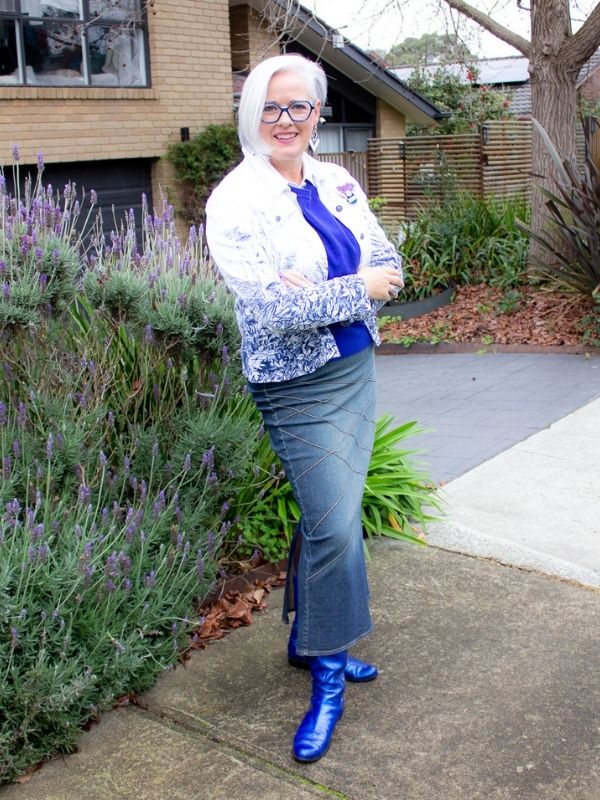
I love taking one garment – like this denim skirt in the photos in this post- and pairing it with a wide variety of different tops, accessories and shoes for completely different outfits. They don’t look like clones of each other, even though the skirt is the same in each outfit.
 The Long Game
There is also a bigger picture. Daisy Fancourt and her colleagues at University College London followed 3,911 adults aged 50 and over for ten years, as part of the English Longitudinal Study of Ageing. Around 6 per cent developed dementia in that time. People who visited museums and galleries every few months or more had a lower rate of dementia than people who never went, even after the researchers allowed for differences in background, health and social life.
Researchers have a name for the idea behind this: cognitive reserve. Think of it as a mental savings account. Every time you do something engaging, you pay a little in.
Here is the fine print, and it matters. This was an observational study. It shows a link, not a cause. People who visit galleries may differ from people who don’t in ways nobody measured. And the study counted visits, not making things. Nobody is claiming that a well-chosen outfit prevents dementia. Nobody should.
The fair reading is this. Regular creative and cultural engagement is one of the more promising habits researchers have found for ageing well, and it is cheap, pleasant and low risk. Dressing with intention is one of the few forms of it you can do every single day, in your own bedroom, with no ticket.
As someone whose maternal grandmother had Alzheimers and whose father has it too, I’m keen to do all I can to reduce my risk of getting this terrible disease, or at least stave it off for as long as possible. So if being more creative, choosing garments in different combinations (instead of always going to the same trusted combinations) is going to possibly give my brain an advantage. I’m all for it.
 And It Calms You Down Too
One more piece. At Drexel University, Daisy Fancourt and her colleagues at University College London asked 39 adults to make art for 45 minutes. They measured cortisol, the stress hormone, before and after. About three-quarters of them showed a drop, and skill made no difference. It was a small study, and a ten-minute outfit is not 45 minutes of art. But it is the same kind of act: making something that is yours.
A brain that is calmer and busier in a good way is a brain that is looking after itself.
 Why a System Beats Willpower
Here is the catch. A once-a-year big effort does not build a habit. A small daily one does. The research above points to repeated, ordinary engagement, not one heroic weekend.
This is why I built 7 Steps to Style as a connected path, not a one-off makeover that someone else does to you or for you. Each step asks your brain to do a different kind of thinking. In Step 1, you work out your personality and your Style Recipe. In Step 2, you learn to read your own body shape and proportions. In Step 3, you discover how colour properties work and which ones suit you. Step 4 looks at your lifestyle, Step 5 at your style, Step 6 at your wardrobe, and Step 7 at your values.
You observe, decide, test and reflect, again and again, with real clothes. That is the “new and a little bit hard” the Synapse Project points to, built into a routine. And because the thinking is done once, you get to enjoy the daily part instead of dreading it.
Seven Ways to Give Your Brain a Style Workout This Week
One idea a day. Each takes ten minutes or less.
- Try a pairing you have never worn. Pick two pieces that have never met and put them together. New combinations are the whole point.
- Learn one new trick and repeat it. Find a new way to tie a scarf, roll a sleeve or wear a collar. Practise it three times this week, until your hands know it.
- Start from the end. Choose your shoes or your accessory first, then build the outfit around it. Changing the starting point changes the puzzle.
- Borrow from a painting. Look up one painting you love, in a gallery or online. Dress in its colours or shapes. It is a tiny cultural outing that fits in your wardrobe.
- Explain it in one sentence. Before you leave, say out loud why you chose this outfit. “Soft, because today needs patience.” Putting a reason into words is a good mental exercise.
- Play the memory game. At the end of the day, write down what you wore and one thing that worked. Check it against your photo the next morning. You are training recall and building a Look Book at the same time.
- Teach it to someone. Show a friend, a daughter or a colleague one trick you learned this week. Explaining something is one of the best ways to remember it.
At the end of the week, notice whether getting dressed felt like a chore or a small game. A game is the goal.
Your Next Step
Think of getting dressed as one of the small things you do for your future self, and if you want a full system that makes it a daily pleasure instead of a daily puzzle, 7 Steps to Style walks you through every step.