







The Difference Between Wearing Clothes and Wearing Your Clothes
Nothing is actually wrong. The fit works, the colours coordinate, and everything is technically doing its job. Yet when you look in the mirror, something feels a little absent. The clothes are there. You aren’t quite there yet. You haven’t done anything wrong. You’ve just done everything correctly, which turns out to be a different thing entirely.
There’s usually a reason this happens. You saw the exact outfit on an Instagrammer, pinned it from Pinterest, or copied the mannequin in the shop right down to the belt, and it slotted onto you technically fine. Technically fine is exactly the problem. You’ve reproduced someone else’s outfit rather than built one that’s yours, and no amount of correct styling makes a borrowed choice feel like your own. Unless their style is your exact style, copying that outfit won’t make you feel stylish in the way you want to.
This is where learning to make an outfit feel like you can make an enormous difference.
I don’t mean you need to start bedazzling jackets or monogramming everything you own (although if that’s your Style Recipe, go for it, and it’s something I do myself). Here’s a denim jacket I added some angel wings to.


What is it that you love about a garment? I love the angel wings on this denim jacket (the jacket is super comfy and stretchy too, which is a plus). I like the individuality and the unexpected detail of the wings.
Often it’s something much quieter. A pair of glasses that has become yours unmistakably. A necklace you wear in a way nobody else would. A motif that keeps turning up in your wardrobe. A beautiful button replacing the boring plastic one the manufacturer chose. Even the way you roll a sleeve, layer your jewellery or combine particular colours can become part of your visual signature.
Personalisation is the point where clothes stop being things you’ve bought and start being your clothes.
It Doesn’t Have to Be Dramatic to Be Personal
When we think about personalising our style, we usually imagine adding something, and an accessory is often the easiest way in. You can change the whole feeling of an outfit without changing a single garment.
But personalisation can also mean altering what’s already there. You might love a coat except for the buttons, so you replace them with something more special. Perhaps a necklace keeps landing in exactly the wrong place, so you have it shortened. Maybe the self-fabric belt that came with a dress looks a bit limp, so you wear your own belt instead. None of these changes is dramatic. But they can be the difference between wearing something because it’s fine and wearing it because it’s right.
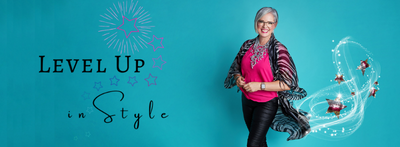
It can be as simple as taking a plain outfit and adding a statement piece of jewellery (like my moon and stars necklace above).
Mass-produced clothing is built to suit as many people as possible, which usually means it doesn’t quite know your proportions, your personality or the things you find beautiful. No rule says it has to stay exactly as it left the factory. Sometimes you’re not customising anything. You’re just finishing the job.
This works best with pieces that are almost right, held back by one fixable detail rather than anything more fundamental. It’s not an excuse to rescue every bad purchase, mind you. If the fabric feels awful, the colour drains you and the fit is wrong, new buttons aren’t a miracle cure. They’re a distraction from a decision you already know you need to make. But when the important elements are right, one small adjustment can turn “nearly” into “yes.”
Meaning Is Often What Makes the Difference
Some of the most powerful personal touches aren’t fashionable at all. They matter because they mean something: jewellery you’ve inherited, a scarf you picked up on your travels, something handmade that came from an art gallery or craft market, a gift from somebody important, a piece made specifically for you. Nobody else may know the story. You do, and that changes how you feel wearing it.
There’s genuine research on the idea that what we wear can affect how we think and feel, usually filed under “enclothed cognition.” The original lab coat studies found people made fewer errors on attention tasks when they believed they were wearing a doctor’s coat rather than a painter’s smock, but later attempts to repeat those exact results haven’t always landed the same way. The more robust part of the effect seems to run through how the clothing makes you feel (more capable, more “yourself”) rather than the fabric doing anything magical on its own. I don’t think most of us need a study to know that clothes can carry meaning, though. We experience it. There are days you put on a particular pair of earrings, your favourite glasses or that bracelet you’ve had for years, and you simply feel more like yourself.
That’s part of why personalisation feels different from decoration. Decoration is often adding something because there’s a gap to fill. Personalisation is closer to choosing something because it already belongs to you.
My butterflies are a good example. I don’t buy every butterfly I see. Plenty of them are completely wrong for me. But when I find one in the right colours, the right style and with the right feeling, I’m drawn to it. Over time, butterflies have become a small recurring thread through my wardrobe because of what they represent to me – transformation – which is what I see my life’s work to be all about.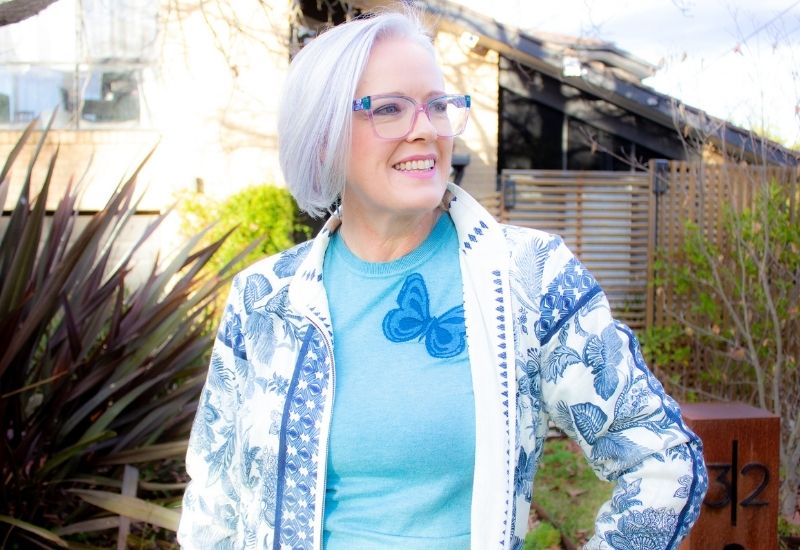
Blue works the same way. It’s not that I only wear blue, but it flatters my colouring and turns up often enough that it has become part of how people recognise my style.
Neither of these things happened because I sat down one afternoon and decided I needed a personal brand. They happened through repetition. And that’s often how signature style develops.
Repetition Doesn’t Make You Boring
Women sometimes tell me they worry about wearing the same accessories too often. Shouldn’t they keep changing things up? Won’t people notice?
Yes, people may notice. That’s rather the point.
If you keep returning to a particular style of glasses, or the same kinds of jewellery, colours, motifs or scarves, those choices start to become associated with you. Once is an accessory. Repeated over time, it’s a signature. In fact you may remember (if you’ve been reading for a long time) Jill Chivers talking about her love of leopard print turning into her signature style.
That doesn’t mean wearing the exact same garment or accessory every day. It’s more about recognising the visual qualities you keep gravitating towards, whether that’s bold and architectural jewellery or something delicate and sparkling, natural materials or polished shine, unusual asymmetry or refined simplicity. None of that is random. It’s usually your Style Recipe showing up in accessory form, whether you’ve ever written it down or not.
That’s also why copying somebody else’s signature rarely works well, and it’s the same trap as the Instagram outfit or the Pinterest pin from earlier. A statement necklace that looks entirely natural on one woman can leave another feeling like she’s borrowed a stranger’s outfit, for the same reason a screenshot of somebody else’s look never quite translates onto you. A dramatic red lipstick might be someone’s perfect finishing touch and someone else’s idea of fancy dress and just too much. Neither woman is doing it wrong. Personal style was never about finding the universally correct accessory, or the universally correct influencer to copy. It’s about finding the one that makes sense on you.
Scale and refinement matter here too. Something chunky, matte and natural reads completely differently to something delicate, polished and sparkling, and the version that works for you usually has more to do with your own physical characteristics and personality than with the outfit you happen to have on. You don’t need lots of pieces either. Often it’s about choosing well rather than piling on more.
Sometimes one strong personal detail beats five competing ones. If you’re wearing show-stopping earrings, they don’t also need to fight an equally dominant necklace and scarf for attention. You can relate accessories to the rest of an outfit through colour, shape or level of refinement, without asking everything in it to be the star.
This is exactly where “ordinary” clothes earn their keep. A simple navy knit isn’t thrilling on its own, but it’s exactly the backdrop your favourite necklace needs. A plain shirt gives unusual glasses, statement earrings or an interesting scarf the room to shine.
Not every garment needs to be a hero piece. In fact, if everything is extraordinary, nothing gets much chance to be noticed.
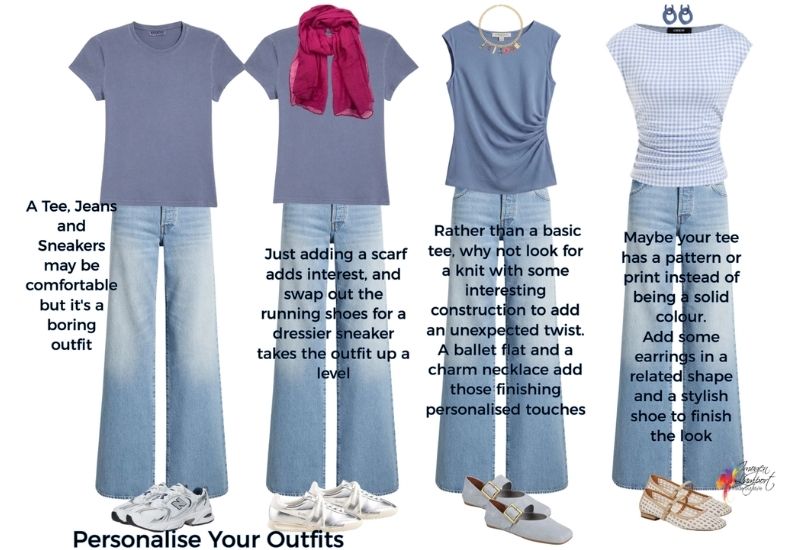
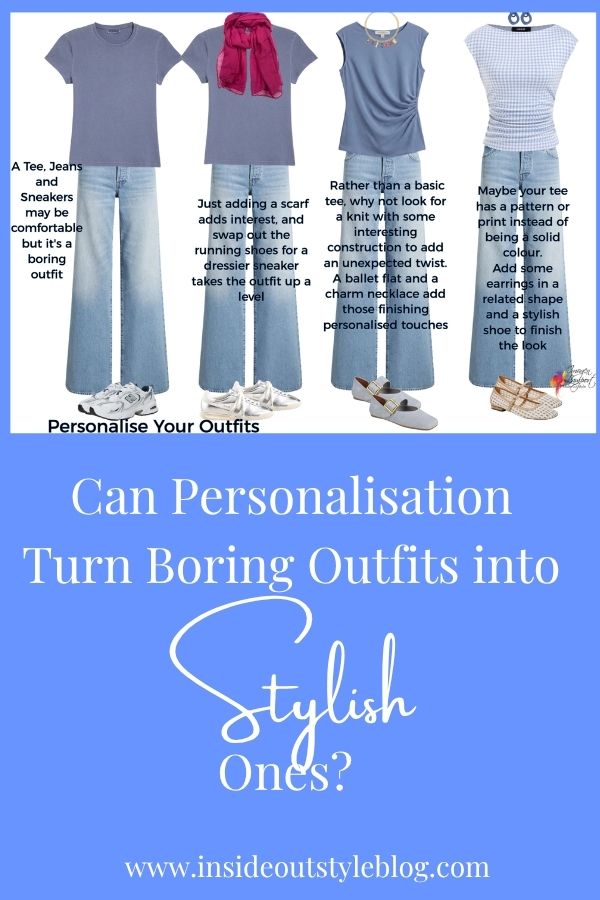
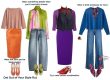
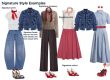
Some quick examples above:
A jean, tee and sneakers is a pretty common outfit, but it’s dull and bland.
- Adding a scarf in an alternate colour or with some pattern will add a pop of personalisation.
- Swap the running sneakers out for a dressier pair (a metallic, leopard print, laser cut… the options are vast)
- Your knit doesn’t have to be boring and plain; why not look for one with some interesting construction detail that adds visual interest?
- A ballet flat can be comfortable and is dressier than a sneaker
- A charm necklace that tells a story about you is a great way to personalise any outfit and could become your signature
- Swap the solid colour for a pattern; it could be a simple stripe or check, a graphic print, florals, leopards or any other sort that you find visually appealing
- Add a statement earring to finish your outfit
These are just a few examples to help you get started; even if your lifestyle is super casual, your outfits can still be stylish whilst being comfortable.
What Makes an Outfit Feel Like You?
The next time you get dressed and think, “It’s fine, but there’s something missing”, resist the urge to assume the answer is another new garment. Instead, ask yourself what would make the outfit feel more like you.
Maybe it’s the earrings you keep saving for some imaginary special occasion. Perhaps it’s changing the buttons on the jacket you already own, wearing your favourite scarf differently, adding a colour you know you love, or pulling out the brooch you inherited and haven’t worn for years. You may even discover that the thing you need to repeat is something you’ve already been wearing without consciously recognising it as part of your style.
That’s often how signature style works. We don’t necessarily invent it. We notice the patterns that are already there.
So this week, rather than buying something new, experiment with the small changes that make an outfit feel like you, using details already in your wardrobe.
Wear the necklace again.
Change the belt.
Put the brooch on the jacket.
Wear the glasses that make you feel interesting rather than the pair that simply disappears.
Because personalisation isn’t really about making ordinary clothes extraordinary. It’s about making ordinary clothes unmistakably yours.
If you’d like a system for working out exactly what “unmistakably you” looks like, rather than finding it by trial and error, Step 1 of 7 Steps to Style walks you through building your own Style Recipe the short list of words that turns every future colour, accessory and repeated detail into a deliberate choice instead of a guess. And understanding what kinds of details are right for your personality so that you don’t have to feel like you need to copy anyone else’s outfits.
Recommended Reading
Your Personal Style Isn’t a Puzzle to Solve – It’s a Painting You Keep Creating
How Can I Make My Current Wardrobe More Stylish? One of the most Googled Style Questions