





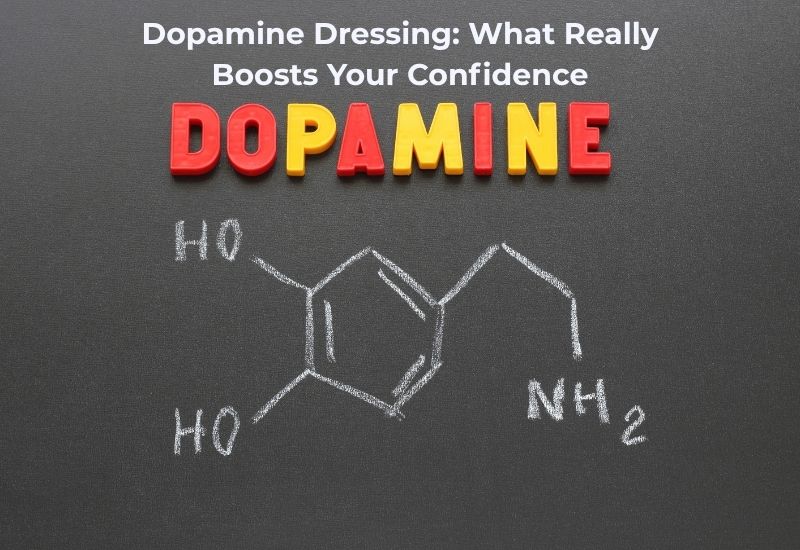
“Wear yellow and your brain will flood with happy chemicals.” That’s the promise of dopamine dressing, the trend that’s had everyone reaching for hot pink and lime green for the last few years. It’s a lovely idea. It’s just not quite what’s happening.
Here’s my problem with it. Dopamine is a real brain chemical, bound up with reward and motivation, but I’ve yet to find a single study that measures what happens to it when you put on a bright frock. The “neuroscience” you see quoted is mostly a borrowed word doing a lot of heavy lifting.
That doesn’t mean the feeling is fake. You know the one: you put on an outfit and something in you straightens up. That feeling is real, and there’s better research to explain it than a neurotransmitter nobody has measured.
 What dopamine dressing gets right
The heart of the idea is sound: what you wear changes how you feel. I’ve watched this happen more times than I can count. Take someone who’s been living in loose activewear, put her in a smart, well-cut jacket, and her whole body language shifts within seconds. She stands taller. She speaks differently. Nobody injected anything. (It’s one of the reasons I’ll never accept that style is shallow.) I get a kick out of it myself, and I’d happily bet my own dopamine joins the party. I just can’t prove it, which is rather my point.

The research agrees, up to a point. In 2012, a team led by Karen Pine at the University of Hertfordshire asked 100 women what they’d wear when they felt happy and when they felt low. 62% said a favourite dress when happy, against 6% when low. Notice the word: favourite. Not brightest. It’s self-reported, so it shows a link rather than a cause, but it points the same way.
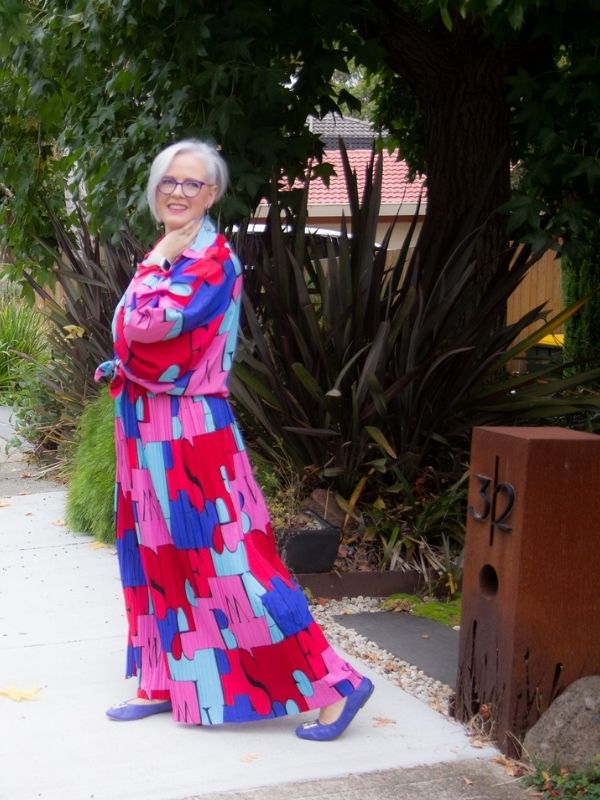
Where the trend wobbles is in turning that into a formula. Bright colour equals happy. If only. Plenty of women feel most like themselves in charcoal and inky navy, and pushing them into fuchsia would make them feel like they’d borrowed someone else’s outfit for the day. That’s not a boost, that’s a costume. That said, wearing colour makes other people feel happier; those people you interact with will get a little boost of dopamine. I notice that when I’m out in the stores, wearing brighter colours (so that it makes it easier for my clients to find me between the clothing racks), I frequently have people stop me and comment on how they enjoy the colours in my outfit.
 Is there anything special about colour itself?
A little. Ingrid Fetell Lee has spent years studying why certain things spark joy. In her TED talk she describes colour as “a sign of life, a sign of energy.” Bright colour, round shapes and abundance turn up again and again in the things that lift us. Her examples are rainbows, confetti and painted schools, though not wardrobes. She’s describing the pull of colour in general, not ruling on fuchsia. That pull is plausible. Whether it works on you depends on what comes next.
The research that actually explains the boost
In 2012, Hajo Adam and Adam Galinsky coined the term enclothed cognition. People wearing a lab coat they’d been told was a doctor’s coat paid closer attention on tasks than people told the very same coat belonged to a painter. The effect needed two things working together: what the garment meant to the wearer, and physically having it on.
I’ll be straight with you. The lab coat result hasn’t held up well. A preregistered replication in 2019 found no lab coat effect at all. A 2025 review of 40 studies, co-authored by Adam and Galinsky themselves, found the early studies raise replication concerns, while those published after 2015 look sturdier. So treat it as promising rather than proven.
The idea underneath has better support. Slepian and colleagues found in 2015 that people wearing more formal clothes tended to think in a more abstract, big-picture way, and that feeling more powerful seemed to be the reason.
Notice what’s doing the work in both. It isn’t the colour. It’s what the clothes mean to you.
Colour meaning shifts with context too. Researchers Andrew Elliot and Markus Maier have spent years showing that the same colour can read as attraction in one setting and as a warning in another. One recent test of their idea found red nudges arousal up a little wherever it appears, but whether that feels good or bad depends on the setting. Red across a dinner table is not red scrawled across your exam paper. So a universal “joy colour” was always going to be a stretch.
Why your happy colour might not be on the list
The trend lists come from somebody else’s associations. Yours might be a soft sage that reminds you of your grandmother’s garden, or a warm caramel that feels like your favourite coat. If a colour means something good to you, it’s already doing the job the trend promised.
There’s a practical catch, though, and it’s the bit the trend skips entirely. A colour can feel joyful on the hanger and still wear you once it’s on. If its intensity is brighter than your own colouring, people see the top before they see your face, and every mirror you pass shows someone who looks a little tired. The good feeling usually drains away by lunchtime.
That’s why I’d always rather you find the version of a happy colour that suits you. If bright coral lifts your spirits but your colouring is soft, a muted coral gives you the same emotional lift without the glare.
The shopping trap hiding inside dopamine dressing
Here’s what worries me most. The easiest way to chase a feel-good hit is to buy something new, and most dopamine dressing advice quietly encourages it. Go get the orange top!
Lee draws a useful line between joy and happiness. Joy is a short, intense burst. Happiness is how good you feel over time. A new purchase delivers the burst and not much else, and it can leave damage behind. Anthropologist Grant McCracken named this the Diderot effect in 1986, after the philosopher Denis Diderot, whose gift of a scarlet dressing gown made everything else he owned look shabby. One shiny piece that doesn’t belong with the rest of your wardrobe doesn’t lift it. It makes everything around it look tired, and suddenly you “need” more.
The confidence that lasts comes from clothes that belong to you twice over: they fit who you are, and they work with what you already own.
How to dress for a real confidence boost
Before you get dressed on a day when you need a lift, run through three quick questions:
- What do I need from today: focus, warmth, authority or ease?
- Which piece I already own means that to me?
- Does it suit my colouring, or will it wear me?
- Can I include colour without having to wear it? Try an accessory in colour instead of a garment.
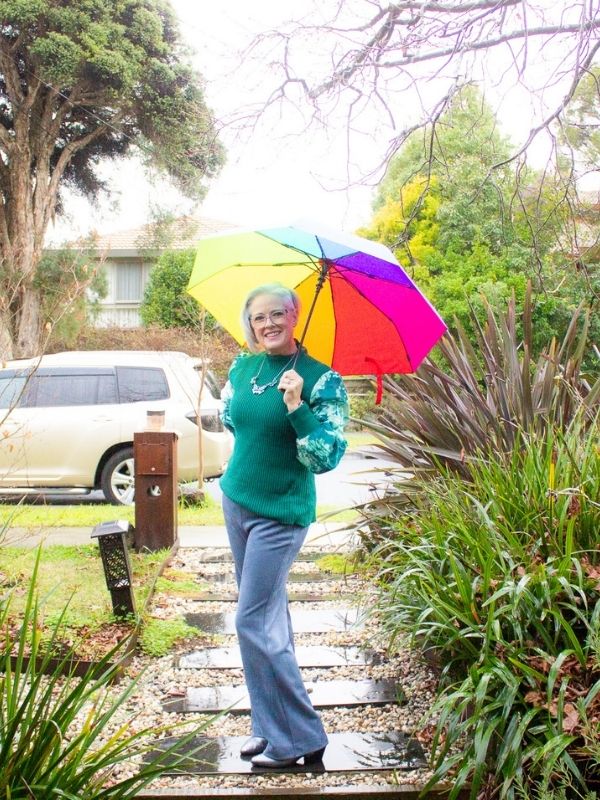 This is what I call mood enhancement dressing, choosing clothes for how you want to feel rather than how you already feel. It works in black as well as it works in bubblegum pink, because the power sits in your choice, not in the dye.
If you’d like to map exactly which colours give you which kind of energy, my Energy of Colour masterclass walks you through it, one colour at a time.