






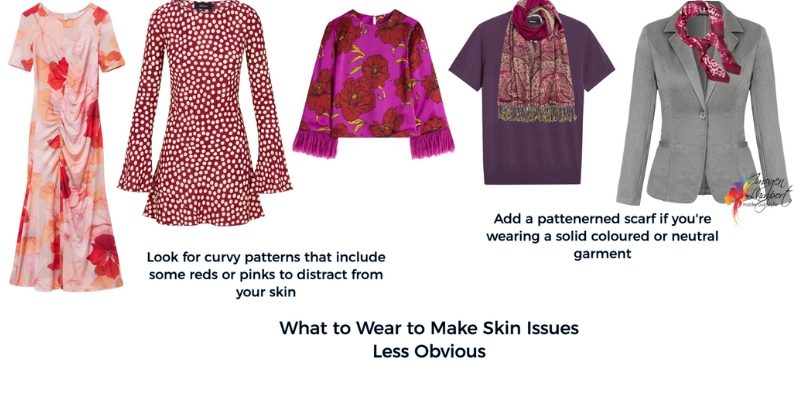




Skin flare-ups can feel like a spotlight you never asked for, especially when acne or rosacea seems to draw attention before anything else. But the truth is, what you wear has the power to redirect the eye. With a few smart choices in colour and pattern, you can distract from pimples and other skin conditions. The trick is not to hide, but to harmonise.
Whether or not it’s acne, rosacea, mast cell disease (MACD, MCAS), or even Lupus.
When your skin isn’t behaving the way you’d like, the instinct is often to retreat into neutrals. You might think that black, beige, or grey will make your skin look calmer. In reality, it can have the opposite effect. Plain, single-coloured outfits create a strong contrast against your skin, which makes any redness or unevenness stand out even more.
The goal isn’t to cover up. It’s to create harmony between your clothes and your colouring so that your skin feels like part of the whole picture, not something separate from it.

1. Embrace Colour
Colour is your best ally when your skin is drawing more attention than you’d like. Wearing more colour balances the eye, allowing it to take in the overall effect rather than zooming in on one detail.
Choose shades that suit your natural undertone. If you’ve had a personal colour analysis, you already know which hues bring balance to your skin. Warm, cool, or neutral tones will all help your complexion look clearer when they’re in harmony with your colouring. When colours clash with your natural undertone, your skin can appear more flushed or uneven.
If you’re not sure where to start, look for colours that echo your eyes or lip tone. These naturally complement your skin and subtly restore balance.
2. Patterns Distract the Eye (in the Best Way)
Your skin has texture and pattern. So when you wear smooth, solid fabrics, the difference between your clothing and your skin becomes more noticeable. Patterns bridge that gap beautifully.
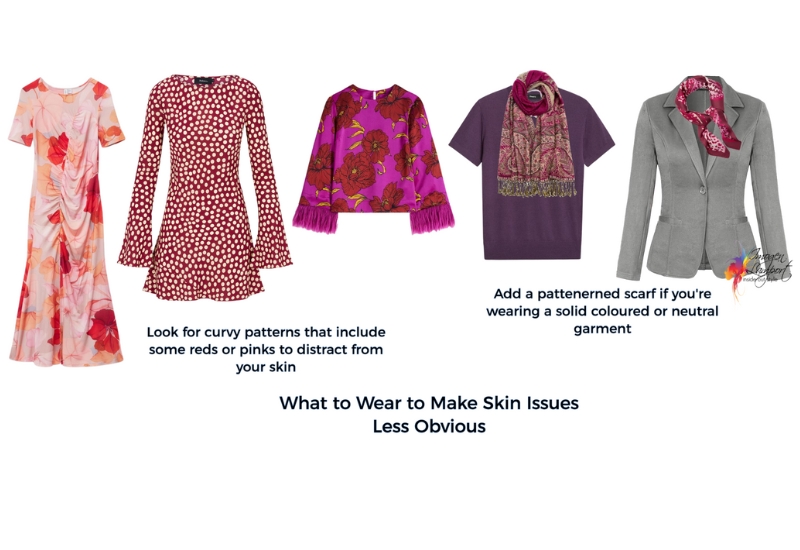
Busy, organic prints – think florals, leopard spots, painterly swirls, or scattered polka dots – create gentle visual movement. This stops the eye from fixating on one area, like redness on your cheeks or a small breakout.
Avoid overly structured patterns such as stripes or grids. These are precise and regular, while skin is naturally irregular. Organic prints feel softer and more cohesive beside your face.
Sometimes it’s as simple as a scarf or blouse in a multi-coloured print. The mix of tones and shapes helps the brain read your appearance as a single, harmonious image rather than contrasting zones of smooth fabric and textured skin.
 3. Use Multi-Coloured Prints for Balance
Patterns with more than one colour are particularly effective. They introduce natural complexity that mirrors the subtle variation of real skin tones.
When you wear a mix of colours that echo your own palette, your skin appears more even because the overall image feels balanced. A print that includes a few of your best colours – say, soft coral, cool blue, or gentle olive – makes everything look more cohesive.
It’s the same principle artists use when blending colour on a canvas: the right mix creates harmony, which the eye interprets as beauty.
If acne or rosacea makes your skin appear redder, a sharp contrast in neutrals will amplify that effect. High-contrast outfits, such as black-and-white or navy-and-cream, intensify visible differences between skin and fabric.
Instead, experiment with soft contrast – mid-value combinations that don’t compete with your complexion. Pairing navy with teal or red, rose with camel, or olive with coral can create a smoother visual transition between your skin and your clothes. By repeating the reddish tones in your skin, they stand out less rather than more.
5. Build Confidence Through Expression, Not Concealment
When you start using colour and pattern intentionally, you’re not hiding; you’re expressing. The goal is to dress in a way that feels like you again, not a muted version of yourself.
A patterned top, a colourful scarf, or even statement earrings can all shift focus away from perceived imperfections and direct attention to your features, personality, and energy. This is style psychology in action – the way external choices change how both you and others perceive your confidence.
If acne, rosacea, or uneven skin tone makes you want to retreat into beige, resist the urge. Step into colour instead. Patterns, harmony, and gentle contrast can transform how your skin looks and how you feel in it.
You don’t have to wait for perfect skin to feel good in what you wear. The right combination of colour and pattern helps your reflection feel balanced, vibrant, and authentically you.
Further Reading
Embracing Patterns: Elevating Your Personal Image with Style and Substance
How to Develop Your Style Confidence: Moving Beyond the Fear of Judgment







Great post, Imogen. I wish I’d had this info in my teens and twenties when my acne was at its worst.
Imogen, you really are at the top of your field. I can’t believe the quality of things you’ve covered, that no-one else dares to go near. I can’t thank you enough!
I have mast cell disease (also known as MCAS, MCAD), similar to rosacea, and used to routinely go bright, glowing, crimson red over my whole face and neck (and the back of my hands). I don’t suffer from this much any longer (thankfully) but still do occassionally – so this information will come in handy whenever I have a relapse. This will also be very appropriate for anyone with lupus – you may want to add both of those terms into your SEI so that people searching can find this.
I now have a new condition that is causing me distress, and immediately thought of you. It turns out, from both age and health conditions I’m told, that the whites of my eyes are suddenly gray/blue. It’s incredibly jarring, and makes me look suddenly old, life-less, and much more ill than I actually am. I’m aware that, more than ever, I need to wear colours that give me some life, but not sure how to counter this new ‘feature’. I once read that you should wear white earrings to give the illusion of looking younger and healthier because healthy eyes are white, but not sure that would help in this case.
There are all kinds of eye issues that I’m sure could be helped by apprpriate colour choices, that I’m sure would merit an blog post, but unlike the others which are treatable and temporary, grey eyes are permanent once you’ve developed them. I hope you’ll consider writing a post to help those of us with this condition.
Thanks Jan for your lovely words I’ll add those additional tems into the post so that those searching will find it. I have seen one client with blue whites of the eyes – I would be avoiding white completely as the eye whites are no longer white, and instead focusing on other signature colours instead – particularly skin enhancers to make you look healthy. Life is tough at times but I’m glad you’re still here! I will write a blog post for you.