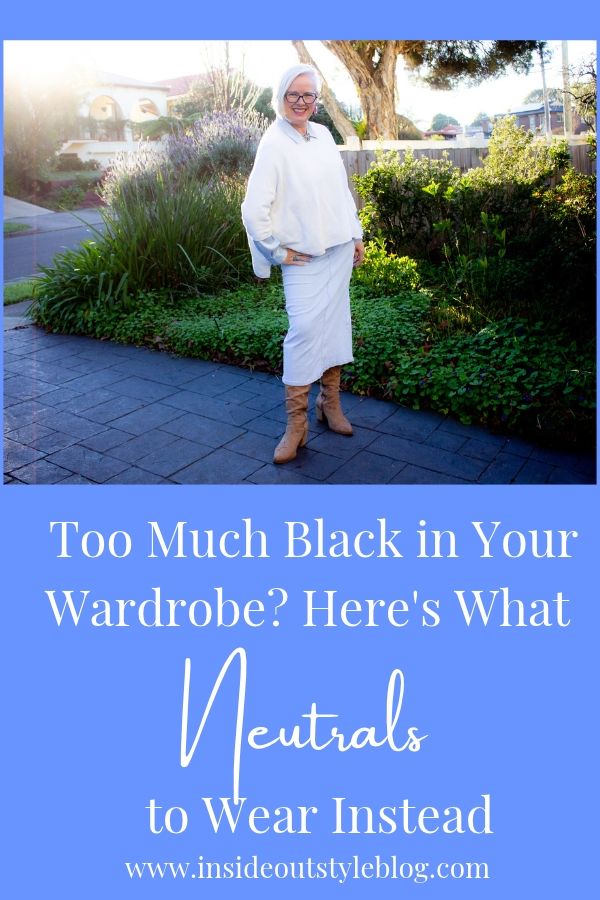









Do you struggle to put together a wardrobe of clothes in your colour palette, and find yourself reaching for black all the time because it feels safe, or just easy? You’re not alone, and the good news is that there are plenty of flattering neutrals you can wear instead of black.
Gail wrote to me recently. She’d spent the day sorting and curating her wardrobe and wanted to be able to mix and match her clothes more easily. She loves wearing autumn colours, but she’d ended up with far too much black, because she believed it made her look slimmer. Her question: “How do I weed the black out of my wardrobe, and what neutrals do I replace it with?”
It’s a great question, so let’s dig in.
Prefer to watch on YouTube? Watch the video on my YouTube channel.

Black isn’t the slimming secret you think it is
Many of us hold on to black because we’ve been told it’s slimming. But black only works its magic on people who share its colour properties.
Black is cool, deep and bright. If those are your colour properties too, black is fabulous on you. But if you’re soft or smoky, warm, or light, black is not your best neutral.
When black isn’t in harmony with your colouring, it actually grabs attention. It can draw the eye straight to the very part of your body you were hoping to disguise. It also tends to look harsh, overwhelming you rather than flattering you, and it doesn’t sit comfortably next to warm colours like the autumn shades Gail loves.
Choosing neutrals instead of black: start with your eyes and hair
So what should you wear instead? The answer is surprisingly personal. Your best neutrals come from your own colouring, in particular, your hair and eyes.
Because these colours are part of you, repeating them in your clothes creates beautiful harmony with your appearance and because you’ve always got those colours on, they are already in every outfit.
Start with your eyes:
- Blue eyes: think navy or mid or light denim depending on your ideal value.
- Warm green eyes: think olive or a warm khaki green.
- Cool green eyes: think a soft sage, deep forest or other similar green.
- Brown eyes: think browns, of course, but have a look at the kind of brown – red browns look great with deep burgundy, bronze browns are great with cognac.
- Hazel eyes: your eyes contain several neutral-ish colours, so choose olives, khakis and browns.

This blue grey is the same colour as my eyes
Then look at your hair. Repeating your hair colour gives you a neutral that will naturally work with you. Aim for a shade that’s similar in value (how light or dark it is) to your hair:
- Black or very dark brown hair: black may well be a good neutral for you.
- Mid-brown hair: try a brown of a similar depth instead of black. Navy will also intensify brown hair.
- Red hair: think cognac or a burnished brown. Deep khaki greens intensify red hair beautifully.
- Blonde hair: look for a beige or white that most closely matches your hair.
- Grey hair: choose greys and silvers that echo your own.
- White hair: white is ideal

White is a neutral I wear a lot, as my hair has turned more white
Your skin tone can also be a neutral, but use it sparingly. Too much of it at once can make you look a little nude.
And remember, neutrals are broader than just black, white, and grey. Olive is a neutral. Navy is a neutral. Tans, browns and warm greys are neutrals too.
For more detail on using your hair and eyes to choose neutrals, including hair enhancers and intensifiers, read How to Select Your Best Neutrals or listen to Podcast Episode 78: Choosing Your Best Neutrals.
A note on hair colour
If you colour your hair, it’s especially important to choose the right shade. Your hair is one of your key neutrals, so if it’s the wrong colour it will clash with the rest of your palette. Get your hair right and everything else falls into place more easily.
Warm neutrals, cool neutrals (and why grey is tricky)
Not all neutrals are created equal. Put a warm palette next to a cool one, and the difference is striking.
- A warm palette, like my Spicy palette (which is a lighter version of a traditional Autumn palette), has warmer tans and browns, warmer greys and olive tones.
- A cool palette, like my Sublime palette(related to Summer), has much cooler greys and cooler browns.
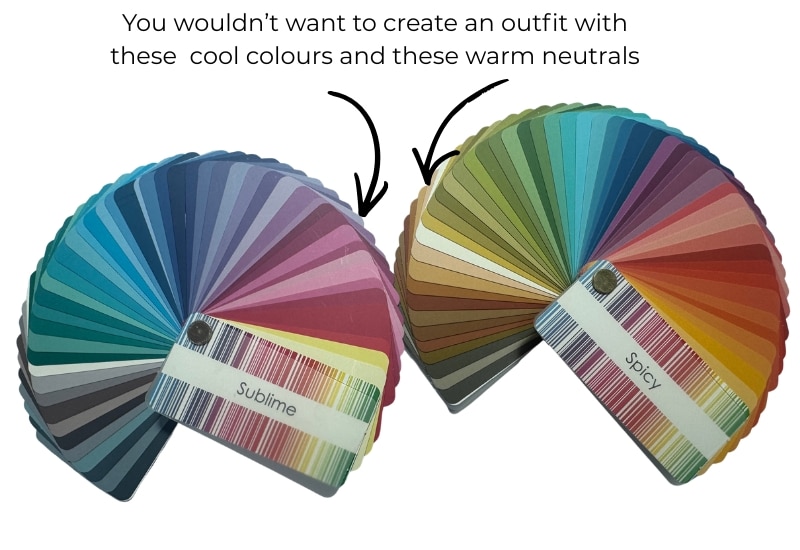 Each set of neutrals works with its own palette, not the other. Neutrals from the wrong palette look “off” next to your colours. Neutrals from the right one look as though they belong.
Grey is the classic example. Look at a grey on its own, and you’ll think, “Yes, that’s grey.” It’s only when you place it beside a different grey that you see its undertone. Cool greys are more blue-based. Warm greys lean yellowy-green. Put them together, and they simply don’t go. I’ve written a specific post about that here.
This is exactly why having your own colour palette makes life so much easier. Your neutrals and colours already harmonise, so your wardrobe mixes and matches with far less effort.
A little colour theory goes a long way
Understanding the basics of colour makes choosing clothes so much simpler. Every colour has three properties:
| Property | What it describes |
|---|---|
| Undertone | Whether a colour is warm or cool |
| Value | How light or dark a colour is |
| Intensity | How bright or greyed-down a colour is |
If you’ve had a colour analysis, your palette should already contain only warm or only cool colours, matched to your undertone. But that’s not the whole story.
You also need to know:
- Your value: are you better in overall lighter, medium or darker colours, and in what proportions?
- Your personal colour contrast: do you look best in one colour with neutrals, head-to-toe one colour, head-to-toe neutrals, or several colours at once?
A palette on its own is generic. Personalising it, so you know exactly which colours to wear and how to combine them, is the real key to a wardrobe that works and outfits that make you shine. It’s the information I give clients in my online colour analysis and in my 7 Steps to Style program.
How to start wearing neutrals instead of black
You don’t need to clear out every black piece in one go. Here’s the gentle approach I recommend:
- Identify your best neutrals. Start with your hair and eye colours and find the neutral versions of them.
- Start buying those neutrals. Build up a collection of neutrals to wear instead of black before you let the black go.
- Take your palette shopping. Brown is back in fashion, and there’s plenty of it in stores right now. But there are cool browns and warm browns, so check every brown against your palette before you buy.
- Wear your right colours consistently. Once you do, you’ll start to notice how harsh black looks against them.
- Let the black go gradually. As you stop reaching for it, it becomes much easier to release.
What happened when I let go of black
Black used to be wonderful on me. When I had black hair, I was cool, deep and bright, exactly in tune with black’s colour properties. When I went lighter, black suddenly looked harsh on me, and I simply stopped wearing it. Once I’d stopped wearing it, letting it go was easy.
 I’ve kept one black outfit for funerals. But I no longer need a wardrobe full of black.
We often cling to black because it feels safe and we don’t know which neutrals to wear instead of black. Once you know your best neutrals, that safety net isn’t needed any more.
The bottom line
Black is only your best neutral if you share its colour properties: cool, deep and bright. For everyone else, the best neutrals to wear instead of black are hiding in plain sight, in your own hair and eyes.
Find the neutral versions of those colours, build your wardrobe around them, and you’ll discover that your colours and neutrals work together effortlessly. Getting dressed becomes so much easier.
Are you trying to cut back on black? Tell me in the comments which neutral you’re going to try first.
How do I Find the Right Neutrals to Act as an Anchor for My Wardrobe?