







Have you ever noticed that there are some pieces in your wardrobe that just feel like you?
You put them on, and somehow the outfit falls into place. You feel more comfortable, more confident, more recognisable to yourself. It may not even be dramatic. A favourite jacket shape. A particular colour. A print you keep reaching for. A pair of statement earrings that feel like they go with everything.
We’re usually told to build a wardrobe from the outside in, with somebody else’s list of “essentials” and “classics.” I’d rather start from the inside out: find what already feels yours authentically, work out why it works, and let that guide everything else you buy.
Signature Pieces Aren’t the Same as Hero Pieces
It’s worth separating two ideas that get mixed up.

A hero piece is the item that grabs attention in a particular outfit: a bold print, a striking colour, an unusual silhouette. It’s exciting, but on its own it can be tricky to wear, because it wants to be in the centre of the spotlight rather than sharing it.
A signature piece or design element is quieter than that. It’s not about standing out in one outfit. It’s about showing up, again and again, because it genuinely suits you: your colouring, your shape, your personality. Sometimes a hero piece is also a signature. Often it isn’t.
Blue is a good example from my own wardrobe. People assume it’s just my favourite colour. In fact, once when my daughter was in 6th grade at school, and I was driving her and two friends to their dance class, one of them piped up and asked: “Imogen, is your favourite colour blue?” She’d noticed that I wear a lot of blue (it’s not the only colour, but it’s a pretty common one in my outfits). I do love blue, but it’s really a signature colour, one that relates beautifully to my colouring and mixes easily with almost everything else I own. Nobody looks at any single blue garment and calls it a showstopper. Together, though, they form a thread that runs through my whole wardrobe, and that’s exactly the point. A signature item or element doesn’t need to shout to be doing important work.

I do wear colours other than blue, but I do love a full range of different blues, so you’ll find me in everything from pale sky blue, to turquoise and cobalt and everything in between.
Start With What You Already Love
Before you buy anything else, go looking in your own wardrobe.
Pull out five or six pieces you genuinely love wearing, not the ones you think you should love because they were expensive or “practical,” but the ones that actually get worn and make you feel good the moment you put them on.
Then play detective. Ask yourself:
- What colours keep appearing?
- Is there a repeated shape or silhouette?
- Is there a pattern that is common between them? Stripes, florals, animal prints, or repeating geometrics – as just a few examples.
- Do you lean towards crisp structure, or soft drape?
- Is there a particular fabric, texture or sheen?
- What accessories show up again and again?
- What do you get complimented on?
- How do these pieces make you feel, and what words come to mind when you’re wearing them?
You’re looking for a pattern, not a duplicate. You might discover your signature isn’t “a red jacket.” It’s structured jackets in bolder colours. It might not be one pair of metallic shoes; it’s a hit of shine in otherwise relaxed outfits.
Decode the Ingredients, Not Just the Item
Here’s the trap that catches most of us. You love a teal silk blouse, so you go hunting for another teal silk blouse. Then another. Eventually you own seven near-identical blouses, and you’re still wondering why the rest of your wardrobe doesn’t hang together.
The more useful question is: what is it about this piece that makes it work?
Maybe the teal genuinely suits your undertone. The soft fabric moves the way you like to move. The specific shape or style of that original teal blouse fits your body well. Maybe that original fit was just right, the length perfect. Maybe it’s because it’s versatile. It’s dressy enough for work but still pairs with jeans on the weekend. Broken down like that, one blouse gives you five separate, reusable pieces of information about what to look for, rather than one very specific item to try to clone.
Give Your Signature Pieces a Supporting Cast
Once you know what your signature elements are, resist the urge to make every new purchase another lead role. Every great lead needs a supporting cast.
If bold jewellery is your signature, you need necklines and simpler tops that let it be seen rather than compete with it. If patterned jackets are your thing, you need enough plain trousers and more simple knits underneath to ground them. If your signature is a strong, confident colour, useful neutrals give that colour somewhere to land.
This is where a proper colour palette is so valuable. Once you know it in terms of your own undertone, intensity, value and contrast, and how to put your colours together, using your ideal value, value and colour contrasts. Rather than a generic label, almost everything you add will relate back to what you already own, because it’s all sitting in the same family. That’s what turns a wardrobe of individually lovely pieces into a wardrobe that actually works together.
Look for Echoes, Not Exact Matches
Cohesion doesn’t mean everything has to match. It means enough elements relate.
If a favourite patterned jacket carries navy, teal and a soft pink, you might repeat the navy in your trousers, the teal in your earrings, and the pink in your shoes. If your signature is architectural jewellery, you might echo those clean geometric lines in a structured bag or a pair of angular glasses.
These small visual relationships are what make an outfit look intentional rather than accidental, and they let your signature travel through your whole wardrobe without turning it into a uniform.
My signature motif is the butterfly. I love them because they are both colourful and beautiful, but also what they signify, which is transformation (which is what I’m all about). This signature butterfly necklace works with so many of my outfits because it’s in colours that I wear a lot.
Why One Good Piece Beats Five Almost-Right Ones
If you know me at all, you know that I’m a keen reader of neuroscience and psychology, which is why I love that there is a genuine psychological reason behind why building outward from your signature pieces works so well, and why random purchases so often don’t.
It’s called the Diderot effect, named after an eighteenth century essay about a man whose beautiful new dressing gown made everything else in his study suddenly look shabby by comparison. One item, chosen without any reference to what he already owned, made the rest of his possessions feel wrong. That’s exactly what happens every time you bring home something that doesn’t relate to anything else in your wardrobe. It doesn’t extend your options. It just highlights everything that doesn’t match. Making it easy to let go of the pieces that just aren’t you.
Choosing pieces that deliberately build on a signature you already know works flips this in your favour. A new item chosen to complement what’s already there doesn’t create dissatisfaction; it multiplies your outfits instead. One well-chosen blazer, in a colour that’s genuinely yours, can anchor ten different looks. One “bargain” jumper in the wrong colour will sit in the drawer no matter how many times you rearrange the hangers, because it was never actually related to anything else you own.
Make Sure Your Signature Pieces Work With Your Actual Life
An interesting piece that can only be worn to one kind of event isn’t much of a core wardrobe item, however much you love it.
This is where versatility matters. Could that fabulous jacket work over both your smart trousers and your weekend jeans? Could your favourite jewellery lift a plain daytime outfit as easily as it finishes an evening one? Could that colourful top move between a blazer, a skirt and casual trousers?
You don’t need every piece to do absolutely everything. That’s just another impossible wardrobe rule. You do need enough crossover that your signature is part of your everyday life, rather than something saved for “good” and rarely worn at all.
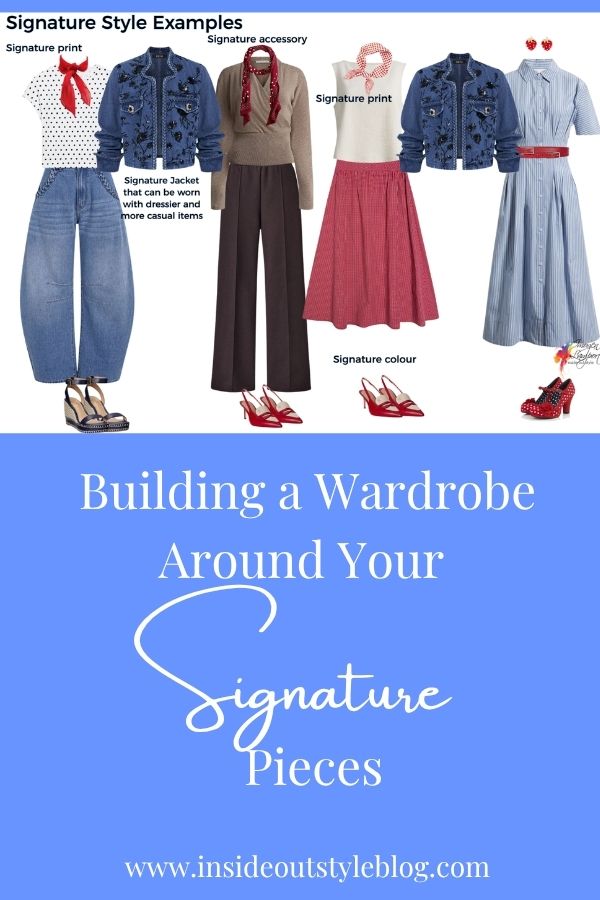
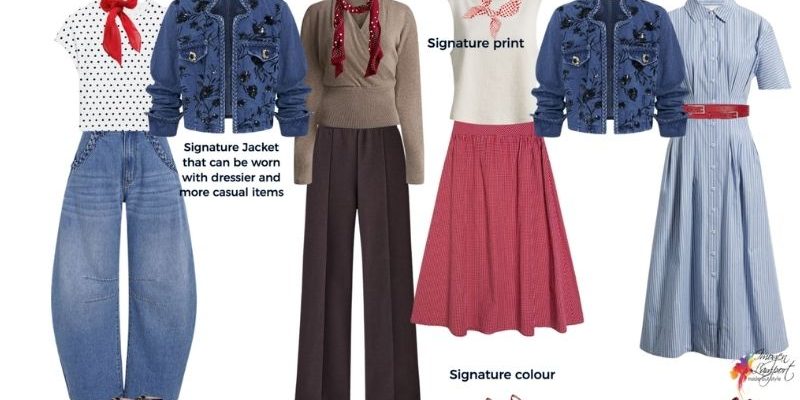
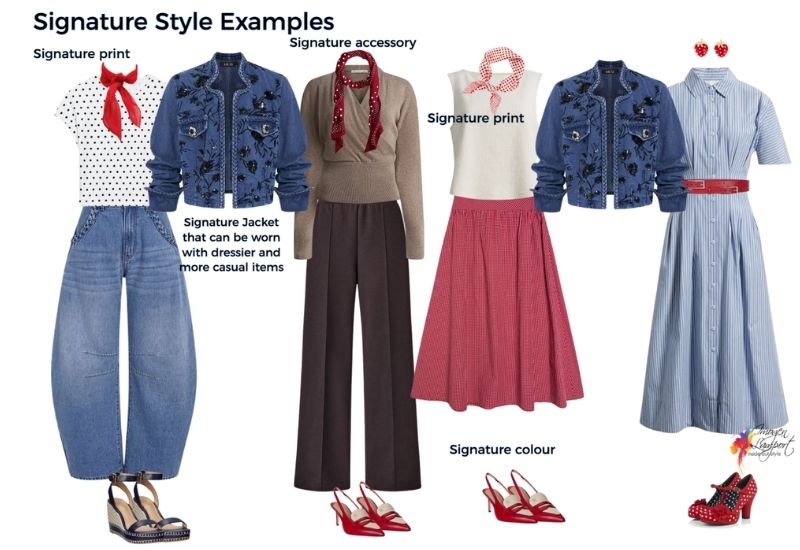 For example, in this signature style image, I’ve picked four things that could become a signature and all work in a wardrobe capsule (you could mix and match most of these garments).
- Signature print – the polka dot
- Signature jacket – statement denim
- Signature accessory – the scarf
- Signature colour – red
Turn Your Signature Into a Shopping Filter
This is where the whole approach earns its keep. Shopping stops being purely about whether something is attractive, because there are thousands of attractive clothes out there. The better question is: does this belong in my wardrobe?
Before you buy, ask:
- Does this relate to one or more of my signature elements?
- Does it work with several things I already own?
- Does it suit my current body, colouring and life, not the one I used to have?
- Can I picture at least three outfits using it?
- Do I genuinely love it, or am I just enjoying the novelty of something new?
It’s also worth asking a few sharper questions before any statement piece comes home, and getting comfortable with knowing when to stop looking once you’ve genuinely found the right one, rather than continuing to browse out of habit.
Your Wardrobe Should Get More You, Not More Generic
The goal was never a perfect capsule wardrobe or somebody else’s list of ten essentials. It’s a wardrobe that gets more recognisably yours over time.
Your signature might be dramatic or barely-there, built on colour, print, silhouette, texture or the way you accessorise. And it’s allowed to change. The woman you are now doesn’t have to dress like the woman you were a decade ago, because your body, your colouring, your lifestyle and you have all moved on since then.
If you’d like help working out the why behind what already works for you, rather than another list of generic rules, that’s exactly what a personal colour analysis and styling session untangles.
For now, start in your own wardrobe. Pull out five things that make you feel most like yourself and ask what they have in common.
What’s the one piece you’d build your whole wardrobe around? I’d love to know what it is for you.
Recommended Reading
The Capsule Wardrobe List Is Lying to You – Here’s What Actually Works
Mastering Hero Pieces: How to Coordinate Bold Statement Items for a Cohesive Wardrobe
7 Questions to Ask Before You Buy that Hero For Your Wardrobe
Choosing your Interest Pieces and Adding Statements to Make Your Outfits Fabulous