










The Most Googled Wardrobe Advice – And Why It Keeps Failing You
“What are the key pieces for a capsule wardrobe?” is the second-most Googled style question over the past couple of years.
Type “capsule wardrobe” into Google and you will find, with remarkable consistency, the same list. A white button-down shirt. A trench coat. A little black dress. Dark-wash jeans. A blazer. A nude heel.
It is presented as universal. Timeless. The solution to every wardrobe problem you have ever had.
And yet here you are, possibly with several of these items already hanging in your wardrobe, still standing in front of it every morning feeling like you have nothing to wear.

That is not a coincidence. That is the predictable outcome of applying generic advice to a specific human being – you – who has a specific personality, a specific body, a specific lifestyle, and a specific set of things she wants to communicate to the world.
The capsule wardrobe concept, in theory, is sound. In practice, as it is most commonly taught, it is one of the most well-intentioned failures in the history of style advice.
 Where the Capsule Wardrobe Idea Came From
The concept was introduced by the London fashion editor Susie Faux in the 1970s and later popularised by Donna Karan’s iconic “Seven Easy Pieces” collection in 1985. The original idea was genuinely radical: instead of chasing trends season after season, a woman could build a small wardrobe of high-quality, versatile pieces that worked together and served her across multiple occasions.
It was a philosophy of intention over consumption.
Quality over quantity. Clarity over chaos.
The capsule works when you have a colour palette which works for your colouring, your contrasts (value and colour contrast) as it makes choosing clothes that will naturally work together simple. But the capsule, where you just arbitrarily choose a couple of neutrals like black and white, and then select a specific set of garments, even if they are not your style, just doesn’t work for the majority of women.
The concept of a capsule is a beautiful idea. The problem is not the idea.
The problem is what happened to it when it was packaged, simplified, and sold to millions of women with different bodies, different lives, and different personalities as though those differences were irrelevant.
The little black dress is not timeless. In fact is suits very few women, but Coco Chanel loved it, made it popular (and it did suit her).
The camel trench coat is not universally flattering. It is flattering on certain proportions and for warm colouring. The white shirt assumes that a crisp, bright white works with your colouring, that your lifestyle includes occasions that warrant it, and that the specific proportions of a classic shirt collar and cuff suit your face and frame and that you actually enjoy wearing this kind of structured garment, and that you’re also happy to iron that shirt before you wear it.

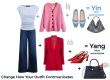
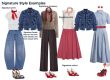
Take one sweater and pair with a dressy pant
None of these is a safe assumption. And yet the list persists, largely unchanged, decade after decade.
The Science of Why Fewer Choices Feels Better – Up to a Point
Here is what the capsule wardrobe concept gets profoundly right: decision fatigue is real, it is well-documented, and your wardrobe is one of its primary battlegrounds.
Research by social psychologist Roy Baumeister and colleagues established that willpower and decision-making capacity are finite resources. We deplete them throughout the day with every choice we make, and getting dressed, for many women, involves dozens of micro-decisions before 8am. What to wear. Whether it fits. Whether it is appropriate. Whether it communicates what you want it to communicate. Whether you feel good in it.
A wardrobe full of things that don’t quite work forces you to make harder decisions because you are compensating for the gaps, the misfits, the aspirational purchases that don’t function in your actual life. A wardrobe of fewer, better-chosen pieces reduces that cognitive load dramatically.
Barry Schwartz’s research on the “paradox of choice” reinforces this: beyond a certain point, more options do not produce more satisfaction, they produce more anxiety, more second-guessing, and more regret. A wardrobe of forty things you love and wear consistently will produce far more daily confidence than a wardrobe of four hundred things that you find hard to mix and match, and you feel vaguely uncertain about.
So the impulse behind capsule dressing – edit ruthlessly, choose well, wear everything – is psychologically sound. The execution is where it falls apart.
A capsule wardrobe is a fabulous concept for packing for travel, and for areas of your life where you need a smaller subset of clothes.
It’s also a brilliant way to build a wardrobe from scratch when that’s necessary.

Same sweater and pair it with jeans and a jacket
It’s perfect if you love a small wardrobe, but if you are a mood dresser and love choice, then it’s not going to be a good choice for you. And you don’t need to use the capsule concept if you work with your colour palette and limit your colours to just those that suit you, as you’ll find that naturally, your wardrobe works easily together and you get the versatility you desire.
Why the Same Ten Pieces Look Completely Different on Ten Different Women
Fashion is designed for a hypothetical body. It is draped on a standard form, photographed on a narrow range of models, and sold to every human being who walks through the door, regardless of height, proportion, colouring, or personality.
This is not a personal failing. It is a manufacturing reality.
In my work as an image consultant, I assess over forty body variation factors when I am working with a client. Not just a simple body shape, a concept I’ve explored in multiple blog posts and will explore again soon, but specific, individual factors: the length of your torso relative to your legs. The shape of your calves, the size of your bust, and the scale of your facial features. The length of your neck, the slope of your shoulders, the proportions of your rise, to name a few.
These factors determine, with considerable precision, which cuts, proportions, and silhouettes will work with your body rather than against it. And they mean that a “classic straight-leg trouser”, a capsule wardrobe staple on every list, will look entirely different on five different women, fit well on perhaps two of them, and genuinely flatter perhaps one.
This is not a flaw in the women. It is a flaw in the advice that ignores them. And the biggest flaw is the fashion retail manufacturing system that tries to fit the myriad of bodies into the same garments and makes us feel like WE are wrong when garments don’t fit or look great
You are not the problem, nor is your body; it’s the fashion industrial complex that is the issue.
The Personality Problem: Generic Lists Can’t Solve
Your physicality is only part of the challenge. The more fundamental issue, and the one that almost no mainstream capsule wardrobe advice addresses, is personality.
A wardrobe is not just a functional system for covering your body appropriately for various occasions. It is a self-expression system. It communicates, before you speak a word, something about who you are, what you value, and how you want to be received in the world.
And different personalities have genuinely different visual languages.
Research into personality and aesthetic preference, including work by Rentfrow and Gosling on the relationship between personality traits and aesthetic choices across multiple domains, consistently shows that our preferences are not arbitrary. They are expressions of our deeper psychological orientation. An introverted, conceptual thinker tends toward different aesthetic choices than an extroverted, pragmatic doer, not because one is more stylish than the other, but because they are genuinely different people with different things to express.

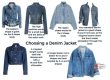
Same jacket with a different coloured top makes it look more different, pair with a dark denim jeans
This is why I begin with personality rather than body shape or wardrobe audit when I work with clients. A classic, structured capsule wardrobe might be exactly right for one woman, and feel like a costume to another who is equally intelligent, equally successful, and equally deserving of a wardrobe that works for her. The difference is not taste. The difference is identity.
Lifestyle Mapping: The Step Every Capsule Wardrobe List Skips
Even if a capsule list happened to suit your body and your personality, it would still face a third obstacle: it does not know your life.
A wardrobe serves a life. And lives are specific, varied, and constantly changing. The woman who works from home three days a week and spends the other two in client meetings has fundamentally different needs from the woman who teaches secondary school, or the woman who runs her own business from a studio, or the woman who has recently retired and is figuring out who she is outside of a professional identity.
Before any wardrobe editing or building exercise, I ask clients to map their actual lifestyle, not the life they wish they had, not the life they had five years ago, but the specific reality of how they spend their time right now. What are the occasions they genuinely dress for? How formal or informal are those occasions? What does comfort mean in the context of their physical environment and daily activity?
From this mapping, the shape of a genuinely useful wardrobe begins to emerge. And it rarely resembles the standard capsule wardrobe list, because the standard list was written for a hypothetical woman living a hypothetical life.
What Sustainability Actually Requires
The capsule wardrobe movement has found renewed momentum through the lens of sustainability, and rightly so. The fashion industry is one of the most polluting on the planet, and the culture of fast fashion and trend cycling is environmentally devastating.
But here is the paradox: buying a “sustainable” capsule wardrobe of high-quality pieces you chose from a generic list and then never wear is not sustainable. It is expensive, guilt-inducing, and ultimately produces the same outcome as fast fashion: a wardrobe full of things that don’t quite work, and the ongoing itch to go shopping and fix it.
True wardrobe sustainability, in both environmental and financial senses, comes from buying fewer things you actually wear. And that requires self-knowledge, not shopping lists.
Research into consumer behaviour and wardrobe utilisation consistently finds that the average garment in a Western wardrobe is worn fewer than ten times before it is discarded. The antidote is not a better list of what to buy. It is a clearer understanding of who you are, how you live, and what your body actually needs, so that every purchase is intentional, every piece is worn, and nothing hangs on a hanger gathering dust as a monument to aspirational shopping.

Dark denim jeans and the same jacket, but with a plain top and turquoise shoes
How to Identify YOUR Key Pieces
So if the generic capsule wardrobe list is not the answer, what is?
The answer is a wardrobe built from the inside out, starting with your personality, lifestyle, and body, and working outward to the specific pieces, silhouettes, fabrics, and colours that will function beautifully in your actual life.
This is not a simple process, and I won’t pretend otherwise. It requires honesty, about who you are, about how you actually live, about which purchases have been aspirational and which have been genuinely useful. It requires some knowledge of the principles of line, proportion, and colour that govern why certain things work, and others don’t. And it requires a willingness to let go of the idea that there is a universal formula, and to do the more interesting and more rewarding work of developing a formula that is entirely your own.
What that process produces is not a capsule wardrobe in the conventional sense. It is something better: a coherent, intentional wardrobe that reflects your personality, fits your body, serves your life, and communicates exactly what you want it to communicate. A wardrobe you reach into every morning with confidence rather than resignation.
That is what genuine capsule thinking was always supposed to be. It just got lost somewhere between Donna Karan and the internet.
It’s Up to You
The little black dress may be right for you. The white shirt may be exactly what your wardrobe needs. The trench coat may be the single most useful outer garment you own.
But those things should be true because you understand yourself well enough to know it, not because a list told you so.
Style intelligence is not about following better rules. It is about developing the self-knowledge to write your own.
Identify Your Style Identity
This is the first place to start, and when you take my
E³ Your Style Identity Reset masterclass, I’ll give you a tool that will have you looking at every garment and accessory in your wardrobe in a whole new light. One that will clarify where you’re going right and wrong with choices so that every choice becomes more functional and more personal.





This is a fantastic post! Years ago I tried to follow these types of lists, only to become frustrated with my wardrobe. Not only were many of the colors unflattering (seasonally, I’m what they call a Blue or Deep Autumn), but many of the “must-have’s” like a white button down, a blazer, a trench, and a LBD, were just not suitable for me. A professional color and style analysis was the solution to this problem. My wardrobe is now cohesive and as hard working as I am. And not a trench coat in sight! 🙂
Brilliant! In other words, if you have the colouring of Snow White and the body of a stick insect, then the list of ‘must haves’ will probably work for you; otherwise not so much. I have, at one time or another, owned all of the 10 ‘must have items’ e.g. the little black dress, the black blazer, the shapeless trench, and many versions of the white button-down, but never felt confident in them. Thank you for your brilliant explanation of why they never worked. I now feel validated in my wardrobe choices.
IT’s the whole “one size fits all ” garbage – we don’t all need the same garments, just as we don’t all fit the same size. Personal style is personal.