






You’d think finding a pair of comfortable pants would be straightforward. Something you can move in, bend in, sit on the floor in… and still feel like yourself in. But if you’ve ever stood in a fitting room wondering why everything either feels good or looks good – but never both – you’ll know it’s not that simple.
Especially when your job demands practicality. When your clothes need to work as hard as you do. And when you don’t want to spend a fortune on pieces that might end up with marker stains or wear and tear by the end of the week.
Why Trousers Are the Hardest Thing to Shop For (And What to Actually Do About It)
I have stood in a change room, stared at myself in the harsh fluorescent light, and tried on what felt like every pair of trousers in existence. The number I’ve brought home compared to the number I’ve tried on? A very small percentage. And I am a professional image consultant. If it’s hard for me, it is absolutely not your fault that it’s hard for you.

I once shopped with a client, and we literally tried on 30 pairs of trousers before we found one whose fit was good enough that, with a small alteration to the waistband, they were worth purchasing.
Trousers are genuinely the most difficult garment to fit on a woman’s body. Not because there’s something wrong with your body, but because there are more fit points in a pair of trousers than in almost any other garment. Waist, hips, thighs, rise, inseam, seat, and they all need to work together at the same time. Ready-to-wear is made to average measurements that don’t correspond to any actual human body, so of course, you’re struggling. The trousers are the problem. Not you.
1. Fit the Largest Area First
Here’s the rule that will save you enormous amounts of frustration: fit the widest part of your body, and alter the rest.
If your hips and thighs are where trousers tend to be snug, buy for your hips and thighs, then take the waist in.
If, like me, it’s the other way around, buy for your waist and have the hips and thighs taken in.
A small alteration can transform an off-the-rack pair into something that actually works. Don’t dismiss a pair just because one measurement is off, because that’s what tailors are for.
Here’s a quick guide on alterations for your body shape.
2. Fabric Is Doing More Work Than You Think
This is the bit most people skip, and it explains a lot of wardrobe disappointments. The fabric determines how the trousers behave on your body, how long they hold their shape, and whether they end up bagging out at the knees after three wears.
Here’s a simple rule on stretch content: 1 to 2% elastane gives you comfort and ease of movement without the fabric stretching out of shape. Once you go to 5 or 10% elastane, you’re in territory where things go saggy and baggy very quickly, and that’s the opposite of flattering, especially if you have a belly or a flatter seat.
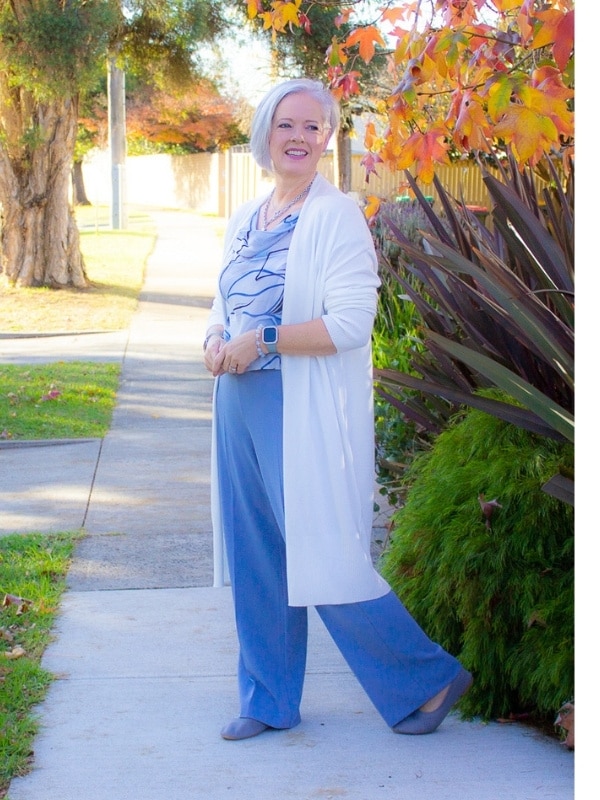 Fine wool and fine crepe are beautifully flattering, but they’re not built for a physical job. Bengaline (a fabric with a gentle stretch and a slightly ribbed texture) sits in a more interesting middle ground. It has some give, it’s more hardwearing than fine wool, and it holds its shape reasonably well. Some people love it, some don’t, but it’s worth trying.
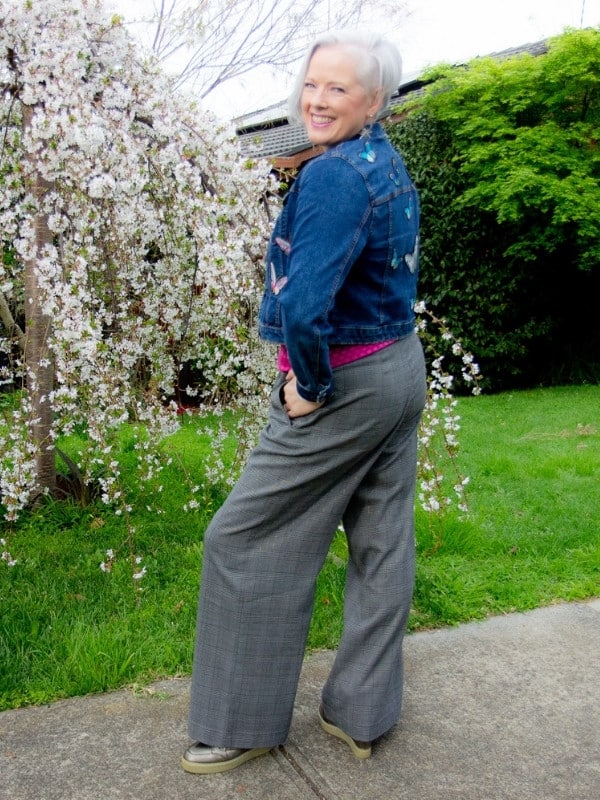
A looser fit style, wide legs, or with a pleat at the front, will make the trousers more comfortable than ones that are skin tight, even if the fabric has no stretch in it.
 3. Your Own Wardrobe Is Your Best Research Lab
Go to your wardrobe right now and pull out every pair of trousers you’ve ever felt genuinely good in. Check the care label. Write down the fibre content. Now do the same for every pair that went baggy, saggy, or clingy within a few wears. That list of fabrics to avoid is just as valuable as the list of fabrics to seek out, because your body is already telling you what works.
Make a note of the great fibre contents on your phone so you always have it with you and can compare to any pair you’re considering purchasing. That way, you know before you get them home whether the fabric has a chance of standing up to your needs and looking good while it does.
4. Colour Does Practical Work Too
If you work in a physical or messy environment, darker neutrals are your friend. A navy or charcoal trouser will absorb a marker stain with considerably more grace than a light khaki. Any medium to darker neutral will be more receding and less obvious, giving you maximum versatility, particularly if it’s in your colour palette, which means you can easily mix and match it with all your tops.
This isn’t just aesthetics, it’s genuinely functional dressing. And for stains that do make it through, laundry products designed for ink and marker are worth having in the cupboard, because a wash-and-wear fabric you can actually treat is worth infinitely more than a beautiful fabric you can’t.
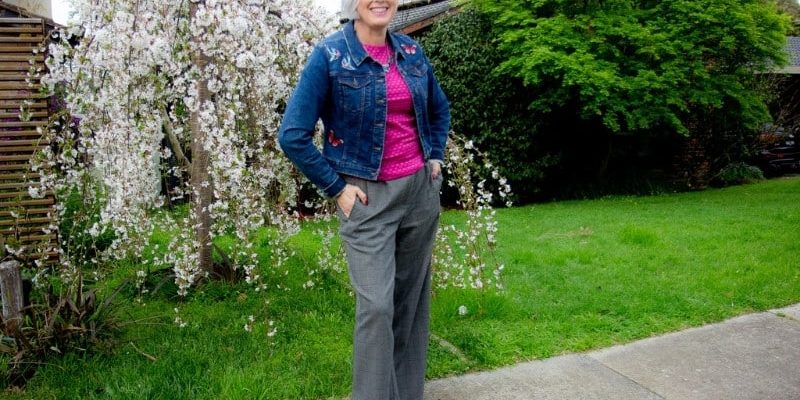
Why not consider trousers with a slight pattern (like this subtle check), as there is already a difference in colours, so a small stain will be less noticeable than on a solid coloured fabric.
 5. When You Find a Brand That Fits, Remember It
Every brand works from a pattern block, a kind of template that determines how its garments are shaped. When a brand’s block aligns with your proportions, their trousers will consistently fit you better than others. When you find that brand, it is genuinely worth noting it down, because that knowledge will save you hours of change-room suffering in the future. Sadly, sometimes their block changes and suddenly nothing fits correctly. Don’t take this as a personal failing; instead, keep on trying lots of different retailers til you find something that fits well, or if all else fails, find a dressmaker or tailor who can make you trousers to your exact measurements and specifications.
Shopping for trousers is one of those activities where the effort rarely feels proportional to the result. But knowing what you’re looking for, in terms of fabric, fit priority, and colour logic, means you can walk in with a strategy rather than just hope. And that makes the whole thing just a little less maddening.
Related Reading
How Can I Make My Current Wardrobe More Stylish? One of the most Googled Style Questions
How to Stop Buying Clothes You Never Wear (Without Guilt or Guesswork)