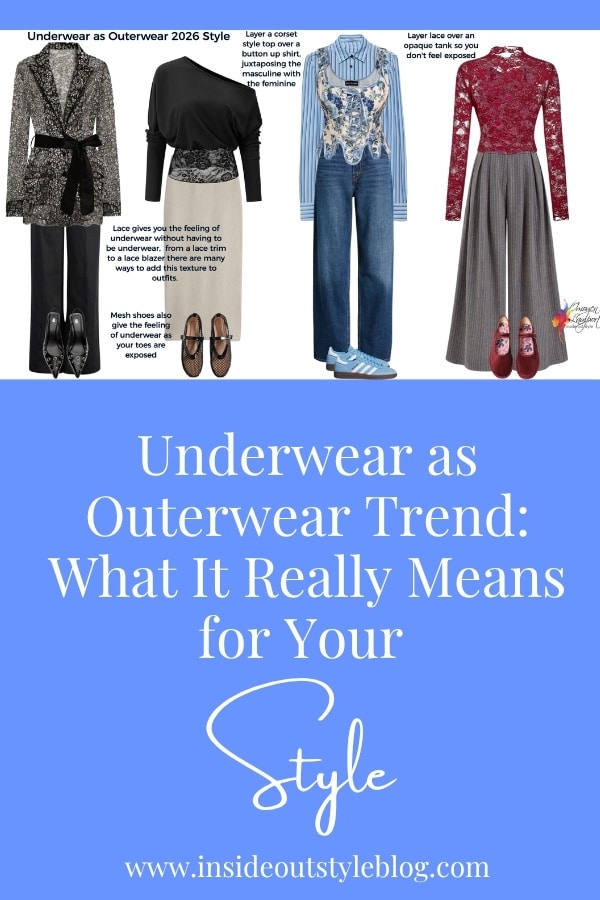



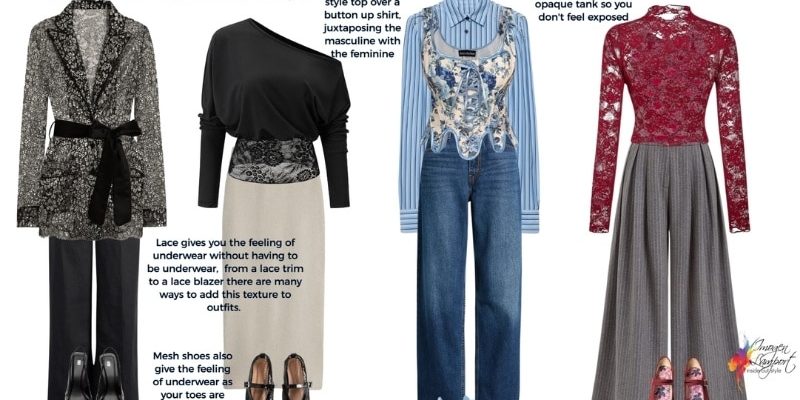




There was a moment at Australian Fashion Week 2025 where it became impossible to ignore – underwear had officially stepped out from beneath the outfit and into full view. Lace bodysuits worn as tops. Corsetry layered over shirts. Silk slips styled as dresses rather than hidden foundations.
And while it might sound like just another fleeting trend, it’s actually tapping into something much deeper about how we relate to our clothes, our bodies, and the unspoken rules we’ve been following for years.
In fact, you’re likely to be wearing regularly, if not right now, a garment that used to be classed as underwear, as outerwear, right now. The t-shirt started off its life as underwear. Jersey (stretch knit cotton) was only used as an underwear fabric for a long time until Coco Chanel brought it into fashion as outerwear. In 1917, Coco Chanel introduced the Breton shirt into her fashion collection, incorporating it into everyday wear.
View this post on Instagram

But jersey fabrics as outerwear didn’t really take off as everyday wear until after the 1950s, when James Dean posed on his Harley Davidson in jeans and a white tee. Even then, the white tee, which was still considered to be underwear, was considered quite scandalous.
View this post on Instagram
Underwear as Outerwear: What’s Really Going On?
At a surface level, the underwear-as-outerwear trend may feel bold, even provocative. Designers at Australian Fashion Week 2025 showcased lingerie-inspired pieces as everyday fashion, reframing items traditionally associated with intimacy into something visible and styled.
If you’ve lived long enough, you’ve seen it all before. The slip dress was a fashion trend popularised by Carolyn Bessette-Kennedy and Kate Moss in the late 1990s (and that era is back with us again).
View this post on Instagram
Madonna wore see-through blouses showing off her underwear back in the 1980s. So it’s not really that daring (it’s hard for me to believe that it was 40 years ago).
View this post on Instagram
But what’s interesting isn’t just the aesthetic shift – it’s the underlying mechanism driving it.
Clothing has always operated as a form of communication, whether we’re conscious of it or not. When something traditionally hidden becomes visible, it disrupts expectation. And when expectation is disrupted, attention increases. That’s the first layer.
But beneath that, there’s a deeper shift happening around ownership and self-expression. Underwear has historically been tied to external perception – designed to shape, smooth, and support the body to meet an ideal, hidden under clothes. We don’t share how much work it’s doing (think the shapewear granny pants in the original Bridget Jones’ Diary movie). Bringing it into outerwear reframes it from something corrective to something expressive. And that changes the psychological relationship entirely.
So why is 90s minimalism and the underwear as outerwear trend back in style? Some of the reasont can be attributed to the rise of GLP1s, the weight loss drugs that are changing how some women now look and the sizes they wear. The lean body is back in fashion, and the styles of Kate Moss and Carolyn Bessette-Kennedy fit their form (plus we’ve just done the 1980s, so the 1990s are the next in line.
Why This Trend Feels So Uncomfortable for Many Women
If your first reaction is hesitation rather than excitement, that’s not a failure of style confidence. It’s actually a very logical response to a clash between internalised rules and external messaging.
Most women over 40 have spent decades absorbing implicit guidelines about what is appropriate, flattering, and age-appropriate. These rules weren’t necessarily taught explicitly, but they were reinforced through media, workplaces, and social environments. So when a trend comes along that contradicts those rules, it creates cognitive dissonance.
And this is where a lot of wardrobe overwhelm actually begins. Not because there are too many clothes, but because there are too many conflicting signals about what those clothes are supposed to do.
On one hand, there’s a desire to stay current, relevant, and expressive. On the other hand, there’s a deeply ingrained instinct to avoid looking inappropriate or like you’re trying too hard. And if you haven’t got the GLP1 body, is this something you want to even consider?
The Real Question Isn’t “Should You Wear It?”
When trends like this emerge, the conversation often defaults to a yes-or-no answer. Should you wear it? Is it appropriate? Is it flattering? Should the concept of flattering even matter to you?
But those questions are actually too simplistic to be useful. Because they ignore the underlying variables that determine whether something works for you.
What matters far more is how a trend interacts with your personal style system – your colouring, your proportions, your personality, and your lifestyle. Without that context, any trend becomes either confusing or irrelevant.
This is why so many women feel like they’re constantly making the wrong choices. Not because they lack taste, but because they’ve never been given a framework to evaluate those choices. It’s the same pattern you see in why you keep wearing the same outfits – when decision-making feels uncertain, the brain defaults to what feels safe.
Reframing the Trend Through a Personal Lens
Rather than asking whether you should adopt underwear as outerwear, it’s more useful to ask what elements of the trend might align with you.
For example, the essence of this trend isn’t actually exposure; it’s softness, layering, and a shift in fabric language. Lace, silk, delicate textures, and structured corsetry all sit within a spectrum. You don’t have to go to the extreme end to engage with the idea.
This is where understanding how to make your current wardrobe more stylish becomes far more powerful than chasing new pieces. You might already have elements that echo this trend – a camisole that could be layered under a blazer, a slip dress that could be styled with knitwear, or a structured piece that adds definition.
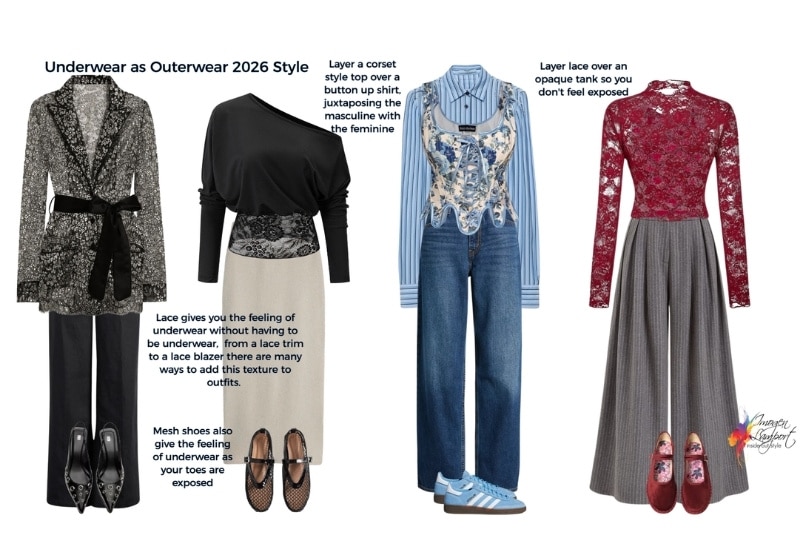 And when you approach it this way, the trend stops being something you either adopt or reject. It becomes something you interpret.
The Role of Self-Trust in Style Choices
What this trend really highlights is how much style relies on self-trust. When the external rules become less clear or are deliberately disrupted, the only reliable reference point becomes your own judgement.
For many women, this is exactly where things feel shaky. Years of relying on external guidelines can erode confidence in personal decision-making. So when those guidelines disappear, it can feel like there’s nothing to replace them.
This is often the point where a more structured approach becomes valuable. Not to impose new rules, but to rebuild the underlying system that supports decision-making. It’s the kind of clarity that sits at the heart of programs like 7 Steps to Style, where the focus isn’t on trends at all, but on understanding what works for you and why.
Because once that system is in place, trends lose their power to confuse. They simply become options.
Expression Versus Expectation
There’s also a broader cultural layer to this trend that’s worth acknowledging. Underwear as outerwear challenges long-standing ideas about modesty, visibility, and who gets to be seen.
And while that can feel empowering for some, it can feel misaligned for others. Both responses are valid. Style isn’t about forcing yourself into expression that doesn’t feel authentic; instead, why not choose expression that feels congruent with who you are now?
This is particularly relevant when navigating changes in body, identity, or lifestyle. What felt right ten or twenty (or 40) years ago may no longer resonate, and trends can sometimes highlight that gap rather than bridge it.
Which is why personal style isn’t about keeping up. It’s about staying connected.
Where This Leaves You
Trends like underwear as outerwear tend to create strong reactions, but those reactions are often more revealing than the trend itself. They highlight where there’s uncertainty, where there’s resistance, and where there might be curiosity that hasn’t quite been explored yet.
And when you look at it through that lens, the value of the trend isn’t in whether you wear it. It’s in what it reveals about your style boundaries, comfort zones, and decision-making process.
Because ultimately, style isn’t about getting it right in the eyes of fashion. It’s about understanding why something feels right, or doesn’t, for you. And once you have that clarity, trends stop being something you need to navigate carefully. They simply become part of the landscape, rather than something that defines it.
Related Reading
Inside Out and Outside In Style – Mood Illustration and Mood Enhancement Dressing
Why Style isn’t Shallow and Why Improving Your Style Gives You Greater Confidence