









“What does my clothing say about me?” is the next in the top 10 list of most Googled style questions.
Every morning, after deciding what to wear and donning your outfit, before you have said a single word, you have already made a statement. You have communicated something about who you are, what you value, how seriously you take yourself, and how you expect to be treated.
You did it with your clothes.
This is not a metaphor. It is not a motivational poster sentiment. It is the conclusion of decades of rigorous psychological and social research into how human beings process visual information about each other, and the findings are, when you sit with them, quietly extraordinary.

We are communicating constantly through what we wear. The question is never whether you are sending a message. The question is only whether you are sending the one you intend.
I can’t tell you how many people I’ve met (often at business networking events) who, when they find out what I do, say things like:
- “Nobody notices what I wear”
- “Caring about style is superficial; it’s what’s inside that counts”
- “Who would pay for that? It doesn’t matter”
Let me share with you the research about how wrong these people are (and how they are negatively affected by it without even realising it).
Fifty Milliseconds is All it Takes
In 1992, psychologists Nalini Ambady and Robert Rosenthal published research introducing the concept of “thin slices” (made well known by Malcolm Gladwell in his book Blink). The idea that human beings make remarkably accurate and remarkably durable judgments about other people from extremely brief exposures.
Subsequent research has refined this further: studies by Willis and Todorov in 2006 found that judgements of trustworthiness are formed within 100 milliseconds of seeing a face. Other research has pushed that figure even lower for overall first impressions.
Fifty milliseconds. Less than the blink of an eye.
In that fraction of a second, before your name has been spoken, before you have extended a hand, before you have offered a single word of greeting, the people you encounter have already begun constructing a narrative about you. Your competence. Your warmth. Your status. Your approachability. Your credibility.
And your clothing is doing significant work in shaping that narrative.
This is not vanity. It is neuroscience. The human brain is a pattern-recognition machine, evolved over millennia to read environmental and social cues with extraordinary speed. Clothing is one of the richest sources of social signal available to us — it communicates tribe, status, values, personality, and intention simultaneously, in a way that language, which is sequential and slow by comparison, simply cannot.
Understanding this is not about gaming the system. It is about becoming conscious of a conversation you are already having.
The Science of Enclothed Cognition
In 2012, social psychologists Hajo Adam and Adam Galinsky published a study that sent ripples through both the academic world and the popular press. They called the phenomenon they had identified “enclothed cognition”, the systematic influence that clothing has on the psychological processes of the person wearing it.
Their initial experiments focused on a white lab coat. Participants who wore a lab coat described as a doctor’s coat performed significantly better on attention-related tasks than participants who wore the same coat described as a painter’s coat, or who simply saw the coat draped over a chair. The physical garment was identical. What changed was the meaning the wearer attached to it.
The implications are significant and wide-ranging. What we wear does not just affect how others perceive us. It affects how we perceive ourselves. It changes our cognitive performance, our confidence, our behaviour, and our sense of our own capabilities.
Subsequent research has considerably extended these findings. A 2015 study by Michael Slepian and colleagues found that wearing formal clothing, even when the environment did not require it, increased abstract thinking and gave participants a greater sense of power and competence.
Research into what has been called “power dressing” has found measurable effects on negotiation outcomes, risk tolerance, and creative thinking.
You are not just dressing for the room. You are dressing for your own mind.
What you wear has power. The research proves it’s not shallow to care about what you wear.
Style as Nonverbal Language
The sociologist Fred Davis wrote in 1992 that fashion constitutes a kind of language, one with its own vocabulary, grammar, and capacity for nuance and ambiguity. But unlike spoken language, which requires a listener who shares your linguistic framework, visual communication operates across a much wider range of contexts with a much broader shared vocabulary.
We all read clothing. We may not read it consciously, or accurately, or with the sophisticated literacy of a trained image professional, but we read it. Constantly. Automatically. Involuntarily.
And we are read by others, too.
The vocabulary of this language includes things like formality signals, the presence or absence of structure, tailoring, and polish that communicate how seriously we are taking an occasion and, by extension, the people in it. It includes colour psychology, the emotional and associative weight that different colours carry, which varies somewhat across cultures but maintains significant cross-cultural consistency. It includes fit and proportion signals; a well-fitted garment communicates a degree of self-awareness and self-investment that an ill-fitting one, regardless of its price point, does not.
It includes what I think of as congruence signals, the degree to which your overall appearance hangs together as a coherent whole, telling a consistent story about a consistent person. When your appearance is congruent, when your clothes, your grooming, your posture, and your accessories are all speaking the same language, and that language is aligned with who you are, your personality and values, it creates an impression of confidence and self-possession that is enormously compelling, regardless of the specific aesthetic you have chosen.
When it is not congruent, when your appearance tells several different stories at once, or tells a story that doesn’t match the one you are trying to live, people feel it, even if they cannot articulate what they are feeling. It registers as a vague uncertainty about who you are. And uncertainty is rarely the impression we are trying to create.
The Professional Invisibility Trap
Nowhere is the gap between intended and actual communication more costly than in professional settings.
There is a particular pattern I encounter with great regularity in my work with professional women, particularly women in their forties, fifties, and sixties who have spent decades building genuine expertise and are, by any objective measure, at the peak of their capabilities. They have responded to the ambient cultural message that professional women should dress conservatively, should not draw attention to themselves through their appearance, and should err always on the side of understatement.
The result, in many cases, is a kind of professional invisibility.
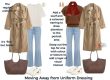
Playing it safe, the boring black pants, the safe white shirt, the deliberately unmemorable outfit, is a strategy. But it is worth being clear about what it is a strategy for. It is a strategy for avoiding notice. And not being noticed is not the same thing as being taken seriously. In fact, in many professional contexts, it is the opposite.
Research by Silvia Bellezza and colleagues at Harvard Business School found something that initially seems counterintuitive: deliberate non-conformity in professional dress, wearing something slightly unexpected within an appropriate professional context, was associated with higher perceived status and competence, not lower. The observers assumed that someone confident enough to deviate from the expected norm must have the social capital to afford that deviation.
In other words, standing out, done thoughtfully, can communicate more authority than blending in.
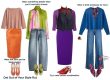
With the rise of AI comes the rise of blandness in many ways. Humans are better than machines because we bring our emotions and feelings to the table, as well as our analytical intellect. This is why someone who dresses in a way that expresses something about their personality, their point of difference, their unique view is seen as more successful and memorable. It’s because it’s more human, and being an original human in alignment with your personality, builds trust in a way that dressing in a uniform way to fit-in never will.
 The women I work with who are most invisible in their professional environments are rarely the ones who are taking bold style risks that align with their personality. They are the ones who have been so careful to not wear anything that stands out for so long that they have effectively disappeared. They have donned the cloak of invisibility, and this has negative consequences.
Dressing for Competence vs. Dressing for Connection
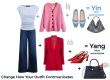
One of the most useful frameworks I use with clients is the distinction between dressing for competence and dressing for connection, because these two communication goals, while not mutually exclusive, do pull in somewhat different visual directions.
Dressing for competence emphasises signals of authority, expertise, and capability. Structure. Tailoring. Restraint. Precision. A degree of formality that communicates: I have taken this seriously, I am prepared, I know what I am doing. In contexts where you need to establish credibility quickly, a new client meeting, a speaking engagement, or a professional evaluation, these signals carry considerable weight.
Dressing for connection emphasises signals of warmth, approachability, and relatability. Softer silhouettes. More colour. Less rigidity. A degree of accessibility that communicates: I am someone you can talk to, someone who is interested in you, someone safe to approach. In contexts where relationship-building matters more than authority, team environments, client relationships built over time, and mentoring, these signals are equally valuable.
Most women default to one or the other habitually, regardless of context. The most sophisticated professional dressers understand both vocabularies and shift between them deliberately, reading the room and dressing accordingly, not from anxiety but from intelligence.
What Does Your Clothing Say About You Right Now?
This is the question I would like to leave you sitting with, and I mean it as a genuine invitation to curiosity, not as a source of anxiety.
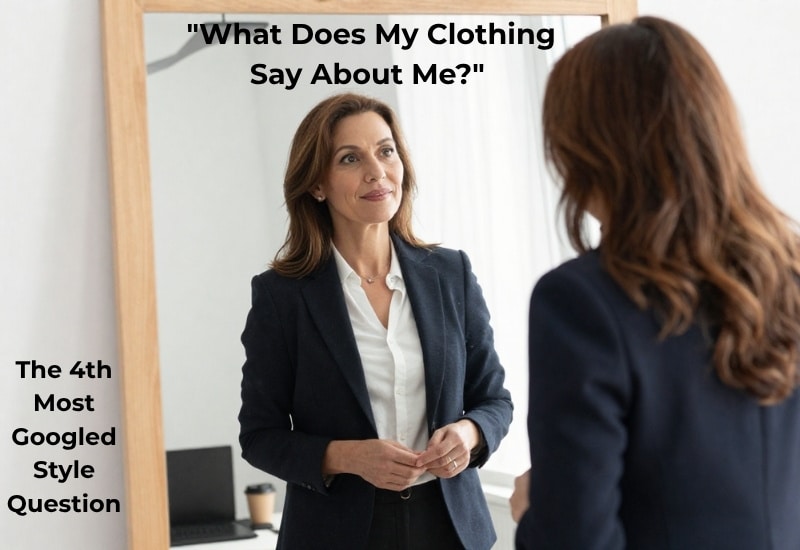
Stand in front of a mirror tomorrow morning, in what you have chosen to wear, and ask yourself: if I knew nothing about the person looking back at me except what she is wearing right now, what would I conclude? What story is she telling? What does she seem to value? How does she appear to feel about herself?
And then ask: Is that the story I want to tell?
This is not about judgment. It is not about conformity. It is not about spending more money or following more rules. It is about consciousness, about becoming aware of a communication that is already happening, and deciding whether you want to take the wheel.
Because here is what I know after two decades of this work: the women who dress most powerfully are not necessarily the ones who dress most expensively, or most trendily, or most conventionally. They are the ones who dress most intentionally. Who have taken the time to understand what they want to communicate and have developed the vocabulary to communicate it.
That vocabulary is learnable. And once you have it, getting dressed stops being an act of guesswork and becomes an act of authorship. And it’s something I teach inside my 7 Steps to Style program.
Deliberate or Accidental?
You have been communicating through your clothes every day of your adult life. The only question is whether you have been doing it deliberately or accidentally.
Deliberately is more interesting. It is more powerful. And it produces, in my experience, a particular kind of quiet confidence that has nothing to do with vanity and everything to do with self-knowledge.
You already have a voice. Your clothes are already speaking.
It might be time to decide what you want them to say.
Let’s become intentional. And let’s be more human, more individual, more personal.
Your style is speaking.
If you want to learn the skills of an image professional and have your style become more aligned, in tune and authentic, then I’d love to teach you all about it in my 7 Steps to Style program. Inside, there are modules on understanding your personality and how to express it through your clothes so they don’t feel like a costume, and on understanding the language of clothing so you’re the one in charge of how your clothes communicate. It’s a small investment that has a big impact. Find out more here.


Oh my goodness, Imogen, this has to be one of the best style posts I’ve ever read! I have been applying so much of what you’ve said to my professional life, dressing in a way that demonstrates both competence as well as approachability, a necessary combination of traits in my line of work. Thank you for fleshing out this important subject in such great detail. I bookmarked this article so I can refer back to it as needed.