








How do I dress for my body shape? is one of the most Googled questions around personal style for women. In fact, I’ve got many of the answers here on Inside Out Style if you want to find out – take my free body shape calculator quiz and download your body shape bible for the answers to this specific question, and you can dive deep into other posts here on the blog too. But I want to dig a little deeper into what may lie behind this question and why you may feel so frustrated with many body shape guides when shopping for clothes, as you are more than just a body shape.
Your Body Is Not the Problem. The Fashion Industry Is.
You walk into a fitting room with the maximum allowed of six garments. One fits if you’re super lucky. If the shopping fairy is on your side today, maybe two. The others, too tight across the shoulders, too loose at the waist, pulling at the hips, gaping at the bust, inexplicably wrong in a way you cannot even name, go back on the hanger.
And the story most women tell themselves in that moment is a story about their body.
Too big. Too small. The wrong shape. Difficult to dress. A problem to be solved.

Here is what I want you to consider instead: you just tried on six garments designed for a body that does not exist. A standardised, hypothetical, averaged body that was never yours, was never anyone’s in particular, and was designed primarily to photograph well on a sample size and hang efficiently on a retail rail.
The fitting room did not reveal a problem with your body. It revealed a problem with an industry that has been selling you a fiction for decades, and quietly, persistently, blaming you for not fitting into it.
When I shop with clients, we try on a lot of garments. On average, we might take 30 items into the change room, and will be lucky if 5 garments both fit well enough (may still need a hem altered here and there) and feel comfortable, and are a good expression of personal style. And that’s the hit rate of me, a professional shopper of over 20 years, picking the eye out of the department store, from thousands of possible garments.
How Fashion Is Actually Made
Understanding why clothes don’t fit requires understanding how clothes are made, because the process is considerably more arbitrary than most women realise.
A garment begins as a pattern, drafted to fit a standardised “block”, a set of measurements that, in theory, represents an average body within a given size. But these blocks vary significantly across brands, countries, and decades.
There is no universal standard.
The size 12 in one brand is not the size 12 in another. The “average” body the pattern was drafted for was never particularly average; it was a design decision, made in a workroom, by pattern cutters working with commercial rather than anthropological priorities.
From that block, the pattern is graded up and down to create a size range. Grading, the process of scaling a pattern between sizes, is itself a simplification. It assumes that bodies scale proportionally and uniformly across sizes, which they do not. A larger body is not simply a smaller body made bigger. The relationship between bust, waist, and hip changes. The proportions of the torso relative to the legs change. The width of the shoulders relative to the chest changes. Grading ignores all of this. This is why learning to sew is such a liberating and beneficial skill to have (which I wrote about here).
The result is a garment that fits the standardised block reasonably well, fits bodies close to the block somewhat, and fits the enormous range of actual human bodies, shorter, longer, broader, narrower, differently proportioned in a hundred different ways, with varying degrees of inadequacy.
This is not a minor technical imperfection. It is a structural feature of the industry. And for decades, the industry’s response has been to suggest, implicitly and sometimes explicitly, that the solution is for bodies to change, not patterns.
The 672+ Possible Body Variations
In my work as an image consultant, I assess each client against more than 672+ body variation factors before we discuss a single garment. Not just body shape, a concept I want to examine carefully in a moment, but specific, measurable, individual characteristics that determine how clothing will interact with a particular body.
These include vertical proportions: the length of your torso relative to your legs, the position of your natural waist, the depth of your rise, and the length of your neck. They include horizontal proportions: the width of your shoulders relative to your hips, the width of your hips relative to your waist, and whether or not you have a defined waist. And then all the other bits and pieces, your body variations, petite, average or tall, small or large bust, the shape of your calves, the fullness of your thighs or upper arms, even the length and width of your neck and the shape of your jaw. They include three-dimensional factors: how much forward projection you carry at the bust, at the seat, and at the abdomen. They include skeletal factors: whether your shoulders slope or are square, whether you have a sway back, and whether your posture creates particular fitting challenges at the upper back or the neckline.
Each of these factors influences which cuts, silhouettes, and proportions will work with your body. And each of them interacts with the others in ways that make the idea of a simple, categorical body typing system, pear, apple, hourglass, rectangle, not just inadequate, but actively misleading.
 Why Plain Body Shape Typing Fails Most Women
Many body shape systems reduce an infinite variation of human bodies to four geometric categories: Pear, Apple, Rectangle, and Hourglass, then assign prescriptive rules to each category, as though all “pear-shaped” women have the same proportions, the same height, the same colouring, the same personality, and the same lifestyle. They don’t. The category is so broad as to be almost meaningless.
There is nothing wrong with finding some body shape guidelines, but firstly, you need to know what it is that you want. For some women, body harmony is an important value; they care deeply about dressing in harmony with the body they have. For others, it’s an irrelevance, and they feel that “figure flattery” is all about body shaming (it’s not meant to be, but it can be perceived in that way)
I use a seven-shape system, and that still simplifies our bodies (but has more nuance than the typical four). Body shape guidelines are useful for understanding overall silhouette and g how to use line and design elements in your outfits, but there are so many other factors that also need to be added into this equation. Its appeal is obvious. It is simple. It is memorable. It offers a clear answer to a complicated question: find your shape, follow the rules for your shape, and dressing becomes easy.
The problem is that it doesn’t work alone. Not for most women, and not in any meaningful depth.
Here is why.
You also have body proportions, lateral body shape, a myriad of body variations, along with the scale of your body and features. All this adds up to over 672+ possible body configurations. You can see why 4 body shapes is a little stiffling (and inaccurate).
Every kind and shape of body is beautiful. Each element of your body is an asset. There are no figure flaws. How you dress those assets will depend on how you feel about them at any one time.
From Body Shame to Body Intelligence
There is a meaningful difference between dressing to hide your body and dressing to work with it, and that’s why I prefer the term body harmony over figure flattery. And that difference matters, not just aesthetically, but psychologically.
Research by Tiggemann and Lacey, and a significant body of subsequent work in the psychology of body image and clothing, has found consistent relationships between how women feel about their bodies, the strategies they employ when dressing, and their broader wellbeing and self-esteem. Women who dress primarily from a place of concealment, who approach their wardrobe as a tool for hiding or minimising, report lower body satisfaction, higher self-consciousness, and less pleasure in dressing than women who approach it from a place of enhancement and self-expression.
This is not simply a matter of body size or shape. It is a matter of orientation. Two women with identical bodies can have entirely different experiences of getting dressed, depending on whether they are asking “how do I hide this flaw?” or “how do I enhance my body?”
Body intelligence, as opposed to body shame, means understanding your body as a specific set of parameters within which your style operates. Not limitations. Not problems. Parameters. Your height, your proportions, your colouring, the way fabric moves on your particular frame, these are the given conditions of your personal style equation, and understanding them precisely and without judgement is what allows you to make genuinely good decisions about what to wear.
The difference in outcome, once a woman shifts from shame to intelligence, is remarkable. And it has nothing to do with her body changing.
This is why when I developed my Absolute Colour System and decided to name the palettes words that were not seasonal (becuase the Seasonal colour systems pull heavily from a Northern European and Northern American and very Western idea of what seasons look like), when I live in a country closer to Asia that has all manner of seaons, from Wet and Dry, to the Aboriginal’s of the Kulin Nation where I live in Melbourne, who ascribed 7 seasons to our climate. None of them looks like the traditional 4 Seasons of Northern Europe or America. Instead, because all colours are beautiful in the right context, I wanted every palette to have a name that was positive, from Exquisite to Rich, from Sophisticated to Sublime. Just as all colours are beautiful, so are all bodies.
The Principles That Actually Work
If body shape typing is too blunt an instrument, what replaces it?
The answer is a set of principles, grounded in the physics of visual perception and the geometry of the human body, that are both more precise and more universally applicable than any simple categorical system.
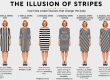
Visual line is perhaps the most powerful of these. Every garment contains lines, seams, hems, edges, patterns, and the direction of fabric grain that direct the eye. Vertical lines create visual length. Horizontal lines create visual width. Diagonal lines create movement and interest. Understanding the lines in a garment and how they interact with the lines of your body allows you to make informed decisions about what a particular piece will do for your particular silhouette, there are guidelines in body shape categories, but understanding line helps you decide for you, as an individual, exactly what you want to do.
Scale refers to the relationship between the scale of a garment’s details, pattern, print, collar, lapel, pocket, button, and the scale of your own physical features. A woman with fine, delicate features and a slight frame will be overwhelmed by a large, bold print or an oversized lapel in a way that a woman with stronger, larger features and a broader frame will not. Getting scale right is one of the simplest and most consistently overlooked principles in dressing well.
Balance, the deliberate distribution of visual weight between the upper and lower body, is the principle that body shape typing was clumsily attempting to address. It is a real and important principle. But it works differently for each individual, depending on their specific proportions, and cannot be reduced to categorical rules without losing much of its usefulness.
Fit remains, as I talked about here, the single most transformative variable in how clothing looks and feels. A garment that fits well works with your body. A garment that doesn’t fit fights it, and in that fight, your body is always blamed for losing.
Try this Quick Thought Experiment
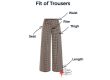
Imagine you’re out shopping with your mother, sister, 2 friends, and daughter (whatever combination of these that works for you – there are 4 of you on this imaginary shopping expedition). You go into a store, you pick out the same pair of trousers in your “size” and you go into the change rooms to try them on. . Will they fit and look good on all of you? You know the answer to this is a resounding “NO” and that’s because you can see with your own eyes, one of you has a narrower waist and broader hips, another has little waist and longer legs, the third has a sway back, and a rounded booty with short legs, and the last (but never least) has fuller thighs and tummy and is taller than the rest of you. When you think about retail clothes fitting in this way, you realise quickly that your chance of finding anything to fit is almost impossible and that it’s not your fault.
The Even Bigger Problem: Slim Women Struggle Too
One of the most revealing indicators of how broken the fashion system is comes from an unexpected direction: the women who, by the industry’s own standards, should have the easiest time finding clothes that fit.
Slim women, women who are close to the standardised sample size, are supposed to be fashion’s ideal customers. And yet they report, with consistent regularity, the same fitting frustrations as everyone else. Shoulders that are too wide. Waists that are too loose. Hemlines that hit at the wrong point on the leg. One of my modst tricky shopping trips was with a client who was a professional ballet dancer. It doesn’t matter what shape your body is, retail fashion is not making clothes to fit real humans.
Because the problem was never about being the wrong size. It was about being a specific, individual human being in a system designed for a statistical abstraction.
Every woman is, in some respect, non-standard. Every woman deviates from the block in ways that the grading process does not accommodate. And every woman, at some point, has stood in a fitting room and told herself a story about her body that was really a story about an industry’s failure to serve her.
What This Means in Practice
Understanding the structural failures of the fashion industry is not just intellectually satisfying. It changes how you shop, how you dress, and, most importantly, how you talk to yourself when you are getting dressed.
It means approaching the changing room as a researcher rather than a supplicant. You are not auditioning for the clothes. The clothes are auditioning for you. If something doesn’t fit, the question is not “what is wrong with my body?” The question is “what is wrong with this cut for my specific proportions, and is it fixable, or should I move on?”
It means developing a working knowledge of your own body’s specific characteristics, not as flaws to manage, but as data points to work with. Knowing that you have a longer torso means you should look for high-rise trousers. Knowing that your shoulders are narrower than the standard block means you know that set-in sleeves will likely gape, and raglan or dolman sleeves will serve you better. This is not complicated knowledge. It is learnable, applicable, and genuinely liberating.
It means building a relationship with a good seamstress (or learning to sew) because fit, as we have discussed, is the variable that matters most, and the fashion industry is not going to solve its fitting problem anytime soon. Alterations are not a consolation prize for women who can’t find things that fit. They are a sophisticated, intelligent response to a system that was never designed with your specific body in mind.
And it means, perhaps most fundamentally, releasing the story that your body is the problem. It never was.
The Fashion Industrial Complex is the Problem
The fashion industrial complex (the women’s apparel market is worth over $1.05 trillion) has spent decades selling women solutions to a problem it created. It made clothes that didn’t fit, told women their bodies were the reason, and then sold them shapewear, diet programmes, and styling guides designed to close the gap.
You do not need to close a gap. You need to understand your body, specifically, intelligently, without judgment, and dress it with the knowledge and intention it deserves.
Your body is not difficult to dress. It is specific. There is a profound difference between the two, and understanding it changes everything.
If you’d like my professional opinion on your body and how to dress it, you’ll get that inside my 7 Steps to Style program. It’s packed with tried and tested advice that shows you all the different things you need to know, rather than just a set of basic rules that you don’t know how to adapt to your unique being.
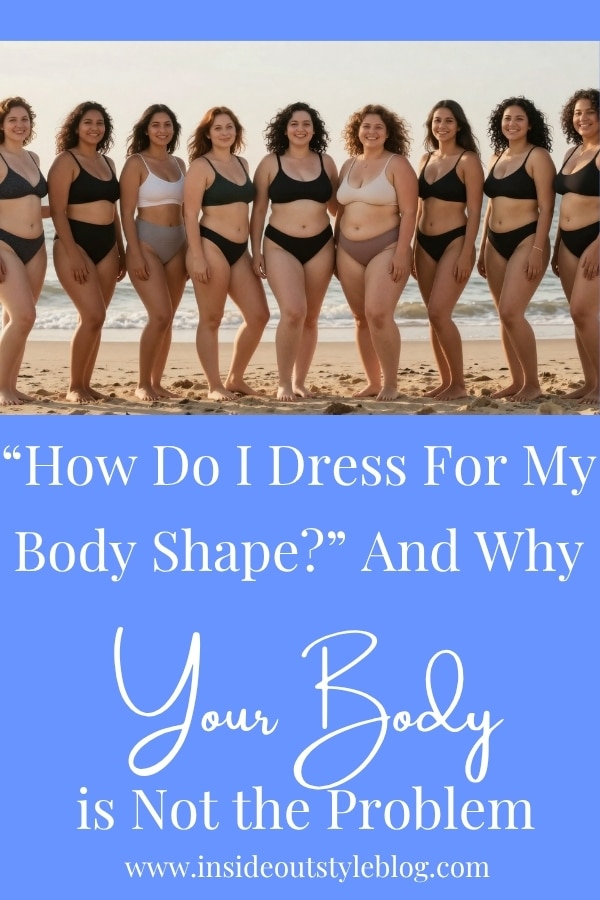
The Key to Feeling Fabulous in Your Own Skin: Decoding Your Unique Body Equation
What Guidelines to Follow When Your Body Shape isn’t “Standard”