







This Isn’t a New Palette. It’s a Smaller Working Set.
One thing worth naming before we go further: this isn’t the traditional “seasonal” colour analysis system, where you’re filed permanently under Winter or Autumn. My own framework, the Absolute Colour System, moved past that years ago in favour of eighteen palettes built on the real scientific properties of colour, undertone, intensity, value and contrast, rather than a label that pretends every woman fits neatly into one of four boxes. If you want the full story on why I made that shift, I’ve written about it in Why the Colour Analysis Has Evolved Beyond the Seasons and Personal Colour Analysis: The Hot New Old Trend.
Your undertone, intensity and value don’t pack up and change with the weather, and neither does mine. What does shift, season to season, is how much of that fifty-colour palette you actually need in rotation at once. That’s the real skill here: not choosing new colours, just narrowing the ones you already have down to a working set you’ll actually reach for. You may find in summer you want to wear more of the medium to lighter colours, and in mid-winter, the medium to darker colours.
 Maybe in summer you want to feel cooler, so reach for your blues and greens more.

 Whilst in winter, if it’s grey and cloudy, you want to feel warm and cosy, so could choose your reds, burgundies and pinks to do this for you. The choice is yours.
Start With What’s Already Working
Don’t start with a trend report or an appealing palette you found on Pinterest. Start in your own wardrobe and with your colour palette.
Pull out what you expect to actually wear over the coming months for the upcoming season: the reliable jacket, the trousers you reach for, the tops that survive a wash and still look good. Notice which colours keep turning up. Those repeats are your starting point, not a fresh, untested colour that’s never had to prove itself against your real life.
You will find that there are current colour trends available in stores. It may be that you consider what’s more easily available also as a starting point, if that’s a colour or neutral that’s great for you. If not, who cares what’s currently in stores, the speed at which retailers change their palettes means that next month something entirely new will be available.
Maybe you have a scarf that you love, that is made up from a few colours in your palette – use this as inspiration to build your season’s wardrobe around if you are starting from scratch (which can happen with weight loss or gain, or lifestyle changes).
Choose Your Anchor Neutrals
Pick two to three neutrals to be the backbone. Ideally, these neutrals will be your best ones, the ones that repeat your hair colour (or colours if you have multi-tonal hair), your eyes and possibly your skin. They are the best place to start
The only rule: they need to share an undertone with each other, which, if you have the right kind of hair colour and a colour palette, is an easy choice. A cool charcoal and a warm camel will always look like they’re having an argument, no matter how good each one is individually. And don’t default to black simply because fashion calls it neutral. Black is a cool, dark, and bright colour, so if those aren’t your colour properties, you can do much better than black.
Instead, match your hair – it might be cool beige, camel, grey or brown. Match your eyes: olive, navy, soft denim, dark camel or chocolate. These will be the colours that work hard for you and earn their keep.
Add Two or Three Signature Colours
These are the colours that are some of your very best. Pull them from your own palette and your signature colours that you’ve been given in your colour consultation; choose ones that already coordinate easily with the neutrals you just picked. Now, some seasons, different colours are more on-trend in the stores, so they are easier to find. One way to easily figure out what your best options may be (if you need to shop for something new) is to go onto a local department stores website, and search up women’s clothing, then do a filter by colour – you will discover what colours are more popular (and therefore there is more choice for you) and what is less popular and so will be harder to source (if you don’t already own them).
Choose an Accent Colour (or Two)
Want to make the outfit pop? Use the concept of a pop of colour – it’s a colour used strategically in your outfit three times; an accent colour used once looks like a mistake. Used 3 times, that accent colour looks strategic – find out more about this here. The late Brenda Kinsel called these “beauty bundles”; you can call them accents – they mean the same thing.
What’s great about using accent colours in accessories is that they really can enhance and change up an entire wardrobe. Accessories are the finishing touch; choosing them thoughtfully shows that you’re put together and can express your personality easily through accessories. They can be fun and playful, dramatic and bold, quirky and unusual, or delicate and feminine (or whatever it is that you love).
Keep the Whole Thing Small Enough to Use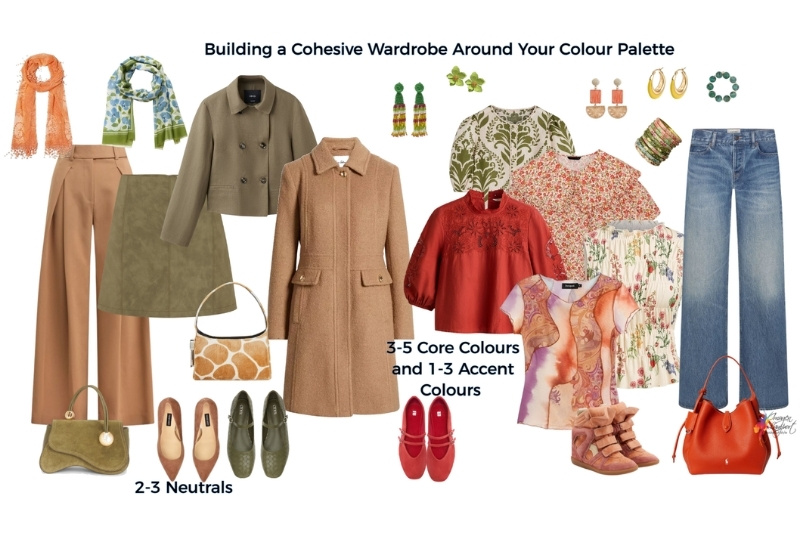
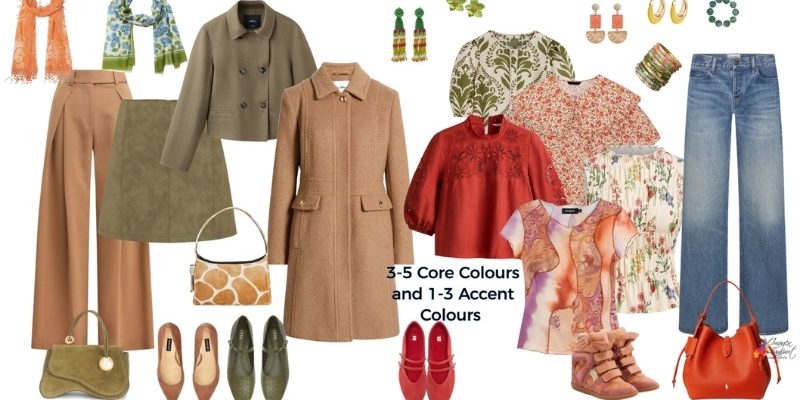
Put it together and most wardrobes land somewhere around: two neutrals, two or three signature colours, 2-5 accents. That’s it. Five to ten colours, not fifty.
That’s the real work of narrowing your colour palette: it helps reduce decision fatigue when getting dressed in the morning. And when you think about a palette for the coming season, it makes it easier to know that you have maximum versatility and lots of ability to mix and match, so you can make more outfits from fewer garments.
In the image above, the 10 garments alone, because they all work together, have an easy 48 different outfit options; that’s before we change up the accessories!
Check It Against Your Actual Calendar
A gorgeous palette that only shows up in silk blouses isn’t useful if your season is mostly spent on the school run or it’s mid-summer and just too hot to wear. Before you commit, ask what you’ll actually be doing for the next few months, and check that your chosen colours show up in the garments you’ll genuinely need, not just the ones that look great in the advertising photo.
Let It Evolve
At the end of the season, be honest with yourself. Which colours earned their place? Which one looked wonderful in theory and never left the wardrobe? That’s not failure, that’s information, and it makes the next round of narrowing your colour palette sharper than this one.
If you’d like your full fifty colours mapped clearly, undertone, intensity, value and contrast, so narrowing them down to a working seasonal set becomes obvious rather than overwhelming, my online colour analysis is where that starts. And if you want the fuller wardrobe system built on top of it, that’s inside 7 Steps to Style.
Which two or three colours from your palette have you been neglecting, and could this be their season?
Further Reading
How do I Find the Right Neutrals to Act as an Anchor for My Wardrobe?