








You’ve probably experienced this without quite naming it.
You put on an outfit that’s perfectly “fine” – good fit, flattering colour, nothing technically wrong – and yet it feels a little flat. Then, on another day, you wear something with just a hint of sheen… and suddenly everything feels more elevated. Not overdressed. Not flashy. Just… better.
More alive. More like you, on a really good day.
The Science of Subtle Shine
Here’s the thing about light-reflecting fabrics – they change how light behaves around your body. And that has a very real impact on how you’re perceived, and how you perceive yourself.

Matte fabrics absorb light. They create a flatter visual surface, which can feel grounded and understated. There’s nothing wrong with that – in fact, matte textures are incredibly useful. But when everything you wear is matte, the overall effect can lack dimension.
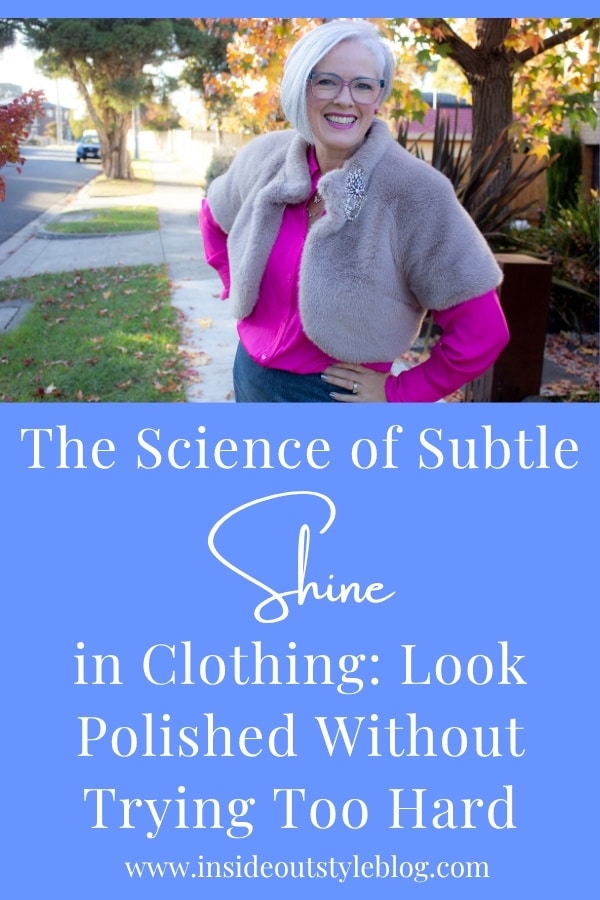
Fabrics with sheen – silk, satin, fabrics with a slight metallic thread – reflect light back into the environment. This creates variation, movement, and visual interest. And your eye reads that as depth, vitality, and subtle sophistication.
It’s not about being shiny. It’s about how the fabric interacts with light.

Sheen and shine are great in accessories – from scarves to earrings and necklaces as they grab attention, focusing attention and bringing light to your face.
Why Shine Feels “Elevated” (Without Being Over the Top)
What’s interesting here is that your brain is constantly interpreting visual cues, even if you’re not consciously aware of it. Light reflection is one of those cues.
When a fabric reflects light softly, it creates micro-contrast across the surface of the garment. That variation signals complexity and quality. It’s the difference between a flat photograph and one with depth and shadow.
And when that sits next to your face, something else happens – it can subtly enhance your skin. Light bounces upwards, softening shadows and creating a gentle luminosity. Which is why a silk blouse or a satin neckline often feels more flattering than a completely matte one, even in the same colour.
This isn’t about trends. It’s about physics and perception.
The Confidence Signal You Didn’t Realise You Were Sending
There’s also a psychological layer to this that’s worth understanding.
Highly reflective fabrics – think sequins or high-gloss finishes – tend to signal visibility and attention-seeking. That’s why they can feel “too much” for everyday wear.
But subtle shine sits in a different category. It signals intention without effort. Care without overthinking. A kind of quiet confidence.
And this matters, because what you wear influences how you feel – this is the principle of enclothed cognition. When your clothing communicates polish and presence, your brain registers that. Self-perception shifts. Behaviour follows.
So it’s not that the fabric itself gives you confidence. It reduces the internal friction between how you want to feel and how you’re presenting yourself. That alignment is what creates ease.
Why Many Women Avoid Shine (Even When They’re Drawn to It)
This is something I see time and time again, particularly with intelligent, analytical women.
There’s often an unspoken rule sitting underneath the decision-making – that anything with shine might be “too dressy”, “too noticeable”, or somehow inappropriate for everyday life. Especially in professional or practical environments.
And when you’re already navigating wardrobe overwhelm, it feels safer to default to what’s neutral and predictable.
But what’s really happening here is a form of overcorrection. In trying to avoid standing out in the wrong way, you remove the very elements that create presence and polish.
Which is often why you end up with a wardrobe that technically works… but doesn’t feel like enough.
Using Subtle Shine as a Strategic Tool
Rather than thinking of shine as a “special occasion” feature, it’s far more useful to see it as a functional element in your wardrobe.
Because when you start to look at it this way, it becomes something you can apply with intention rather than hesitation.
1. Place it where it enhances, not overwhelms
A silk blouse, a satin trim, a softly reflective scarf – these bring light towards your face, which is where you generally want visual attention. It’s a controlled way of creating focus without relying on bold colour or pattern.
I love a satin blouse, whilst keeping my bottom half in matte fabrics – as the sheen draws attention up and away from where I don’t want people to notice.
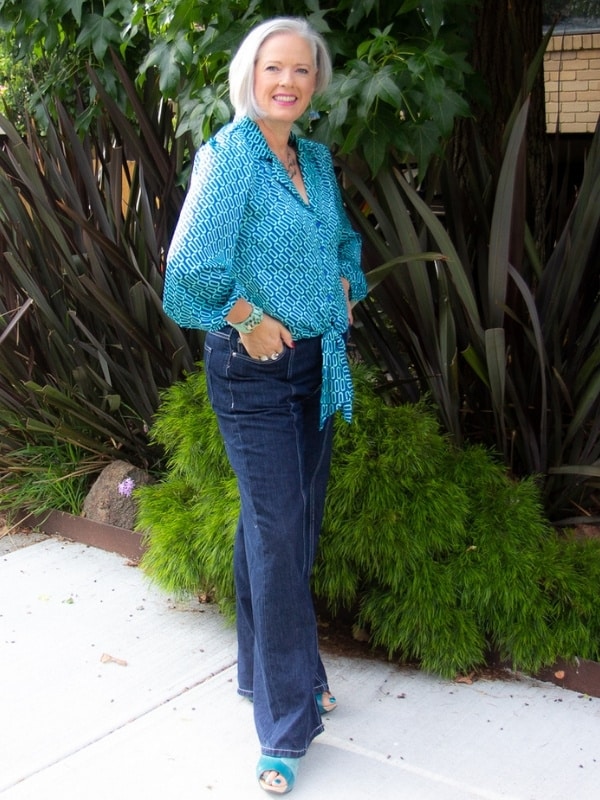 2. Balance it with matte fabrics
Shine works best when it has contrast. Pairing a satin top with a matte jacket or textured knit creates visual balance. Without that contrast, the effect can feel too uniform or, in some cases, overly formal.

3. Keep the scale subtle
This is where many women get caught. It’s not about adding more shine – it’s about adding just enough. A hint of metallic in a fabric weave will always feel more wearable than a fully reflective surface.
And this is often the difference between feeling elegant and feeling like you’ve dressed for the wrong occasion.
4. Wear it In a Relaxed Style
Consider the style of the garment. If it’s a relaxed style, like the satin bomber jacket I’m wearing, the relaxed feel of the garment balances the formality of the shine.
 Why This Often Changes Everything
When you start introducing subtle shine into your wardrobe, something quite practical happens.
Your outfits begin to require less effort to feel complete. You don’t need as many accessories or layers to create interest. The fabric itself is doing some of that work for you.
Which reduces decision fatigue – one of the biggest underlying issues in why you keep wearing the same outfits even when your wardrobe is full.
And this is often the point where women realise that the issue was never a lack of clothes. It was a lack of functional elements within those clothes.
This is also where a more structured approach can make a real difference. Inside my Evolve Your Style program, this is exactly the kind of shift we focus on – not buying more, but understanding how small changes in fabric, texture, and detail can transform how your existing wardrobe works.
It’s Not About Dressing Up – It’s About Feeling Like Yourself
What’s often sitting underneath all of this is a very simple desire.
You don’t necessarily want to be more “fashionable”. You want to feel like a more refined version of yourself. More put together. More aligned. A little bit elevated, without losing your sense of ease.
And subtle shine supports that in a very quiet, effective way.
It doesn’t demand attention. It doesn’t rely on trends. It simply shifts how light interacts with you – and how you experience yourself in your clothes.
Which is why it can feel almost transformative, even though the change itself is small.
Because when the visual signal matches how you want to feel, dressing stops being something you overthink… and starts becoming something that just works.
Related Reading
Your Ultimate Guide to Choosing the Best Fabrics for Your Clothes