









I have been asked this question so many times I could answer it in my sleep. And honestly? That tells you everything. If “business casual” were actually clear, nobody would need to ask.
Here’s the uncomfortable truth. “Business casual” and “smart casual” are not dress codes. They are dress code suggestions written by people who assumed everyone shared the same mental image. They don’t. You don’t. And that’s not your fault.
So let’s fix this properly.
Why these terms are genuinely useless
Language only works when the speaker and listener share a reference point. When your boss says “just come business casual,” she might be picturing tailored trousers and a silk blouse. You might be picturing jeans and a tee. Your colleague might be picturing chinos and a polo. All three of you said yes. None of you are wearing the same thing.
Researchers who study communication call this “illusory transparency,” the tendency to assume our meaning is clearer than it actually is (Keysar & Henly, 2002, Psychological Science). Dress codes are a perfect storm for it. The words feel specific enough to be useful but are vague enough to mean almost anything.

Add to that the fact that “business casual” was invented in the 1990s by Levi Strauss & Co. as a way to sell more casual trousers to American office workers, and you start to see the problem. It was a marketing concept masquerading as a dress standard. It was never designed to actually tell you what to wear.
What the words do actually mean, at their core
If we look at these terms structurally, they each sit on a spectrum between formal and fully relaxed. Think of it as a dial that goes from black-tie at one end to beach at the other.
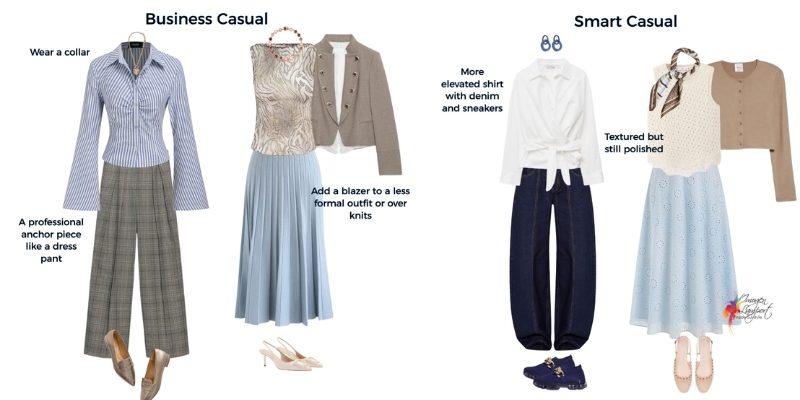
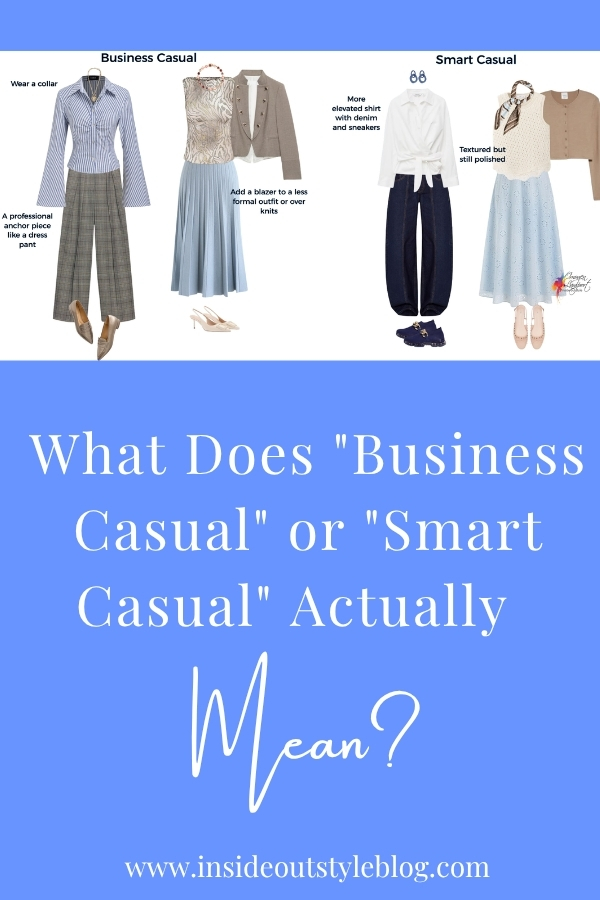
“Business casual” sits closer to the formal end. It means: the formality of a professional environment, minus the full suit. You are signalling competence and credibility. You are not signalling that you are about to attend a board meeting. Think: well-fitted trousers or a skirt (not jeans, usually), a blouse or collared shirt, a blazer, optional but often welcome, and shoes that are closed-toe and polished. The key word is “business.” The “casual” is the modifier, not the main event.
 “Smart casual” is a notch more relaxed. The key word here is “smart.” It means casual, elevated. You can wear jeans, but they need to be doing something intentional. A great-fitting dark jean or solid white jean with a structured top and a leather shoe reads very differently to mid-blue denim, distressed denim and trainers. Both are technically jeans. Only one is smart casual.
The difference between the two? About one blazer and a pair of heels.
The real framework: read the room, the industry, and the occasion
Here, I want to give you something more useful than just a list of garments.
Every dress code exists in a context, and that context tells you far more than the label. Three questions will unlock it every time.
What is the industry? A law firm’s “business casual” and a creative agency’s “business casual” are entirely different animals. Finance skews formal even when it says casual. Tech skews casual even when it says smart. Creative industries often use dress codes as creative expression. Know your sector.
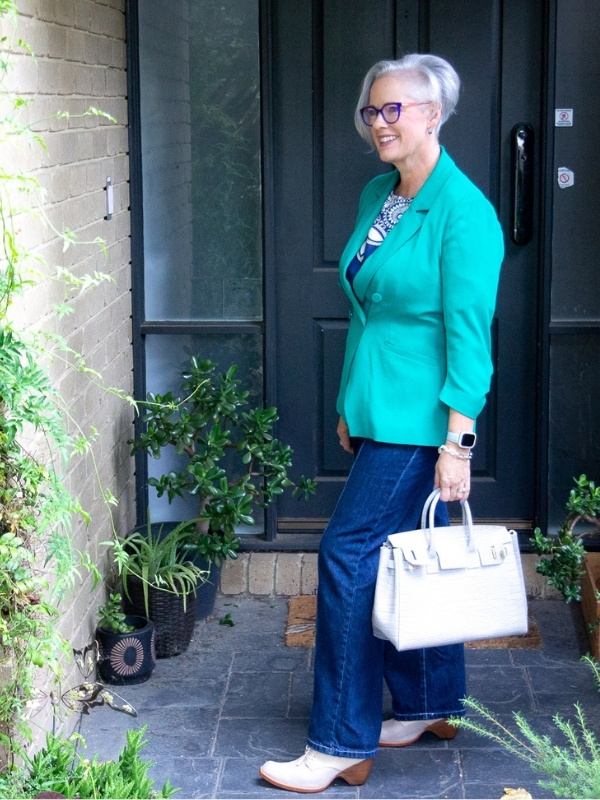
Smart casual in a more formal environment, business casual in a less formal one
Who else will be in the room? Research on social identity theory (Tajfel & Turner, 1979) shows that we instinctively use clothing to signal group membership. You are not dressing for a dress code. You are dressing to communicate something to the specific people in that room on that specific day. A client presentation calls for something different to an internal team meeting, even inside the same organisation.
What is the occasion asking of you? Are you meeting someone for the first time? Are you in a position of authority? Are you asking for something, pitching something, or representing someone? Each of these shifts the dial slightly. Enclothed cognition research (Adam & Galinsky, 2012, Journal of Experimental Social Psychology) has shown that the clothes we wear influence not just how others perceive us, but how we think and perform. Dress for the version of yourself that needs to show up, not just the room.
A practical guide you can actually use
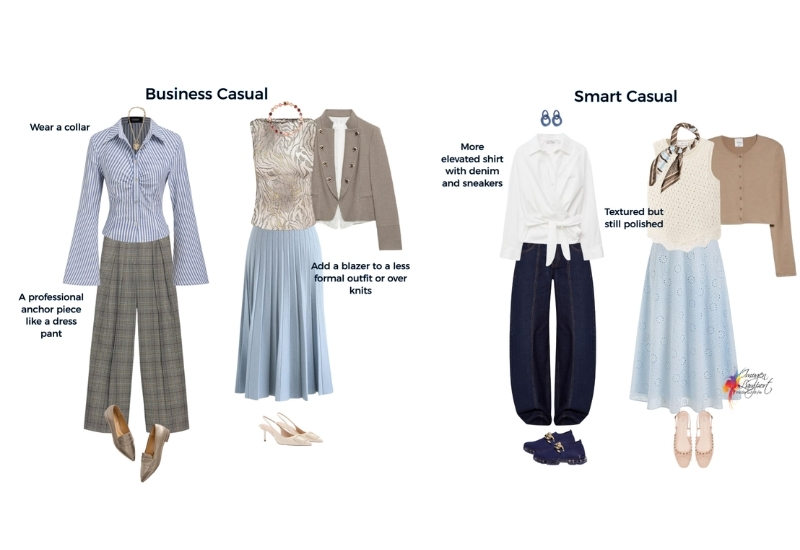 Business casual: Aim for one “professional anchor” piece in every outfit. A blazer, a tailored trouser, a structured dress, a collared shirt or blouse, a quality leather shoe. Build around that anchor with items that are clean, well-fitted, and intentional. Avoid anything that reads as purely leisure: gym fabrics, distressed denim, visible logos on cheaper brands, overly casual footwear.
Smart casual: One elevated element lifts the whole look. Dark jeans or white jeans work if everything else is doing its job. Trainers can work if they are leather or minimal and the rest of the outfit is polished. The test is simple: could you walk into a nice restaurant and feel appropriately dressed? If yes, you’re there.

smart casual, not business casual
Both codes: Fit is everything. A perfectly fitted simple outfit will always read as more intentional than a more expensive but poorly fitted one. Research on first impressions (Willis & Todorov, 2006, Psychological Science) suggests we form a competence judgment within 100 milliseconds of seeing someone. Fit and grooming are doing a lot of that heavy lifting before you say a single word.
The line I want you to remember
Dress codes are not rules. They are starting points for a conversation between you, your context, and your audience. When in doubt, check in.
“Business casual” and “smart casual” are not trying to tell you exactly what to wear. They are trying to tell you roughly where to land on the dial between formal and relaxed. Your job is to read the rest of the cues, know your industry, know your occasion, and then dress like you meant it.
Because the people who always look great in ambiguous dress codes? They are not better at following rules. They are better at reading rooms.




This wedding says “dressy casual”. I guess that’s not diamonds but maybe pearls? Probably not linen but not silk? This is hard.