






Have you ever put on a “wardrobe essential” and thought: why does this look so wrong on me?
Not slightly off. Not just-not-your-style. Fundamentally, inexplicably wrong.
Maybe it’s that essential white tee (that you can never find quite the right version of, and you just feel frumpy wearing it).
If that’s happened to you, I’d put money on what came next. You started wondering if you were the problem. Maybe your body is awkward. Maybe you just don’t have the eye for this.
Here’s what I want you to hear: you are not the problem.

The problem is a fashion industry built on the idea that one template can work for every woman. And that idea is, frankly, a bit of a fantasy.
Why standard sizing was never really about you
Fashion runs on standardisation. Standard sizes, standard proportions, standard cuts (such as deep armholes to fit the maximum number of arms into). From a manufacturing perspective, this makes perfect sense. You can’t produce clothes at scale if you’re designing for every individual body.
But here’s the thing. Women’s bodies are not standard.
We vary in height, bone structure, the way our weight is distributed, and the way our bodies change across a lifetime. Two women who wear the same size can have completely different proportions and need completely different cuts to feel comfortable and like themselves.
I always remember trying on the same dress as a friend, we were the same height, similar weight and wore the same size. And even though we both could get on the same dress, on her it looked great… on me, I felt like I looked like the side of a house because it just wasn’t designed for my shape.
The system wasn’t designed with you in mind. It was designed with efficiency in mind. Those are very different things.
When clothes don’t fit, we blame ourselves
This is the part that really bothers me.
When a dress pulls in one place and gaps in another, or trousers sit strangely no matter how many pairs you try, the instinct is to assume something is wrong with your body. But clothing is designed. Design can be flawed. The dress isn’t failing because of you. It’s failing because it was never cut for your particular combination of proportions.
I was in the changing room of a jeans store, trying on some jeans, and in my head, my mental conversation went something like this:
“Imogen, you’ve got to lay off the pies; nothing ever fits right”
And then I heard from down the way a man saying to a sales assistant, “Can you get me some other styles, there’s something wrong with these jeans”.
And it stopped me in my tracks. I thought, “He’s right, and I’m wrong. There is nothing wrong with my body. They didn’t come and take my measurements and make these jeans specifically for me. It’s not me that’s wrong, it’s the jeans.”
Once you start seeing it that way, something genuinely shifts. You stop trying to wrestle yourself into clothes that weren’t made for you, and you start asking better questions about the clothes themselves.
Size and shape are not the same thing
This is one of the most useful distinctions I can give you.
Size tells you a bit about the measurements of a garment, but it’s not consistent across brands, let alone different stores. Size may give you an idea of how much fabric has been used to create that garment. Shape tells you how that fabric is distributed. Which is why you can try on two items in exactly the same size and have a completely different experience in each one. One skims beautifully. The other feels like it was cut for a different person entirely. Because it probably was.
Plus, the same garment made from different fabrics can behave and look completely differently. Fabric is such an important part of garment choice.
Understanding your own proportions, rather than chasing a size label, is one of the most practical shifts you can make. It moves you from “why doesn’t this work?” to “this wasn’t cut for my shape” or “it’s not the right kind of fabric for me” and that’s a much more solvable problem.
“Flattering rules” are generalisations
You’ve heard them. Wear this shape if you’re pear-shaped. Avoid horizontal stripes. Choose a pointed-toe shoe if you want to look longer.
There is nothing essentially wrong with following some of this information in deciding what to wear. The trouble is, these rules are built on broad generalisations. They don’t account for your specific combination of height, proportions, colouring, or the way you carry yourself. They’re designed to apply to as many people as possible, which means they’re not really designed for anyone in particular.
Even the “avoid horizontal stripes” rule doesn’t take into account the width of the stripes; some act like fences (broadening) and a few act like ladders (lengthening). It’s just you have to know the difference.
Following the rules doesn’t quite work. Breaking them feels risky. You end up stuck in the middle, which is exactly where most style frustration lives.
The answer isn’t better rules. It’s a better understanding of you.
Personal style is personal for an actual reason
When you stop looking for a universal solution and start developing your own framework, your wardrobe gets much simpler to manage.
Your body is unique, you need to take what works from body shape, proportions and variations, along with all the other pieces of the style puzzle and put them together into a set of guidelines for you.
This means thinking beyond body shape to include your lifestyle, your preferences, how you want to feel in your clothes, and what you’re actually going to wear on a Tuesday morning when you’re running late. It also means giving yourself permission to choose what works for you, even when it’s not what the magazines are calling essential right now. And it’s important to remember that the magazines are telling you what you should own because it makes them money with their advertisers, not because it’s in your best interests.
If you’ve ever felt like you’re trying to build a wardrobe from advice that was clearly written for someone else, you’re not imagining it. You probably were.
Let’s Talk About Those Fashion Staples Every Stylish Wardrobe Is Supposed to Need
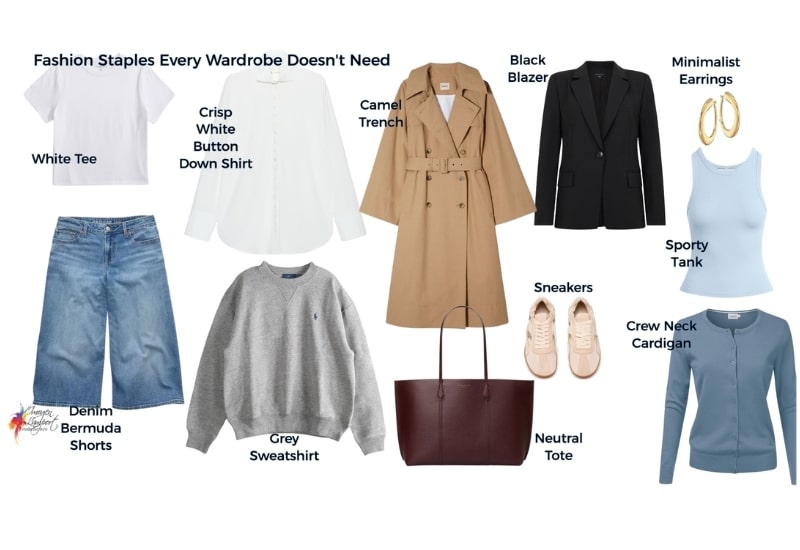
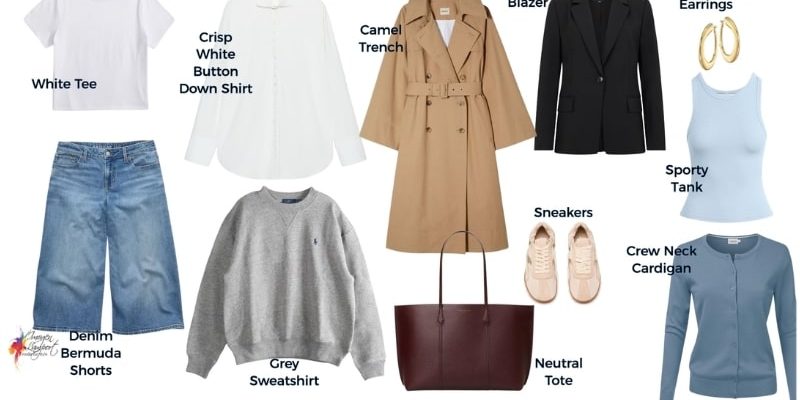
After a super brief search on the internet, I came across a myriad of sites with ubiquitous lists of the “fashion staples/trends that every wardrobe needs for this season/year”, and I do disagree.
There is no one list of garments that suits everyone.
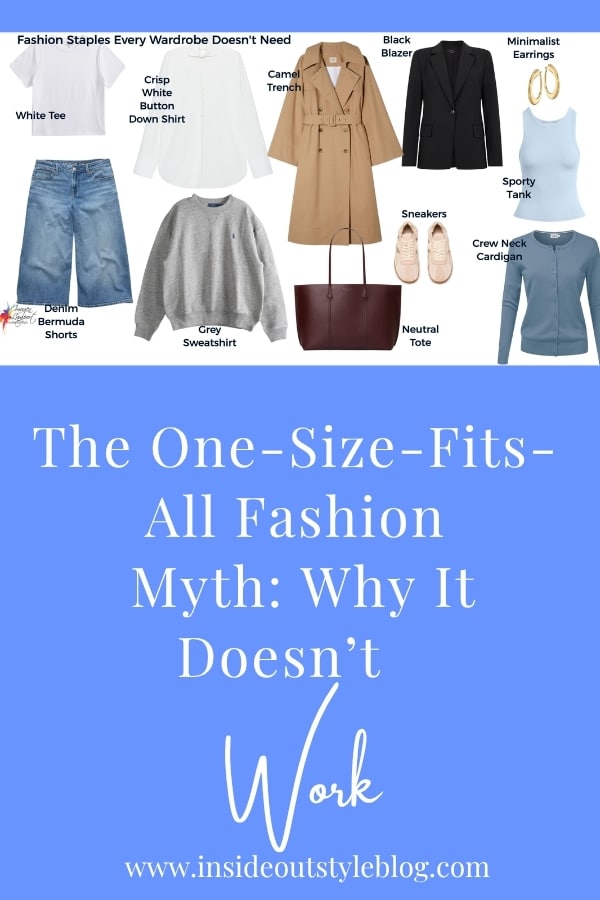
You don’t need to own a white tee, crisp white shirt, a black blazer, black pants, a crew neck cardigan, or any of the other items that I saw recommended as being essentials in every stylish wardrobe.
Now, if you love any of these garments, they suit you, they work for your personality, body, colouring and lifestyle, then absolutely they have a valuable place in your wardrobe. But that’s because they are your personal style.
I can’t tell you how many crisp white shirts I’ve seen in women’s wardrobes over the years that never get worn. They are bought because we’re told we should own one. But they are often a waste of money. If white is not a great colour on you, you may feel washed out in that white shirt. Or maybe that crisp fabric makes you feel uncomfortable. Maybe you just hate ironing, and that crisp white shirt doesn’t feel like “work” to you. There are so many reasons why any of these garments shouldn’t be an automatic “buy” for a stylish wardrobe.
In fact, I don’t own 90% of these so-called wardrobe essentials because they don’t relate to my personal style. I do own a white button-up shirt, but it’s not your traditional one that is always recommended.

Here’s my version of the white button down shirt,, it has big fancy sleeves with pintucking and bows and all sorts of fun. It’s so far from the basic version always recommended.
That’s because not all of us need basics (read my post here about non-boring basics to see if they are right for you).
The industry is changing, but slowly
There’s more awareness now around the need for inclusivity in fashion. More brands are extending their size ranges and experimenting with different fits, which is genuinely positive.
But real inclusivity isn’t just about size. It’s about proportions, shapes, and the vast variation in how women are actually built. Until designing for that variation becomes standard practice, the most useful thing you can do is develop your own eye for what works for your body.
What changes when you stop trying to fit the mould
There’s a quiet confidence that comes from realising the clothes and the advice were the problem, not you.
Your shopping becomes more intentional because you know what you’re looking for. Getting dressed becomes simpler because you’ve stopped second-guessing yourself against a checklist that was never meant for you. And your wardrobe starts to feel like it belongs to you, rather than like a collection of things that almost work.
If you want to take that further, 7 Steps to Style is where I help you build exactly this kind of personal understanding, your proportions, your preferences, and a way of dressing that actually fits your life.
Because style was never supposed to be about fitting into someone else’s system. It was supposed to be about building your own.
Related Reading
Why Living with a 3D Body in a 2D Fashion World Makes Shopping Such a Nightmare