






“I’ve Retired, But My Casual Clothes Are Still Boring”
A reader recently asked me a question I hear all the time from women who’ve just left the working world behind: after years of dressing for business, how do I actually express my personal style now that “casual” is all I need?
You don’t even need to be retired to find the answer to this question of value, as often a work wardrobe is the easy part to sort out, whilst the casual feels lacking.
How to Bring Personal Style Back Into Your Everyday Casual Wardrobe
Here’s the honest answer. It’s not that your casual clothes are wrong. It’s that they’re nondescript. Plain trousers, plain tops, safe neutrals, nothing that says anything about you. And that makes sense. When you spend decades dressing for meetings and boardrooms, your wardrobe gets trained to disappear into the background. The trouble is, once you retire, that background is all you’ve got left to wear, and it was never designed to carry your personality on its own.

So let’s fix that. Not by throwing your wardrobe out and starting again (please don’t), but by working through the three places personality actually lives in clothing: pattern, colour and the finishing details.
Start by working out what pattern you actually like
This is the bit most people skip, because “I don’t really do pattern” feels like a personality trait rather than a habit you fell into. But pattern is one of the fastest ways to add interest to an outfit, and there are far more options than florals versus stripes. I can’t tell you how many clients I’ve shopped with who tell me that they don’t wear prints, but then will pick up a garment they like the look of that is a print. They just didn’t know how to describe that print to me (and they still may wear more solids, but do have some prints, particularly in scarves or smaller garments, not their pants or jackets.
Ask yourself honestly which of these you’re drawn to: stripes, checks, animal print, florals, abstract prints, wearable art, or graphic prints. Not which one you think you “should” like. Which one makes you stop scrolling or stop in a shop. That’s the one worth building around.
You don’t need to wear pattern head to toe. One patterned piece- a scarf, a shirt, a bag- does the job of announcing “an interesting person lives here” far more effectively than another plain T-shirt ever will.
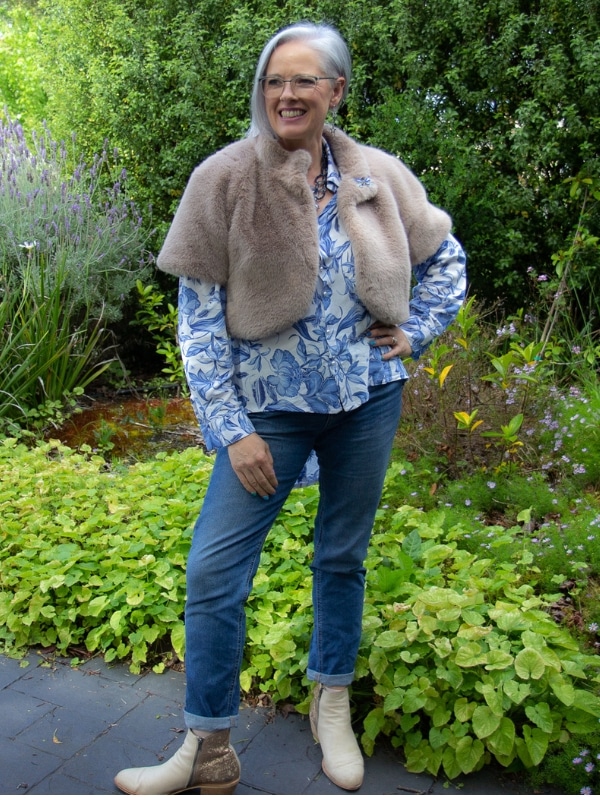
Notice how instead of a plain white shirt in my outfit above, teh blue and white floral makes it that much more interesting. Then I’ve layered a faux fur bolero over the top (normally something most people would save for a wedding or fancy event, but I use those items in my everyday casual. Then the boots, see there is a decorative detail on the backs above the heel? That’s the reason I bought them.
Let colour back into the picture
So much of the time, people default to black, beige and other neutrals head to toe because it feels safe. And it is safe. Safe also becomes boring, fast, especially when it’s the only trick in the book.
You don’t need to overhaul your whole wardrobe in one go. Start by asking, can I add some colour here? Can I bring in an accessory in a shade that actually suits me? This is where knowing your own colouring, your undertone, your intensity, your natural contrast, pays off, because colour that’s right for you does more work than colour chosen at random ever will. Not sure of your palette? Get your colour analysis with me here and find out all the good stuff!
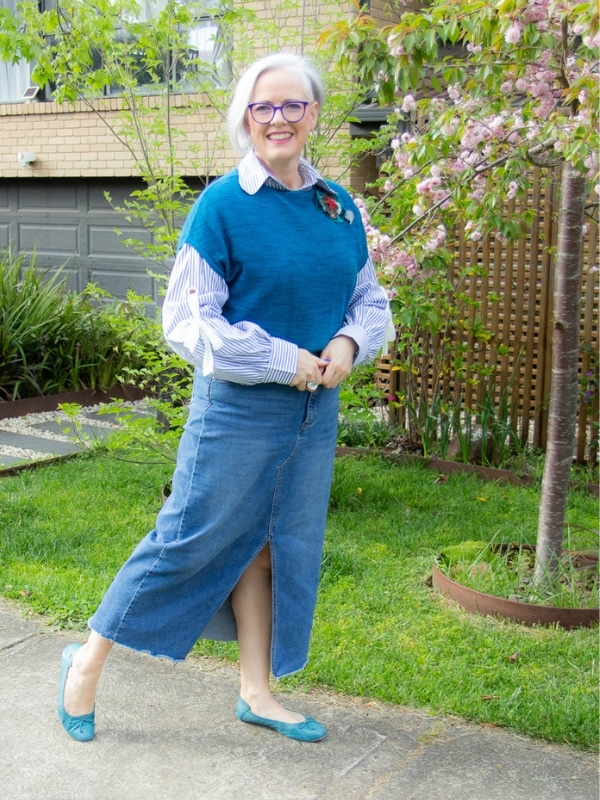
My denim skirt is pretty plain, but adding a blue and white striped shirt (that has a fun bow detail at the elbow) then layering a short sleeve teal knit and my teal ballet flats adds a textural element. Then my brooch which has a pop of red in the centre creates the finishing touch and colour pop.
The finishing touch is doing more than you think
This is the detail most people underestimate, and it’s the one I lean on hardest myself. A pair of earrings. Interesting glasses. One quirky little thing that has nothing to do with functionality and everything to do with personality.
Take my boots. Flat, plain, entirely sensible boots, the kind that could quite happily disappear into anyone’s wardrobe. What sold me on them was a small design detail on the heel, done in rose gold. They actually came in beige, which is what most people buy, but I painted mine silver instead. The rose gold detail stayed. Still comfortable, still practical, still exactly as wearable as the beige pair. Just more me.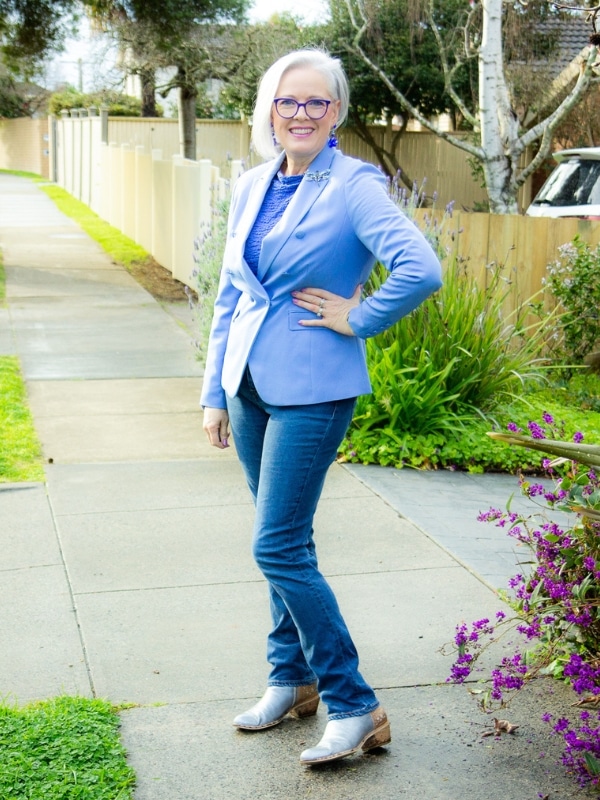
You saw these boots above when they were beige, and here they are silver, to match my silver hair. I’ve used a coloured blazer and textural knit to elevate the jeans into something a bit smarter.
That’s the whole exercise, really. Find the one detail in a piece that makes it yours, rather than a piece that could belong to anyone.
There’s a reasonable body of psychology behind why this works, not just how it feels. Researchers Hajo Adam and Adam Galinsky coined the term “enclothed cognition” to describe how the clothes we wear don’t just change how others see us, they change how we think about ourselves while wearing them (Adam & Galinsky, 2012, Journal of Experimental Social Psychology). Their original lab coat experiment got enormous attention, though it’s worth saying a later replication attempt didn’t fully hold up, so I’d treat the specific numbers lightly rather than as settled science. What does seem to hold, both in the research and in twenty years of watching women get dressed, is the broader idea: a deliberate detail changes how you carry an outfit. That part isn’t in question.
Small upgrades lift the whole outfit
You don’t need to reinvent your basics to make this work. Today I’m wearing a jumper, shirt and jeans with those boots. On paper, that’s about as practical and unremarkable as an outfit gets. But a collared shirt or blouse instead of a plain t-shirt lifts things instantly. A collar elevates. It’s a small structural change that reads as “put together” rather than “grabbed from the drawer.”
The other trick I use constantly is a jacket. Not the old-fashioned office jacket pulled out of a suit you no longer need, but something with a bit of colour or texture that you can throw on over almost anything. I’m always on the hunt for jackets that are comfortable and practical but not standard corporate-style blazers, because that’s what elevates a casual look without tipping it into “corporate.”
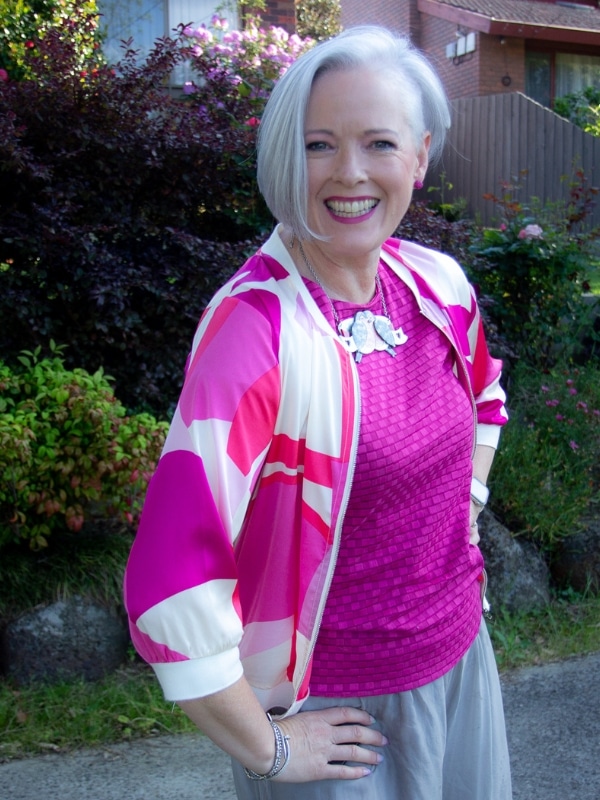
Here’s another jacket example: it’s a soft, lightweight bomber-style jacket in a geometric print that tones with the pink (and textured) tee, plus, of course, a statement necklace. Still comfortable, still casual, but more interesting and stylish.
The bigger picture: build your style recipe
All of this- pattern, colour, detail- sits inside a bigger question, which is: what suits your body now, what suits your lifestyle now, and who are you now? Your life has changed. Retirement is exactly the kind of shift that means your style needs updating to match, because it always will, at every stage.
This is what I call a style recipe, and it’s genuinely the best starting point for working out what belongs in your wardrobe next. I’ve written a fair bit about building one, and I go into real depth on it in my free Rediscover Your Style masterclass, if you want the full walkthrough.
Next step: pick one thing this week; each day, select a pattern, a colour, a single accessory, and try bringing it into an outfit you’d normally leave plain. See how it feels.
6 Things to Look for When Choosing Dresses and Skirts for Relaxed and Casual Environments
8 Ways to Look Stylish in a Casual Environment when Jeans are Not Your Thing