









We’ve all grown up with dolls, celebrities, and media ideals quietly whispering (or sometimes shouting) what the “ideal” body should look like. And for many generations, Barbie – with her impossibly long legs, tiny waist, and perfect proportions – has set a standard that’s not just unrealistic… it’s physically impossible.
But don’t take my word for it. Let’s take a look at the data….
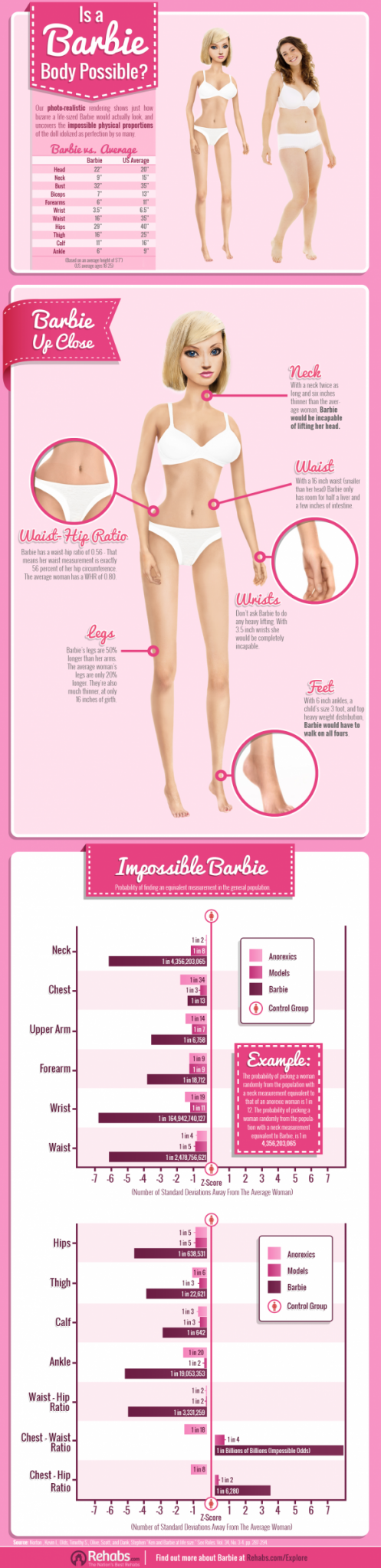
Image Source
This image comparison (from Rehabs.com) overlays the hypothetical measurements of a real-life woman with Barbie’s proportions. Spoiler: Barbie would have to walk on all fours to function – her proportions simply couldn’t support her in the real world.
What the Barbie Myth Teaches Us (And Why It’s So Harmful)
Barbie’s body sends a very specific – and subtly dangerous – message: that beauty = extreme thinness, long legs, large bust, tiny waist, and zero body fat. And even if you’ve long grown out of dolls, that message lingers in the fashion industry, pop culture, and even dressing room mirrors.

Here’s what this idealisation can lead to:
-
Body dissatisfaction (even in healthy, strong women)
-
Unrealistic expectations about weight, height, and proportions
-
Shame-based dressing, where you try to hide rather than celebrate your body
The Real Problem? The Fashion Industry Still Designs for Barbie
Mass-market fashion still favours Barbie-esque proportions. Think long torsos, straight hips, small busts, and tall frames. Sound familiar?
If you’re petite, curvy, have a shorter waist, a longer rise, or wider hips… chances are you’ve struggled to find clothes that actually fit. And it’s not because your body is wrong – it’s because the industry’s fit models still align with that outdated, hyper-unrealistic standard.
Here’s the Truth I Want You to Know:
-
Bodies come in beautiful, functional, diverse shapes. You’re not defective if your proportions don’t match a mass-produced standard.
-
Fit is a technical issue, not a personal failure. If off-the-rack clothes don’t work, it’s the clothes that need changing – not you.
-
You can look stylish, put-together, and powerful at any size, age, or shape. But it starts with understanding your body, not comparing it to a plastic fantasy.






I knew she was a little unrealistic, but I didn’t realise how unrealistic. Rachel x
Applause for posting this! Thank you. So important.
I’m surprised that the average women has the same waist measurement as her bust. Surely this is an error and they are both not 35″ as listed here?
That 35″ waist seemed strange to me, so I looked it up and the average American woman does indeed have a 35″ waist. While I think we can all agree that Barbie is unrealistically proportioned, it is a fact that the “average”American woman is getting pretty hefty these days. The average woman in the 1950s was 5’3″, had a 25″ waist, weighed 120 and wore a size 8 (equivalent to a size 0 or 2 in today’s sizes), whereas today the average American woman is 5’4″, weighs 145, and has a 35” waist and wears a size 12 (size 16 or 18 in 1950s sizes. We are a little taller and much wider these days, but I am not convinced it is Barbie’s fault.