








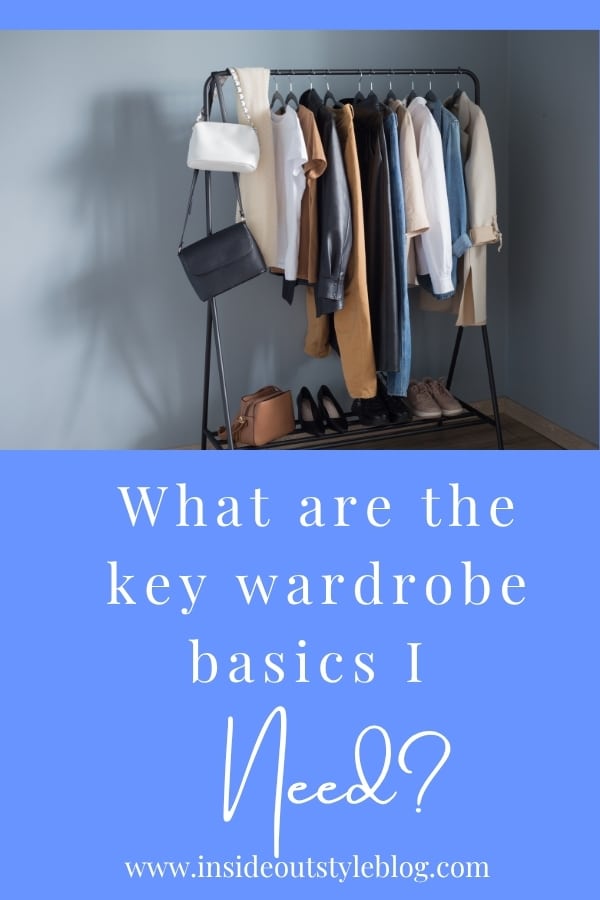
What are the key wardrobe basics I need?
Type this question into Google and you’ll get the same answer fifty times over: a white shirt, dark jeans, a trench coat, a little black dress, nude heels. Pin it, buy it, you’re sorted.
Except you’re not, because that list was written for nobody in particular. It assumes you have somewhere to wear a trench coat. It assumes black actually suits you. It assumes “basic” means the same thing for a primary school teacher as it does for someone who works from home in their pyjamas until 11am as well as a woman in a boardroom chairing a meeting.
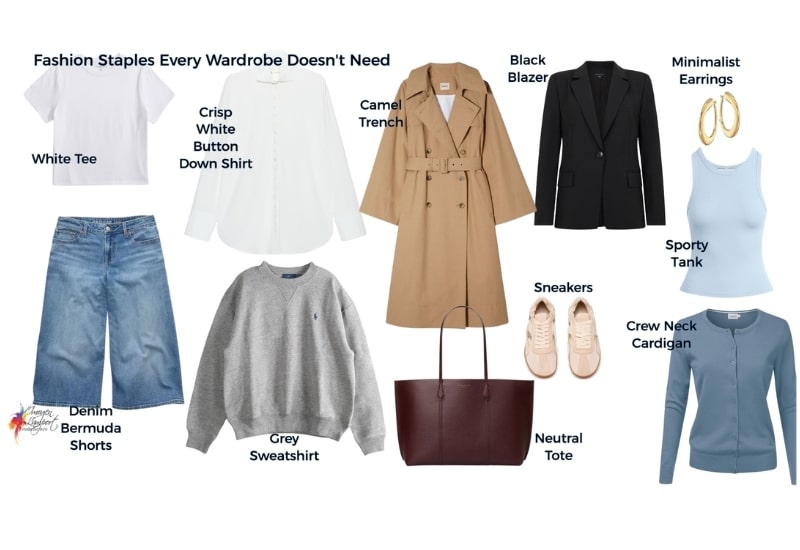 So let’s bin the list and ask a better question. Not “what are the basics” but “what makes something a basic, for me”.
The myth: basics are universal
A basic is just a piece that works hard. It mixes easily, it doesn’t date, it earns its place. That’s the whole definition. Nothing in there says it has to be a white shirt. For someone who lives in trainers and never irons anything, a crisp white shirt isn’t a basic, it’s a chore that lives at the back of the wardrobe making you feel guilty.

Your basics are the small number of pieces that quietly do most of the work in your actual life, not in an idealised version of it. I like to think of wardrobe basics as your core pieces – the workhorses that you wear with lots of other garments that add the interest, the personality and your own version of pizzazz.
Some people need core items that are more “basic” and plain, others prefer core items with more personality and interest.
Why fewer, better-chosen pieces actually work
There’s good reason this approach beats the generic list, beyond it just feeling nicer. Back in 2000, researchers Iyengar and Lepper ran a now-famous experiment in a California supermarket, setting up a jam tasting table that sometimes offered six flavours and sometimes twenty-four. The huge selection drew more browsers, but only 3% of them bought anything. The smaller, curated selection converted at ten times that rate, and the people who bought from it were more satisfied with their choice afterwards.
Your wardrobe works the same way. A rail crammed with forty “maybe” items doesn’t make getting dressed easier, it makes it harder, because every morning becomes its own mini supermarket of indecision. (Worth saying, later researchers found this effect isn’t universal, it depends on context. But the core idea holds for wardrobes specifically: a smaller set of pieces you trust beats a sprawling set you’re constantly deciding between.)
This is why a small, well-chosen selection of core garments that work with your colouring, that make your body feel great as well as look it, beats a stuffed wardrobe of a million not-so-great garments every time, not because minimalism is morally superior, but because it removes friction.
So what actually decides your basics or core wardrobe garments?
Five things, and they all talk to each other rather than sitting in separate boxes.
Lifestyle. This is the practical filter and it goes first, because no amount of styling logic survives contact with real life. If 80% of your week is spent in meetings, on the school run, or behind a laptop, your basics need to flex through all of it. If you genuinely need a trench coat once a year for the one day that it’s not hot or super cold when you need a much warmer coat, it’s not a basic, it’s an occasion piece, and that’s fine.
Body. Not “what’s flattering” in the abstract, but what fits your body and proportions without a fight. A basic you have to constantly adjust, tug, or apologise for isn’t doing its job, however classic it’s supposed to be. The right trouser shape for your body may be nigh on impossible to find (as pants are notoriously hard to fit garment, instead you may find skirts work better, or you prefer a simple dress that you can add interesting jackets over for variety. This is why some common basics like a pair of dress pants may be frustrating non-starter but for for someone built differently an essential core wardrobe item.
Colouring. A neutral isn’t automatically a basic for everyone. Black is the textbook “basic” colour, but for some colouring it drains the face rather than grounding an outfit. Your basics should be in colours that make your skin look alive, not ones that just happen to be culturally agreed as “safe” or on trend. This is why I recommend that you choose neutrals that reflect your hair, eye and skin colours – as they are today (not what they were 20 years ago). This way you’re creating harmony with your current appearance.
Personality. This is the one people skip, and it’s why so many capsule wardrobes get built and then quietly ignored. If you’re naturally a bit bold and a bit loud, a wardrobe built entirely from muted neutrals will feel like a costume, not like you. Maybe you love soft feminine pieces, rather than a classic blazer, you may prefer a cardigan with a flowing or frilled collar. If you’re creative and quirky then a moto jacket may be more your vibe than the classic blazer. And if you’re dominantly relaxed, a blazer may feel like a straight-jacket and you’d much prefer a bomber jackrt or a sweater of some sort. Your basics need to be pieces you’d actually reach for, not pieces you think you should want.
Personal preference. Underneath all the frameworks, you still get a vote. If you hate the way wool feels, a wool basic is never going to earn its keep, no matter how “correct” it is on paper. Maybe you hate ironing so that cotton tee or shirt which needs ironing to look smart isn’t for you. For me, most items that are plain, are just too plain for me. They have to have some colour, pattern, tetxture or interesting construction (apart from my jeans, but even then… I like a little personal detail).
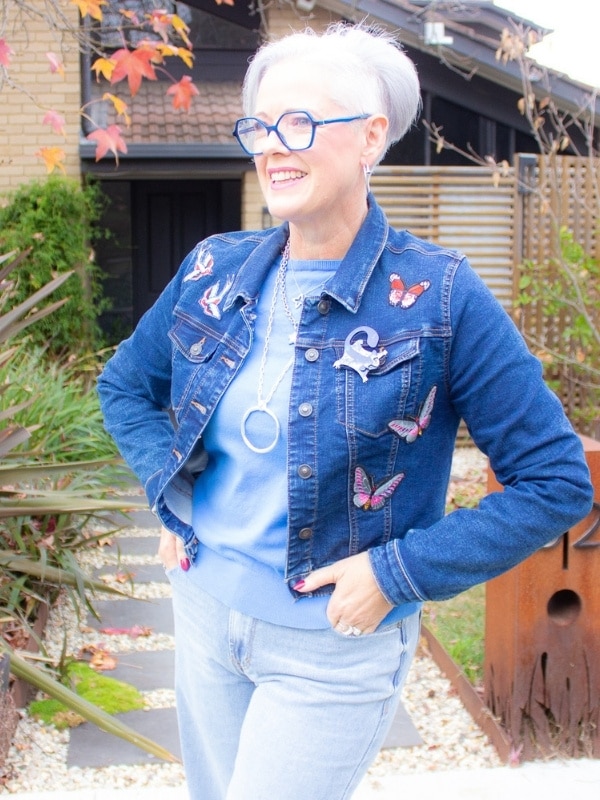
A denim jacket like the one I’m wearing in the pic above, may be a common basic, but they don’t have to be plain if that’s not your style.
Look through what you love and do wear, and notice what it is that you love about those garments. This will give you a filter with which to consider any new “basics” that my need to come into your wardrobbe. As much as a wardrobe of hero garments is fun, they don’t always all work together, and you may need those core pieces to create stylish outfits that scream your personal style.
How to actually figure out yours
Start small. Look at the things you already reach for again and again, the ones that survive every wardrobe clear-out without a second thought. That pattern is data. It’s telling you, in real terms, what already fits your lifestyle, body, colouring, personality and preferences, because you’ve already voted with your hands.
Then ask, for each one: why does this work? Is it the cut, the colour, the fact it goes with everything, the fact it’s comfortable for an entire day? Once you know why something earns its place, you can go looking for more pieces that share that quality, rather than copying a list built for a stranger.
That’s the real shortcut. Not fewer choices for the sake of it, but fewer, right choices, so that getting dressed stops being a daily negotiation and starts being something you don’t have to think about at all.
If you read all that and thought “great, but I still don’t know my colouring, my body shape, or whether I’m actually a bold dresser pretending to be minimalist”, that’s exactly the gap my 7 Steps to Style programme closes. Instead of guessing your way through five different factors on your own, I walk you through each one in order, so by the end you’re not building a wardrobe from a generic list, you’re building it from a clear, personal blueprint. You’ll know precisely which colours make your skin glow, which shapes work with your body rather than against it, and how to dress in a way that actually feels like you. No more buying “basics” that sit in the wardrobe unworn. Just clothes that earn their place, every time.



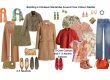

“For someone who (…) never irons anything, a crisp white shirt isn’t a basic, it’s a chore”
Laughing out loud and feeling seen. 🙂