






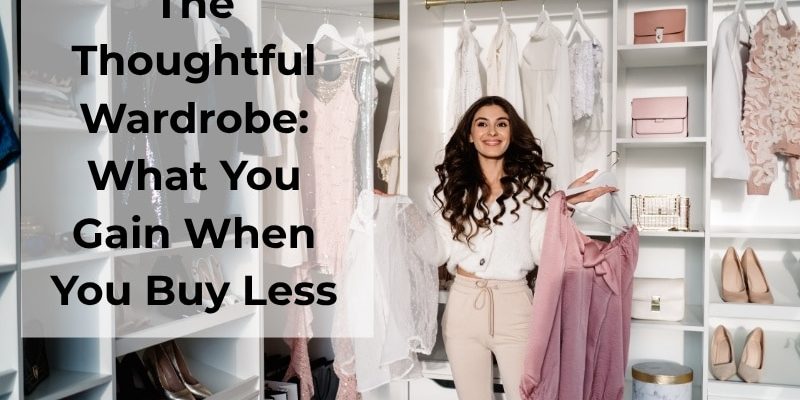




You don’t actually need more clothes.
What you need is a wardrobe that works harder for you. A wardrobe full of clothes that work seamlessly together, rather than separate outfits that you can’t split.
Because more clothes rarely solve the problem. They usually make it harder to see all your options, even though having those clothes makes you feel like you have more options.
And once you start looking at your wardrobe through that lens, not as a collection of items, but as a system that either supports or drains you, something shifts. Your decisions become easier. Your mornings become quieter. And interestingly, you often find yourself buying less, not because you’re trying to be disciplined, but because you simply don’t need as much.


You don’t need more clothes, you need the right ones that you love to wear in many ways
Why Buying More Doesn’t Solve the Problem
Unless you’re an exception and have a super limited wardrobe, or nothing in your current wardrobe fits your current body. Your lifestyle or location has radically changed. Or everything is falling apart. Most wardrobes aren’t underfilled. They’re under-functioning.
What I see time and time again is women who have plenty of clothing, yet still experience wardrobe overwhelm. Not because they lack options, but because too many of those options don’t align with their colouring, their proportions, or their life.
And when that happens, decision fatigue increases. Every outfit becomes a small problem to solve. Every morning requires energy that could be used elsewhere. So the natural response is to buy something new, hoping it will simplify things.
But unless that purchase is aligned with a clear system, it usually just adds another variable into an already complex equation.

The joy of a palette is that it’s easy to mix and match your clothes, and dress them up and down
Cost-Per-Wear as a Diagnostic Tool
Cost-per-wear is often talked about as a budgeting concept. Spend more on quality, wear it more often, and get better value.
But that’s only the surface level.
What’s more interesting is what cost-per-wear reveals about how well your wardrobe is functioning. Because when an item is rarely worn, it’s not just about money being wasted. It’s a signal. Something about that garment doesn’t integrate with your personal style or lifestyle.
Once you start looking at your wardrobe this way, you’ll usually see it immediately, the small group of pieces doing most of the work, and the rest quietly sitting on the sidelines.
It might be that the colour is not quite working with your natural colouring. It might be the cut not sitting comfortably on your body. Or it might simply not fit into your real lifestyle, despite looking right in theory.
So when you start buying more thoughtfully, cost-per-wear naturally improves. Not because you’re trying to optimise it, but because each piece has a clearer role within your wardrobe system. It earns its place by being usable, repeatable, and easy to style.

The cost per wear of this skirt is low, as I can dress it up for summer and winter
The Cognitive Load of Too Many Choices
There’s a mental cost to a cluttered wardrobe that often goes unspoken.
Every extra item that doesn’t quite work increases cognitive load. It adds another decision point, another moment of hesitation. Multiply that across an entire wardrobe, and you begin to see why getting dressed can feel surprisingly exhausting.
This is also why many women fall into the pattern of why they keep wearing the same outfits. It’s not laziness. It’s efficiency. The brain naturally defaults to what is easiest and most reliable.
And when you reduce your wardrobe to pieces that consistently work, decision fatigue decreases. The process of getting dressed becomes faster, calmer, and far more intuitive.
You’re not thinking harder. You’re thinking less.
Enclothed Cognition and the Subtle Shift in Confidence
This is where the psychology becomes particularly interesting.
Enclothed cognition, the way clothing influences how we think and feel, isn’t about dramatic transformation. It’s about the cumulative effect. When you consistently wear clothes that align with who you are, your internal state adjusts accordingly.
Your posture changes slightly. Your communication becomes more direct. Your sense of presence becomes more grounded.
And importantly, this isn’t about “dressing confidently” as an external performance. It’s about reducing internal friction. When your clothing supports you, rather than distracting or undermining you, your cognitive resources are freed up for more important things.
This is why a thoughtful wardrobe often leads to increased confidence. Not because something magical happens, but because the small, constant drain on your attention is removed.
Personal style is just that, personal. Your style should be a reflection of your personality and function for your lifestyle. What it doesn’t need to be is a copy of someone else’s style. All those fashion trends and micro-trends – quiet luxury, clean girl, poetcore, as examples, unless they do reflect your personality, won’t ever make you feel stylish.
When you define your personal style, following your own style recipe, one that you decide rather than the fashion industry, you can then start curating your wardrobe in a thoughtful way, buying only pieces that will feel and look great. Rather than buying more of what the fashion industry is selling you as a “must have”, but doesn’t end up being worn because it’s not really you. This is why you have clothes but still feel like you have nothing to wear.

How many ways can you dress up or down your garments?
Time Saved Is Energy Gained
One of the most overlooked benefits of buying less is time.
Less time shopping. Less time returning items that didn’t work. Less time standing in front of your wardrobe trying to make something come together.
But more importantly, it’s not just about time saved. It’s about energy preserved.
Every decision you don’t have to make is energy you can redirect elsewhere, into your work, your relationships, or simply into having a clearer head at the start of the day.
And when your wardrobe becomes predictable in a positive way, reliable, consistent, easy, it stops competing for your attention.
What a Thoughtful Wardrobe Actually Looks Like
A thoughtful wardrobe isn’t minimalist in a strict sense, unless that’s what you want. It’s personal, and it’s functional. It might have a lot of variety, if that’s what your personality craves, but each piece is considered and curated, rather than bought impulsively or because “it’ll do”, which are the two words that should never precede a clothing purchase.
Instead, each piece has a role. Each item integrates with others. There’s a level of cohesion that allows outfits to come together without effort.
This is also where how to make your current wardrobe more stylish becomes a much more useful question than “what should I buy next?” Because often, the raw materials are already there. They just haven’t been organised in a way that supports ease.
And this is often the point where women realise they don’t need more clothes. They need a way to apply what they already know in a practical, consistent way. This is exactly where something like Evolve Your Style becomes useful as a structured way to start using your wardrobe differently, day by day and experimenting with what you already have.
When you have a colour palette to work with, you’ll also find it much easier to ignore 90% of the clothes in stores, not be distracted by them, as you know that they won’t be making you look healthy and vibrant, as the colour is wrong. Plus, what you do have will work more easily together, so the decision fatigue of figuring out which colours work together dissipates.
My Thoughtful Wardrobe in Action
One of the ways I ensure that my garments are versatile and can be dressed up or down easily, like the silver skirt in all the photos in this blog post, is to not buy overly casual clothing. I consider the fabric, as well as the style and construction, in my choices. This silver skirt is a little dressy, but I’m happy to dress it down with sneakers and a sweater (first pic) put it with a denim jacket, or dress it up with a satin blouse (last picture).
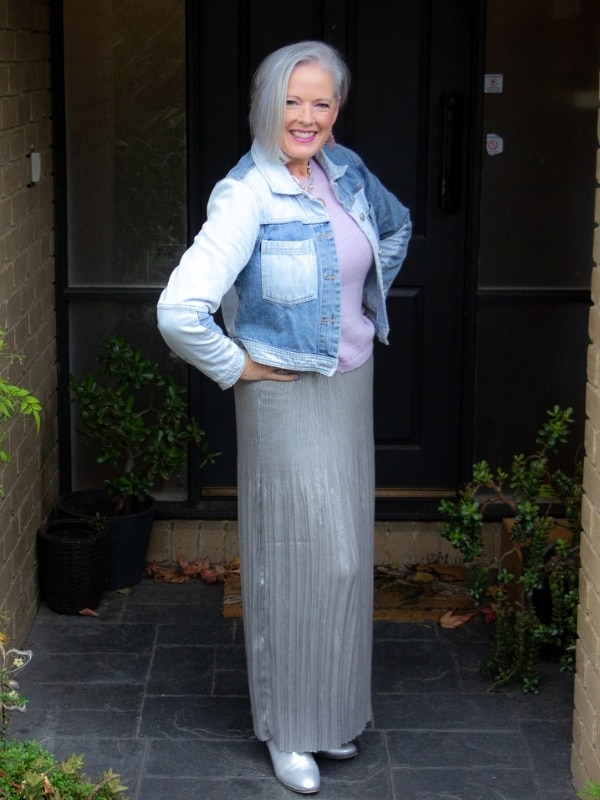
I can dress this skirt up for winter – thick tights underneath and cashmere sweater and a jacket in winter
Because silver is a fabulous neutral for me (it matches my hair, and your hair colour makes a perfect neutral to base your wardrobe around), it means that all my colours work easily and harmoniously with it. I don’t have to try hard to create lots of different outfits from the same piece which is why this skirt has become such a great core item in my wardrobe. Yet it’s also a reflection of my personality and my style.
When I think about my style recipe – which when I follow my E³ formula – my empowerment word is Glamorous (silver and sheen), my ease word is Functional (it’s stretchy and comfortable and doesn’t need ironing or any kind of special care, plus it’s transseasonal, I can dress it up and down for winter and summer), and my expression word is Individualist (not everyone is wearing a silver skirt, plus I like to add my own individual bit of quirk to every outfit – from silver boots, to embellished denim jacket, handmade by me crochet top, and unique jewellery pieces).
Why Buying Less Leads to More
It sounds slightly counterintuitive at first.
Buying less feels like a restriction. But in reality, it creates expansion. More clarity in your choices. More consistency in your outfits. More confidence in how you present yourself.
Because when each item in your wardrobe is chosen with intention, the system starts to support you rather than work against you.
And that’s really the shift. Moving from a wardrobe that demands effort to one that reduces it.
When all your colours work together, you need fewer garments to make more outfit combinations.
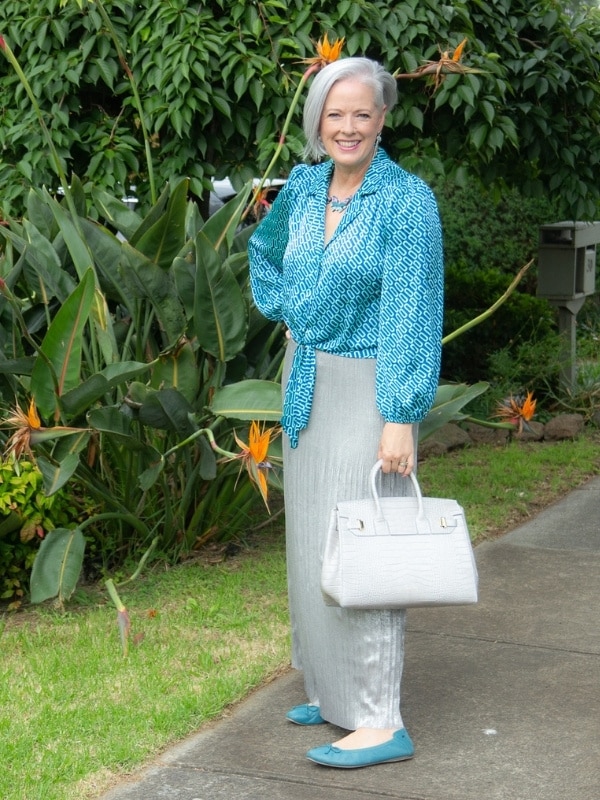
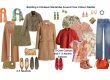
Choosing your best neutrals then having a palette of colours that go with them makes your wardrobe more versatile
A Different Way of Thinking About Your Wardrobe
When you start to see your wardrobe as a system, one that either increases or decreases decision fatigue, either supports or disrupts your sense of self, the idea of buying less stops feeling like a constraint.
It becomes a form of refinement.
In my experience, now that I have a wardrobe full of clothes that easily work together, that work for my lifestyle and express my personality, it’s only when I see something truly different from what I own, or a replacement for a favourite that’s wearing out, that I decide to buy.
Not about having less for the sake of it, but about having what works. What integrates. What reflects who you are now.
And when that alignment is there, you don’t just save money. You gain clarity, energy, and a quiet kind of confidence that comes from knowing things simply work.
Which, more often than not, is what you were looking for all along.
If you’d like to experiment more with what you already have in your wardrobe, to see if you really do need more, or if you’re just overlooking fabulous garments and outfits because you haven’t tried them before, I’d recommend that you try Evolve Your Style, as it’s based on neuroscience to help you move your style into one that feels more personal and to help you wear more of your wardrobe, more of the time, plus it will assist you to weed out what’s not working. Plus, many participants have described it as life-changing. Find out more here.
Related Reading
Inside Out and Outside In Style – Mood Illustration and Mood Enhancement Dressing
Why Style isn’t Shallow and Why Improving Your Style Gives You Greater Confidence





Another brilliant piece! “What’s more interesting is what cost-per-wear reveals about how well your wardrobe is functioning. Because when an item is rarely worn, it’s not just about money being wasted. It’s a signal.” Genius! Bookmarking this article as well. This concept is what truly transformed my wardrobe. I have next to zero decision fatigue in the mornings now, because every piece of clothing works with each other, and they all work for me! Bonus, not being a slave to the latest trends and fads. I only incorporate what works for me and is congruent with everything I already own. Thanks Imogen! 🙂