






The Psychology of Dressing
“Dress for the job you want, not the job you have.” It’s one of those phrases that’s been repeated so often it’s lost most of its meaning, filed away with other bits of advice nobody quite believes any more. Which is a shame, because there’s genuine psychology behind it, and it’s a good deal more interesting than “look smart and you’ll feel smart.” Though, that, too, has some great research backing it.
 The Lab Coat That Changed the Research
In 2012, researchers Hajo Adam and Adam Galinsky ran an experiment that’s since become one of the most talked-about findings in the psychology of clothing. They had people wear a plain white lab coat while doing a test that measured focus and attention. The group in lab coats made about half as many errors as the group without one.
Here’s the twist that makes the study worth remembering rather than just repeating. In a follow-up, they told one group the coat belonged to a doctor, and another group the identical coat belonged to a painter. Only the “doctor’s coat” group showed the improvement. Same coat. Same fabric. Completely different effect, because what changed wasn’t the clothing; it was what the clothing meant to the person wearing it.
Psychologists now call this enclothed cognition, and the short version is genuinely useful. Clothing changes how your brain performs, but only when you’re physically wearing it and it carries real symbolic meaning for you. Not one or the other. Both, at once.

The Superman Effect
Fashion psychologist Karen Pine took this somewhere slightly less clinical. In her research, university students who put on a Superman T-shirt rated themselves as more likeable and believed themselves to be physically stronger than students in a plain shirt. Nobody actually got stronger. What changed was what the shirt symbolised, and that symbolism was enough to shift how people carried themselves.
This is where I think a lot of “power dressing” advice goes slightly wrong. It assumes any blazer will do, any sharp trouser suit, borrowed wholesale from whoever looks most authoritative on the internet. But if that borrowed power suit doesn’t actually mean anything to you, the enclothed cognition research suggests it won’t do nearly as much work as something built from your own creative fingerprint, the colours, shapes and details that genuinely feel like the strongest version of you.
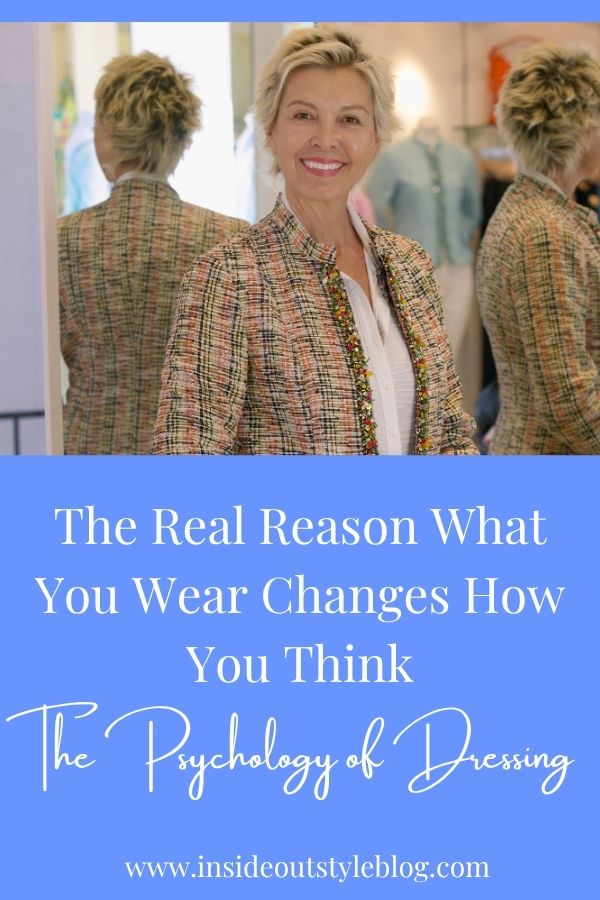
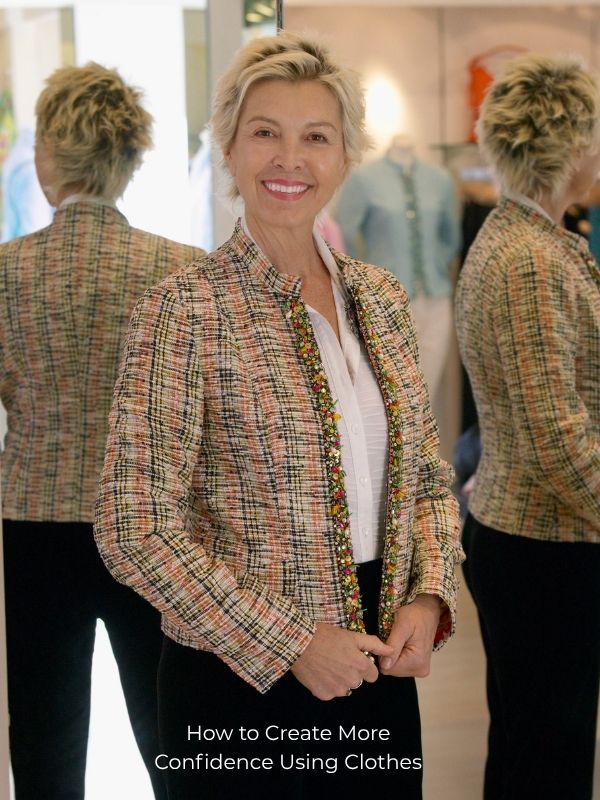
I love a blazer to make my outfit feel smarter, but it’s not going to be a black one or one that looks like it comes from a suit. It’s likely to be in a bolder colour or even a pastel one at times. But the structure of it, even if it’s patterned, like the one above, gives it that more elevated feel.
Making This Practical, Not Just Interesting
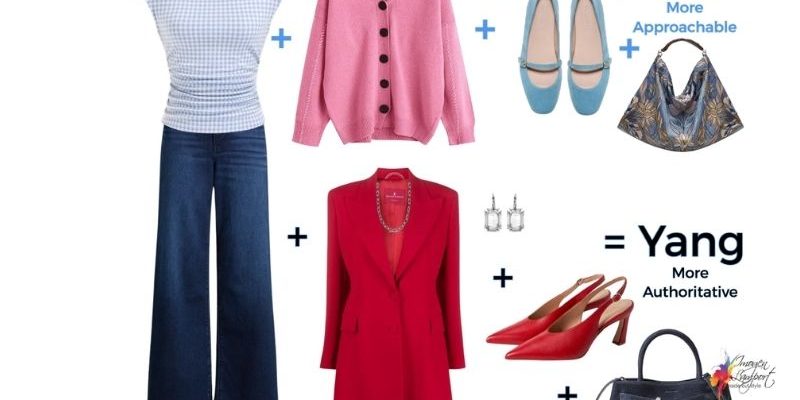
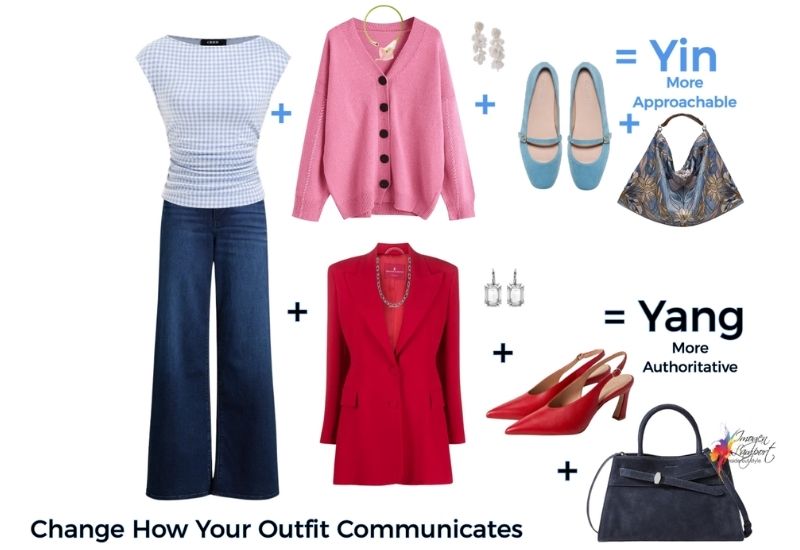
This is exactly how the Yin and Yang framework makes this practical and applicable to your wardrobe. Yin elements are the receding, softer, more approachable end of the spectrum: curved lines, softer textures, gentler colour contrast. Yang elements are the advancing, structured, more authoritative end: straight lines, solid shapes, higher contrast.
You already know, instinctively, which end you need on any given day. The useful part is knowing which specific pieces in your own wardrobe pull you toward which end, so you can reach for them on purpose. Need to walk into a room and be taken seriously? Lean into your yang. Need to put someone at ease in a difficult conversation? Lean into your yin. That’s enclothed cognition, made personal and entirely usable, rather than one lab coat trying to do the job for everyone.
 Seven Symbolic Dressing Experiments for This Week
The point isn’t to dress differently for the sake of it. It’s to notice, deliberately, which choices actually shift how you feel, so you can keep using the ones that work.
- Choose one yang element for your next high-stakes moment. A structured blazer, a solid, strong colour, a sharper shoe- whatever from your own wardrobe reads as authoritative to you specifically.
- Choose one yin element for your next sensitive conversation. Something softer in texture or shape, to help the other person feel at ease around you.
- Wear something with real personal meaning. A piece linked to a genuine achievement or good memory, on a day you need a quiet confidence boost.
- Notice your “off duty” pieces and keep them for off duty. If loungewear makes you feel unfocused, save it for the days meant for exactly that, rather than wearing it into a day that needs sharpness.
- Prepare your “armour” outfit the night before something nerve-wracking. Decide it in advance, so you’re not making the decision while already anxious.
- Run your own mini experiment. Wear a similar silhouette or similar garments in two different fabrics on two similar days, one soft, one structured, and notice if the day feels different.
- Keep score at the end of the week. Which symbolic choices actually changed how you felt, and which didn’t do much at all? You’re building your own evidence of what works for you, which matters more than what works for anyone else.
Your Next Step
If you’d like to know exactly which of your own pieces read as yin and which read as yang, so you can reach for the right one on purpose, that’s precisely what Step 5 of 7 Steps to Style walks you through, not only do you learn about this useful concept in depth, but you’ll also learn about your own physicality and how it communicates non-verbally.