


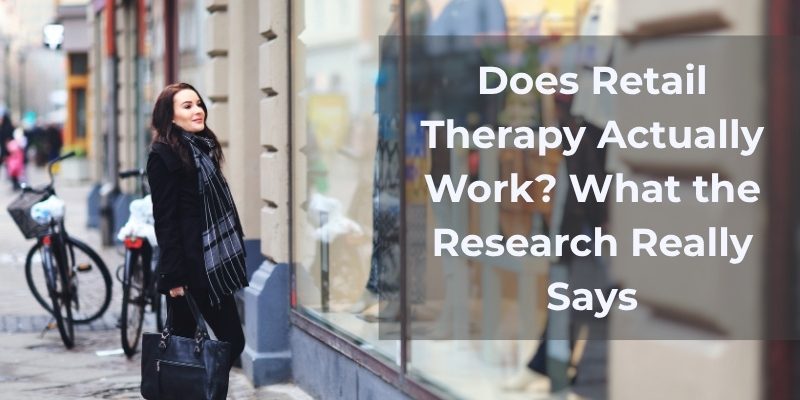




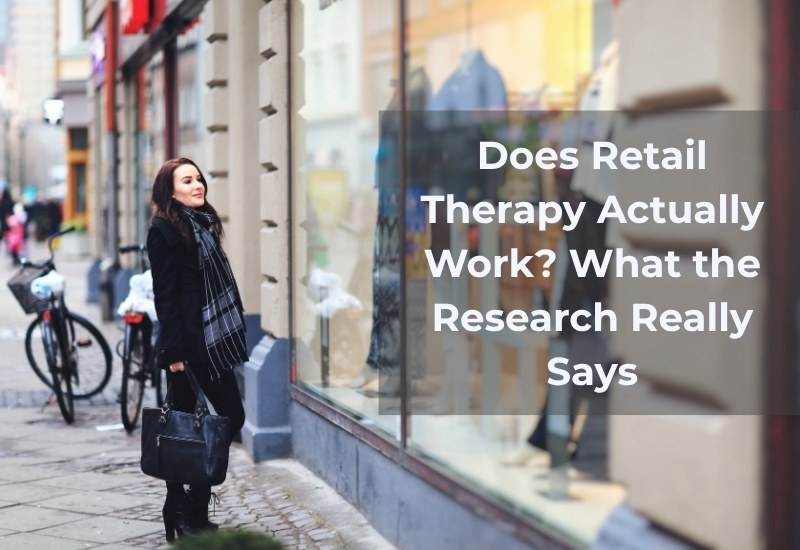
Yes, Retail Therapy Works. Here’s the Bit Instagram Left Out.
Every so often, a piece of research escapes the journals and goes for a wander round social media, and you’ll have seen this one. Some version of: good news, lovely people, science says shopping actually makes you happier, the effect lasts, and you’re not even supposed to feel guilty about it. Cue a great deal of relieved sharing and women heading to the shops.
And here’s the surprising part. It’s true. There is a real, peer-reviewed study that says more or less exactly that. I went and read it, half expecting to find the usual case of a modest finding wearing a giant headline, and instead found the headline was basically fair.
But there’s an asterisk. A rather important one that the cheerful version always leaves off, and that asterisk is the difference between retail therapy that heals and retail therapy that quietly wrecks your wardrobe and your bank balance. So let me give you the good news properly, and then the small print that makes it actually useful.
 The genuinely good news
The study is by Selin Atalay and Margaret Meloy, published in Psychology & Marketing in 2011, under the title Retail Therapy: A Strategic Effort to Improve Mood.

They set out to test the thing everyone assumes about mood-shopping, which is that it’s a trap: you feel low, so you shop impulsively and mindlessly, and then you’re stuck with regret and guilt on top of the original bad mood. A double punishment. Very tidy, very moralising, and, it turns out, not what the data showed.
What they actually found was more generous. Yes, a bad mood does lead people to buy more little treats for themselves. But those purchases can be strategic rather than reckless, meaning people stay in control of them, and even indulge and hold back at the same time, treating themselves while still exercising restraint. The mood lift was real. And here’s the headline the internet correctly seized on: the positive effect on mood lasted beyond the shopping itself, and the purchases were not associated with regret or guilt.
So the caricature of the weeping woman drowning her sorrows in impulse buys and hating herself afterwards is, on this evidence, mostly a myth. Deliberate little self-treats, chosen when you’re down, can genuinely lift you, keep lifting you for a while, and leave no hangover.
That’s a real finding, and you’re allowed to enjoy it. Now the asterisk.
The word doing all the quiet work
Read that study carefully, and one word keeps earning its keep: strategic. The treats that worked were small, deliberate, and firmly under the buyer’s own control. These were people making calm, considered little choices, not people being swept off their feet.
Which matters enormously, because everything else we know about mood and shopping describes the opposite kind of buying and the opposite result. The research on buyer’s remorse is real. Fashion has some of the highest return rates of anything, a good chunk of it driven not by faulty goods but by regret. The studies on impulse buying trace a reliable path from a big exciting rush straight to dissonance and return. So we have a genuine puzzle. One respectable study says mood-shopping leaves no regret. A pile of other respectable studies say it’s soaked in the stuff.
They’re both right. They’re just looking at opposite ends of the same street.
Atalay and Meloy were studying the calm end: small, chosen, controlled treats bought by someone who kept the wheel. The regret research is studying the wild end: big, urgent, engineered impulse buys made by someone a shop had worked very hard to hurry. Same activity, wildly different outcome, and the whole difference lives in one question. Were you the one making the choice, or was the choice being made for you?
That, as it happens, is the thread running through this entire series. The purchase you make calmly, from a place of control, is the one that heals and stays healed. The purchase a retailer engineers out of you with urgency, scarcity, flattering lighting and a painless tap is the one that turns to regret in the car park. The science doesn’t say don’t treat yourself. It says everything depends on who’s driving.
How to tell the therapy from the trap
The useful skill, then, is telling which kind of purchase you’re actually in the middle of, while you’re still in the middle of it. A few honest tells:
Calm or urgent? A genuine treat feels unhurried. If your heart is going and a clock is ticking, that’s not your taste talking; it’s the sales machinery. Real desire is still there tomorrow. Manufactured desire needs you to act right now, precisely because it wouldn’t survive a night’s sleep.
Chosen or pushed? Did you arrive wanting something like this, or did the shop introduce the idea and the urgency in the same breath? One is you exercising control. The other is you having it gently removed.
Small or spiralling? The self-treats in the study were little things. A small, contained treat leaves you steady. A spiralling one, where each item lowers the resistance to the next, is a mood no longer being managed but chased.
From steady or from panic? This is the deepest one. Are you choosing this from a reasonably settled place, or reaching for it to fill something that’s genuinely aching? A settled mood makes good, regret-free choices. A desperate one makes purchases it can’t feel good about, because the buying was never really about the thing.
What’s the feeling you’re trying to solve? As I wrote in this post, shopping to overcome anger will not work, but sadness may be improved.
Get those right, and you’re the woman in the Atalay and Meloy study, the one who treats herself, feels better for longer, and doesn’t lie awake regretting it. Get them wrong, and you’re in the return-rate statistics.
The thing that keeps you at the good end
Here’s what I most want you to take from all this. The difference between therapy and trap isn’t really about willpower, and it certainly isn’t about denying yourself nice things. It’s about knowing yourself well enough to choose quickly and confidently, from control rather than from panic.
Because think about why the panic-buy happens. So often it’s uncertainty. You don’t quite know what suits you, so you’re vulnerable to being told. You’re not sure what you already own, so you buy the thing again in a slightly different colour. You can’t picture what it goes with, so a persuasive shop and a ticking clock rush in to fill the gap where your own confident judgement should be. Every bit of that is a control vacuum, and a retailer is always happy to step into a control vacuum.
The woman who knows her own colouring, her own shape, her own real style and exactly what’s already in her wardrobe is almost impossible to panic-sell to. Not because she has more discipline, but because she has less doubt. She can stand in the shop, feel the pull, and know in about four seconds whether this is a genuine treat for the woman she actually is or a clever bit of theatre aimed at the woman she’s afraid she isn’t. That knowledge is the thing that keeps you permanently at the healing end of the street.
And that knowledge is exactly what my 7 Steps to Style program is built to give you. It walks you through your personality, your body, your colours, your lifestyle and your real style, one clear step at a time, until you know, without agonising, what genuinely works for you and what doesn’t. That’s not just prettier outfits. It’s the confidence that turns every shopping trip from a situation someone else controls into a series of calm, quick, regret-free choices you control. It’s how you make retail therapy actually therapeutic, and keep it that way.
Before your next mood-lifting purchase, ask yourself one question: am I choosing this calmly, or is something rushing me? If you’re calm, enjoy your treat with a completely clear conscience. If you’re being rushed, put it down, because that’s the version the research says you’ll regret.