








You Didn’t Fall in Love With That Dress. Your Nucleus Accumbens Did
There’s a moment in a shop that we all treat as sacred.
You’re walking past a rail, not really looking, and something stops you. You reach out. You hold it up. And you get that small internal lift, the one that says Oh. We give that moment enormous authority. We call it instinct, or taste, or the dress speaking to us. Some part of us believes that if we felt it that strongly, it must be true.
I want to ruin that for you slightly, and then hand you something better.
Because a group of researchers put people in an fMRI scanner and watched that exact moment happen. And what they found is that the lift you feel is not a verdict on the garment. It’s a signal; it fires before you’ve consciously decided anything, and it is being deliberately triggered by almost everything in the room.

 What the scanner saw
The study is Knutson, Rick, Wimmer, Prelec and Loewenstein, published in Neuron in 2007, and it’s still one of the most quoted pieces of research in retail.
The design is beautifully simple. They built something called the SHOP task, for Save Holdings Or Purchase. Participants lay in a scanner with real money to spend on real products they’d actually receive. Each round went the same way: four seconds looking at the product, four seconds looking at its price, four seconds to say yes or no.
Splitting the product and the price into separate windows is the clever bit, because it let the researchers watch the brain react to wanting the thing and to what it costs as two entirely separate events.
And they are separate. Liking the product activated the nucleus accumbens, a small structure buried deep in the brain that deals in anticipation of reward. A price that felt too high activated the insula, which is associated with unpleasantness, and it dampened down the mesial prefrontal cortex, which is involved in weighing things up.
Here’s the finding that should make you sit up. Activity in those regions predicted whether the person would buy, over and above what they said about their own preferences. Their brains gave the game away before their opinions did. As the authors put it, this all happened prior to the purchase decision.
Not while deciding. Before they had even realised they had decided.
So the picture of shopping most of us carry around is wrong. We imagine a single internal judgement, a sort of overall verdict where taste and price and need get weighed together and out comes an answer.
Two Dials, Not One, Are Turning in Your Brain
That’s not what’s happening. There are two dials, and they’re independent.
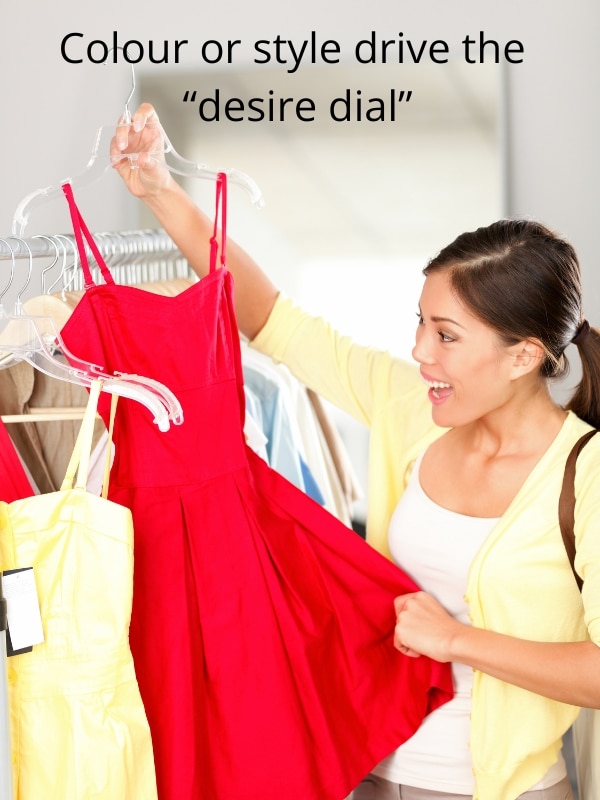
One dial is desire. How much do I want this thing?
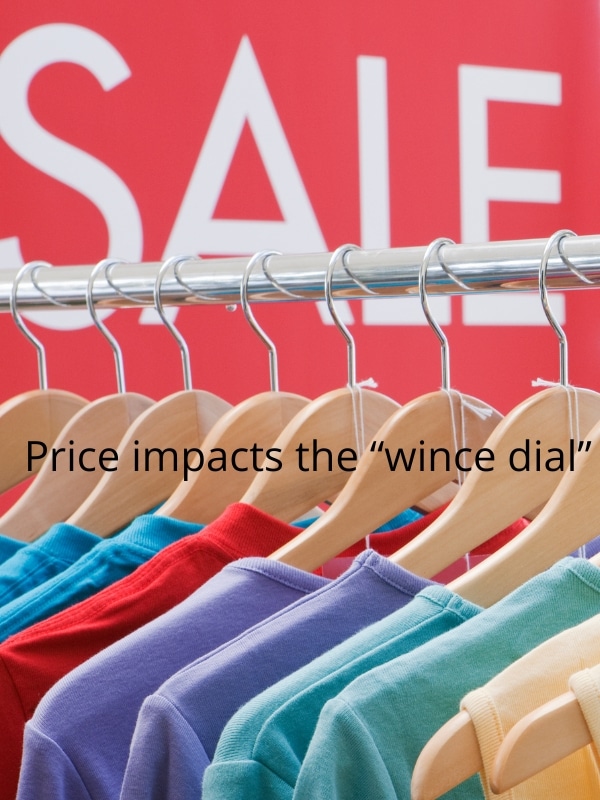
 The other dial is the wince. How much does this hurt to pay?
A purchase happens when the first dial is turned up higher than the second. Which means there are two completely different ways to sell you something, and a good retailer works both at once. They can turn the desire up, using light, styling, scent, scarcity and beautiful fabric.
Or they can turn the wince down, using a discount, a was-and-now tag, four instalments, or a card you tap without ever seeing a number.
Notice that only one of those has anything to do with whether the dress suits you.
This is why the sale rack is so dangerous, and it’s not the reason people usually give. A discount doesn’t make you love the dress more. It doesn’t touch the desire dial at all. It just turns down the wince, so a mild, ordinary, half-hearted amount of wanting is suddenly enough to get you to the till. That’s how you end up owning something you never actively wanted. The bar didn’t rise to meet your enthusiasm. It got lowered until your enthusiasm cleared it.
This is particularly important for what you perceive to be designer goods. The desire dial for owning a piece of that designer’s clothing (whether or not it suits you, it fits you, and it’s actually your style) can completely override these all-so-important personal style criteria, when the wince dial is turned right down because the piece is on a heavy discount. It’s why knowing your style criteria – having developed your personal set that is used whenever you buy clothing- is so critical. As this knowledge will help you override your desire dial when it’s set off inappropriately.
Then you pick it up, and everything changes
Now for the part that genuinely changed how I shop.
Joann Peck and Suzanne Shu published a paper in the Journal of Consumer Research in 2009 called The Effect of Mere Touch on Perceived Ownership. The finding is exactly what the title says: merely touching an object increases your sense that it’s yours, and that increased sense of ownership makes you willing to pay more for it.
Not touching it to check the quality. Not examining the seams. Just holding it.
What prompted the research is my favourite detail in this entire series. The authors were spurred on by a consumer warning issued by the Illinois attorney general’s office, cautioning holiday shoppers about retailers who encourage them to pick items up and imagine owning them. A government office thought this was worth warning the public about. The researchers tested it and concluded the warning was fair.
And they found the online version works too. Where you can’t touch something, being invited to imagine owning it produces a similar lift in perceived ownership and in what you’ll pay. Which is precisely why product copy is written the way it is. Picture yourself in this on a summer evening. Imagine this in your wardrobe. That’s not lyrical description. That’s the mechanism, in words.
Think about what a shop actually is, in this light. Not a warehouse where garments are stored until sold. A room engineered so that you will touch as much as possible. Nothing behind glass. Everything at hand height. Racks spaced so you brush past the fabric. Assistants who don’t say “can I help you“; they say “here, feel that.”
The bit that matters most for clothes
There’s a wrinkle in the Peck and Shu research that nobody ever quotes, and for our purposes it’s the most useful part of the whole paper.
They ran the experiment with different objects, and the effect was not uniform. With a Slinky, which is pleasant to handle, touching it raised both the sense of ownership and the positive feeling, and people valued it more. With Playfoam, which is less pleasant to touch, touching it still raised the sense of ownership, but the feeling went down, and so the value didn’t rise.
Touch only sells you something when the touch feels good.
Now apply that to a wardrobe. It explains the cashmere at the front of the shop and the polyester at the back. It explains why you own a silk blouse in a colour you’d never choose, and why you’ve walked away from a beautifully cut jacket in a fabric that felt papery (which is a good thing, as fabrics matter).
But it also explains one of the most common wardrobe mistakes I see. The polyester may drape well and feel fine when you try it on in the store in air-conditioned comfort, but get it home and wear it out on a hot, humid day, and that comfort level is gone.
Every time you make a decision with your hand instead of your eye, you’re answering a question nobody asked.
But be wary – fabrics like acrylic can feel soft and nice in store, but get them home and they wear poorly. So always check the fibre label on every garment before you even consider taking it into the change room. This is something that I have found makes decision-making so much easier. Check out the care label and fibre content. Before you take it to try on. 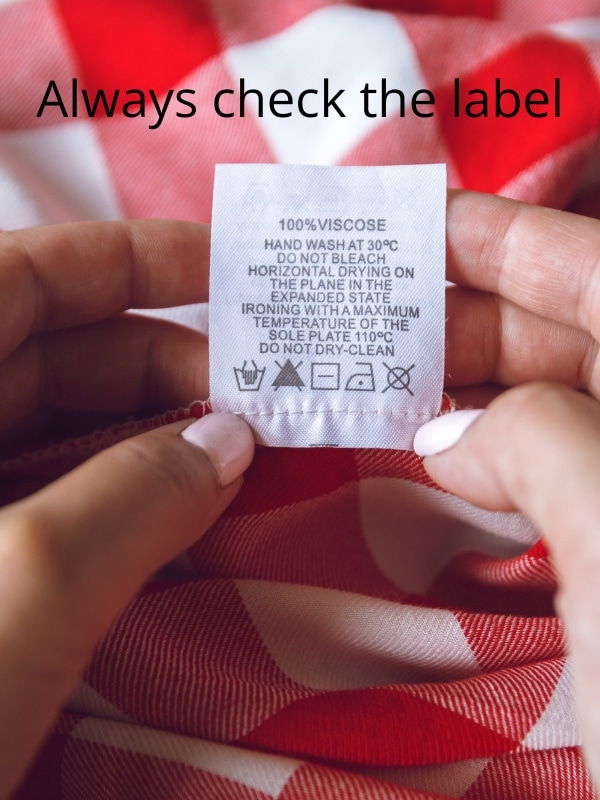
Two questions, asked separately
So here’s what I’d actually like you to take away. Not “beware of shops”, which helps nobody, but a small procedural change that costs you nothing.
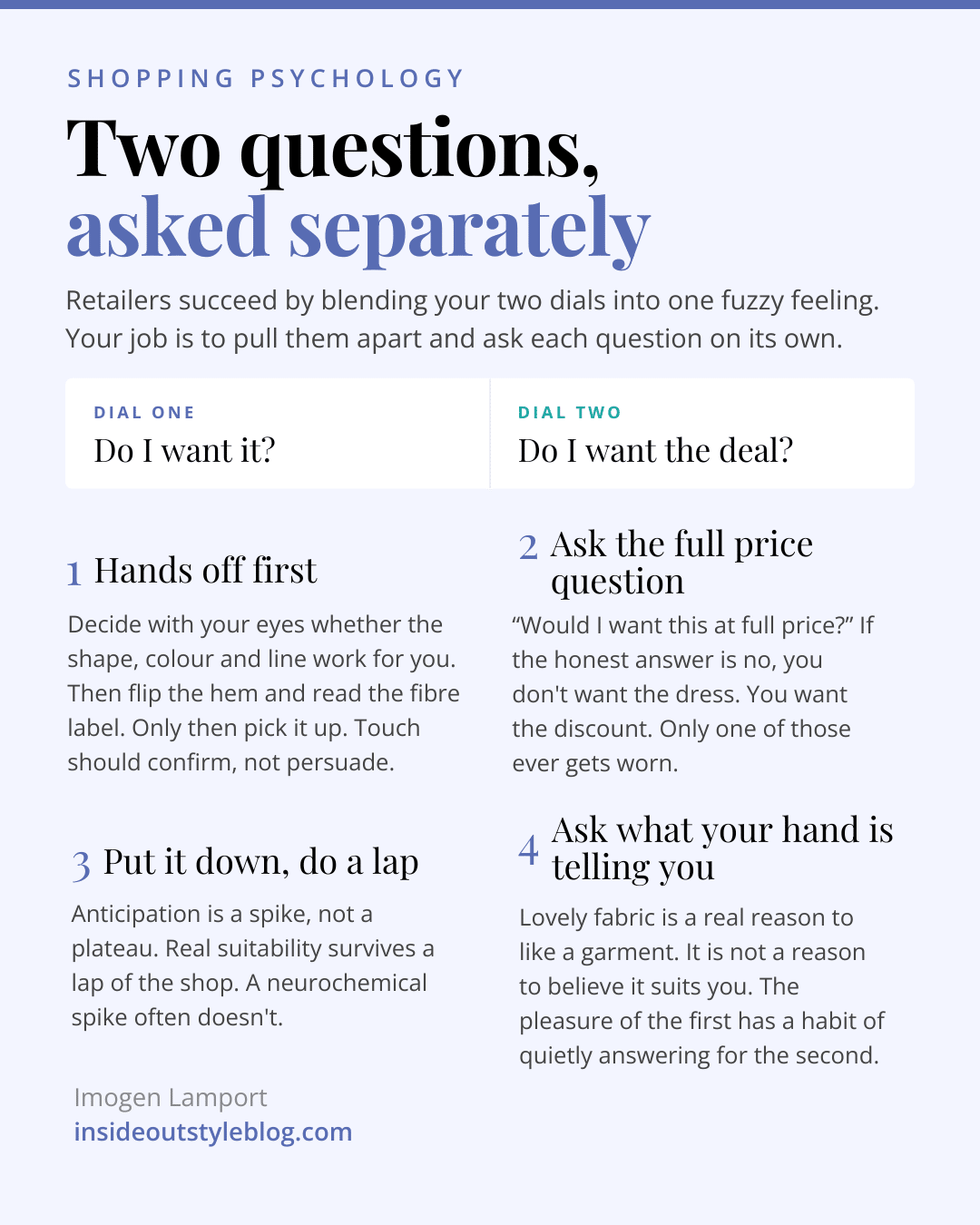
Retailers succeed by blending your two dials into one fuzzy feeling. Your job is to pull them apart and ask each question on its own.
Hands off first. Look before you touch. Decide with your eyes whether this is a shape, colour and line that works for you. Flip the bottom corner of the garment up, and you’ll find the fibre and care label on one of the side seams. Check out what it’s made from – is it a fibre that you love and that will wear well? Or is it one that will pill and wear poorly, or not breathe and make you feel uncomfortable? Only then pick it up if it meets those base-level criteria. You’ve just moved touch from being the thing that persuades you to being the thing that confirms you.
Ask the full price question. “Would I want this at full price?” is the single most useful sentence you can say in a shop, because it isolates the desire dial from the wince dial. If the honest answer is no, then you don’t want the dress. You want the discount. Those are different things, and only one of them ends up being worn.
Put it down and do a lap. Anticipation is a spike, not a plateau. Walk the shop or walk out of the shop for a while, come back, pick it up again. Real suitability survives a lap of the shop or shopping centre. A neurochemical spike often doesn’t.
Ask what your hand is actually telling you. Lovely fabric is a real reason to like a garment. It is not a reason to believe it suits you. Those are two separate assessments and the pleasure of the first has a habit of quietly answering for the second.
 One honest note, because I’d rather you trusted me than be impressed by me. Brain imaging studies use small samples in artificial conditions, and reading intentions off a scan is a genuinely contested area of science. I’d hold the neuroscience loosely as a metaphor with good evidence behind it, rather than as a law. The behavioural findings on touch and on price framing are much more solidly established, and they point in exactly the same direction.
Which is this. The lift you feel in a shop is real, but it’s an anticipation signal, not a verdict. It’s telling you something about this moment. It is not telling you anything about next Tuesday, when you have to get dressed and leave the house.
This week, try one thing: look before you touch. Just once, on one garment, keep your hands off until you’ve decided with your eyes whether it’s the right fabric, colour and great style for you. See what changes.
Set Your Own Personal Style Criteria
The most important factor to help you make decisions around what to buy is authoring your own personal style criteria – when you know as facts what you do and don’t love, the kinds of fabrics that you enjoy wearing and that wear well. The colours that make you shine, the styles that feel good on your body and make you happy to see yourself in the mirror. When you know what really works for you and your lifestyle, you are in charge when you’re in stores, as you are more easily able to be discerning and not let that pesky nucleus accumbens talk you into making a bad decision for your wallet and your wardrobe. If you’d love to become more discerning and empowered around your style, my 7 Steps to Style is the program that will walk you through this process, so that you are deliberate in your choices.