









You Bought It for a Woman Who Doesn’t Exist Yet
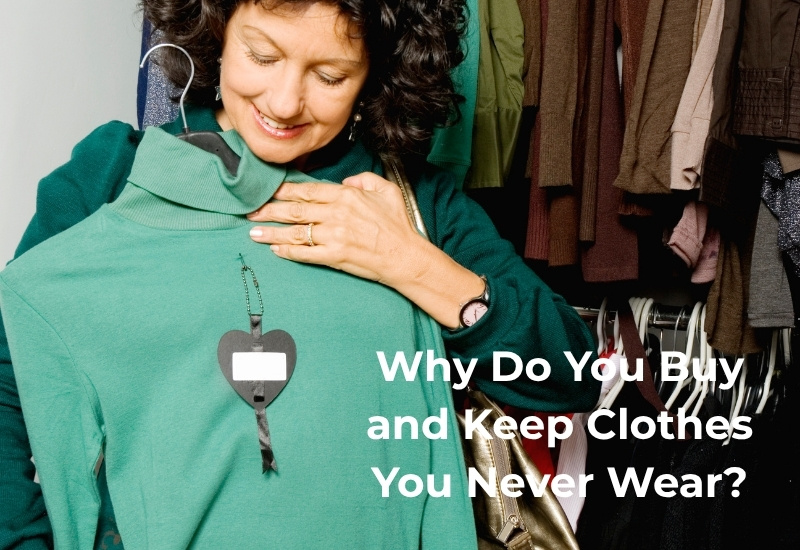
Go and open your wardrobe. Not metaphorically, actually go and look. Somewhere in there, I’d put money on it, is a garment with the tags still on or never worn. Something a size down from where you are. Something for the gallery opening you don’t get invited to, the holiday you haven’t booked, the version of your life that runs slightly more glamorous, cool and more elegant than the one you’re currently living.
You didn’t buy that dress for yourself. You bought it for her. The woman you were planning to become.
And she’s the most expensive person in your house, because she never actually turns up to wear any of it.
I want to talk about her, because she’s not a character flaw. She’s the predictable result of a well-understood psychological mechanism, and once you can see her clearly you can stop buying her things.

 The gap that does all the shopping
In 1987, a psychologist called E. Tory Higgins published a theory in Psychological Review that explains more about your wardrobe than most styling books do. He called it self-discrepancy theory, and the idea is simpler than the name.
Higgins said we don’t carry around one self. We carry three. There’s the actual self, who you believe you currently are. There’s the ideal self, the person you hope and aspire to be. And there’s the ought self, the person you feel you’re supposed to be, all duty and obligation.
Most of the time those three sit reasonably close together, and life feels fine. But when a gap opens up between who you are and who you’d ideally be, that gap doesn’t just sit there quietly. Higgins showed it produces a specific emotional flavour of discomfort, a low background hum of disappointment and dissatisfaction. Not agony. Just a sense that you’re falling short of something.
Now, here’s the part that matters for shopping. That discomfort wants relief. And a dress is a very fast, very available form of relief.
How a garment pretends to close the gap
Buying something for your ideal self feels, for a moment, like you’re actually becoming her.
The elegant woman would own this coat. So you buy the coat, and for the length of the transaction and the drive home, you are the elegant woman. You’ve closed the gap, not by doing any of the slow, difficult work of actually changing your life, but by acquiring one of her props. Psychologists call this compensatory consumption: using a purchase to patch a hole in how you feel about yourself.
The trouble is that the coat can’t do the job you hired it for. It was never a real bridge across the gap, just a picture of one. So the tags stay on, because the moment you actually wear it, out to the ordinary supermarket on an ordinary Tuesday, it stops being the elegant woman’s coat and becomes a feeling inside that if you wore it, you would be too much; it’s a fancier coat than you feel you are, particularly just to go out and buy the milk. And the fantasy is worth more to you intact. So it hangs there, keeping its promise precisely by never being tested.
This is why the aspirational purchase is such a peculiarly stubborn kind of clutter. It isn’t there because you need it or even really because you like it. It’s there as evidence of an intention.
The wardrobe full of intentions
Here’s where the research gets almost uncomfortably specific.
In 2024, researchers from KU Leuven and the University of Utrecht did something wonderfully thorough. Rather than asking people about their shopping habits, they went in and audited actual wardrobes, 156 of them, garment by garment. They found the average person owned 198 items of clothing. And 22 per cent of those, more than one in five, were dormant, meaning they hadn’t been worn once in the past year.
So far, so ordinary, you might think. But then they asked people whether they’d be willing to let those dormant items go. And people refused to part with well over half of them. When the researchers asked why, the answer, by an enormous margin, was the intention to use them in future. A fifth of those clung-to items were being kept specifically for particular occasions.
Read that carefully, because it’s your ideal self on a spreadsheet. Garments not worn in a year, still hoarded, not for what they’ve done but for what they might one day do. The occasion that would finally make sense of them. The event she’d wear it to. The future in which she arrives.
The same pattern shows up wherever anyone looks properly. UK research by the sustainability charity WRAP found the average adult owns around 118 items, of which roughly a quarter haven’t been worn for at least a year, and that the garments most likely to be owned and never worn are precisely the occasion pieces: dresses and skirts, the clothes of a more eventful life than most of us actually lead. Everyday staples get worn to death. It’s the aspirational items that gather dust.
We don’t even know we’re doing it
Now for the finding that should make all of us a little more humble.
That same Flanders research compared what was actually in people’s wardrobes against what people thought was in them. And the gap was staggering. In an earlier version of this work, participants guessed they’d left around a quarter of their wardrobe unworn in the past year. The real figure, once someone actually counted, was closer to nine in ten.
We are not reliable witnesses to our own cupboards. We think we wear most of what we own. We wear a fraction of it, on rotation, and the rest is a museum of intentions we’ve stopped noticing. The aspirational dress becomes wallpaper. You stop seeing it as a decision you made, and it just becomes part of the landscape of the room.
Which is rather the point. If you could see it clearly every morning, the small disappointment might eventually prompt you to deal with it. Because you can’t, it just sits there, quietly having been a waste of money, for years.
The dress is not the problem. The gap is.
I want to be careful here, because this is where a lot of decluttering advice goes wrong. It tells you to be ruthless, bin the lot, buy only what you’ll wear. And that’s not wrong exactly, but it misses the actual mechanism, which is why people declutter and then refill the same wardrobe with the same kind of thing within a year.
The dress was never really the issue. The dress was a symptom. The issue is the gap between who you feel you are and who you’d like to be, and the fact that shopping offers such a quick, cheap, socially acceptable way of pretending to close it.
So the useful question isn’t “will I wear this?” You’ll always answer yes, because you’re not picturing yourself wearing it. You’re picturing her wearing it, and she wears everything beautifully.
The useful question is this: am I buying this for the woman I am, or for a woman I’m hoping to become?
Clothes for the actual you get worn. They fit the life you actually have, the places you actually go, the body you’re actually in, the colours that actually suit you. Clothes for the aspirational you hang there as a reproach, because they were never really clothes. They were a mood-fix dressed up as a garment.
And the quiet tragedy is that the actual you is genuinely worth dressing. Right now, today, in the life you already have. She’s not a waiting room for a better woman. She’s the one who has to get dressed tomorrow morning, and she deserves a wardrobe that was chosen for her, by someone who was paying attention to who she really is.
That someone is you. It’s the whole skill, really. Not becoming a different woman. Learning to dress the one who’s actually here.
What to do with her things
A few practical steps that follow from all this:
Find her. Do one honest pass through your wardrobe and pull out everything with the tags still on, everything a size away from now, everything bought for an occasion that never came. Lay it on the bed. That pile is your ideal self, itemised. It’s usually a sobering amount of money, and seeing it together is the single most clarifying thing you can do.
Ask the real question of each piece. Not “might I wear this,” but “did I buy this for who I am or who I wished I were?” You’ll know instantly. The honest answer arrives before the excuse does.
Separate the two kinds of unworn. Some things are genuinely in waiting: the actual formal dress for the wedding that’s actually in the diary. Fine. Keep those. It’s the aspirational pieces, the ones waiting on a life that isn’t scheduled, that you can let go of without losing anything real.
Buy for Tuesday, not for the fantasy. Before anything new comes home, make it earn its place in your actual week. Where will you wear it, specifically, in the next fortnight? If the honest answer involves a version of your life that doesn’t exist yet, put it back. You’re not buying a dress. You’re buying her, again.
Forgive the money already spent. It’s gone either way. Keeping the dress doesn’t recover it, it just pays rent, in wardrobe space and low-level guilt, on a purchase that already didn’t work. Letting it go is not the loss. The loss already happened at the till.
This week, find the one item that most belongs to the woman you were hoping to become, and decide honestly whether she’s ever coming to collect it. If she isn’t, let someone wear it who’s actually here.
Experiment with what you have. Before you throw it all out, why not try it on and wear it, see how it feels on; maybe you are that woman already, and you haven’t realised yet. My Evolve Your Style month-long fun style challenge is designed to help you discover who you are and what in your wardrobe should stay and what should go.
And if that pile on the bed has left you wondering who you actually are now, underneath all the things you bought for her, that’s exactly the work my 7 Steps to Style program was built for. It walks you through your colours, your body, your real style and the life you actually lead, so you can build a wardrobe around the woman who’s here today and the one you’ll b tomorrow, rather than the imaginary one with the imaginary diary. Not to become someone else. To finally get dressed as yourself, and feel better than you did this morning doing it.



I love this!! Absolutely brilliant, even if a bit uncomfortable lol. So true. Thank you for this. I’m printing out the article and going to my closet right now! Thank you for always bringing great articles to us to help us on our way.