










The Sale Price Is a Comparison, Not a Saving
Here is a sentence that has cost women more money than almost any other: “but it was reduced from $120.”
We say it to ourselves in the shop. We say it to our partners at home. We say it, a little defensively, when someone admires the thing and asks what we paid. And we say it as though the first number, the crossed-out one, were a fact about the world rather than a number a retailer chose specifically so that the second number would feel like a gift.
I want to take that sentence apart, because once you see how it works you can’t unsee it, and you stop handing over money for the pleasure of a comparison someone else rigged.
 Your brain doesn’t judge prices. It judges differences.
Start with one of the most reliable findings in all of psychology, and one of the most quietly alarming.

In 1974, Amos Tversky and Daniel Kahneman sat people in front of a wheel of fortune marked from zero to one hundred. The wheel was secretly rigged to land on only two numbers, 10 or 65. After it stopped, they asked people a question with nothing whatsoever to do with the wheel: what percentage of African countries are members of the United Nations?
The people who had just watched the wheel land on 10 guessed, on average, 25 per cent. The people who saw it land on 65 guessed 45 per cent.
A completely random number, which everyone could see was random, dragged their answers twenty points apart. This is called anchoring, and the uncomfortable part is that knowing about it barely helps. The first number you see sets the frame, and every judgement after it is made by comparison to that frame rather than on its own merits.
Now look again at the price tag. $120, crossed out, $59 beside it. The retailer has handed you the wheel of fortune. The $120 is the anchor, and its entire job is to be the number your brain silently compares $59 against. You were never really asked “is this worth $59?” You were asked “is $59 better than $120?” And of course it is. That question answers itself, which is exactly why it’s the question you were given.
The crossed-out price is not information. It’s the frame the real price gets to sit inside.
Was it ever really that price?
Here’s where it tips from psychology into something closer to sleight of hand.
For the anchor to do its work, the high number only has to be seen. It doesn’t have to be true. And a great deal of “was” pricing describes a price at which the item barely sold, was on the shelf for a token period, or in some cases never genuinely sold at all. The high number exists to be crossed out. It was born to be a former price.
This is common enough that it’s a live issue for regulators. In the UK, guidance on pricing practices exists precisely because a reference price like “was $120” implies the item was genuinely offered at that price for a meaningful period, and shoppers are entitled to assume the saving is real rather than manufactured. The rules exist because the trick is old, well understood, and worth legislating against.
Which tells you something worth holding onto. If the saving has to be regulated to keep it honest, the saving was never simply a kindness the shop was doing you.
There’s even research on how finely this comparison can be tuned. A 2025 study in Frontiers in Psychology found that simply placing the regular price to the left of the discounted price led people to estimate a higher reference price, and to perceive the product as higher quality, than when the prices were arranged differently. The direction your eye travels across the tag is a design decision. Nothing on that little swing ticket is accidental.
The clock that isn’t really ticking
Anchoring tells you the sale is worth grabbing. Something else has to make you grab it now, before the sensible part of you goes home and thinks about it. That something is scarcity, and it comes in two flavours: not many left, and not long left.
“Only 2 remaining.” “Sale ends midnight.” “17 people are looking at this right now.” These cues work by triggering loss aversion, our deep and well-documented tendency to feel a potential loss more sharply than an equivalent gain. The dress at a good price isn’t framed as a thing you could gain. It’s framed as a thing you’re about to lose. And loss makes us act quickly and think poorly.
That’s the real function of the countdown. It isn’t there to inform you. It’s there to remove the one thing most fatal to an impulse purchase, which is time. Time lets desire cool. Time lets you remember the three similar dresses already in your wardrobe. Time lets you ask whether you’d want this at full price. So the clock is set ticking specifically to deny you the pause in which you might come to your senses.
And here’s the tell. Genuine scarcity doesn’t need to announce itself with a flashing timer. When something is truly nearly gone, you find out by trying to buy it and discovering it’s sold. The louder and more theatrical the urgency, the more likely it exists to move you rather than to describe the stock.
And then they make the paying stop hurting
So far everything has been aimed at one side of the equation: making you want it, making the price look generous, making you hurry. There’s a final move, and it works on the other side entirely. It makes the actual handing-over of money hurt less.
Drazen Prelec and Duncan Simester, at MIT, ran a now-famous study published in 2001 with the wonderful title Always Leave Home Without It. They held a real auction for tickets to a sold-out Boston Celtics basketball game. Half the bidders were told the winner would pay in cash. Half were told they’d pay by credit card. Same tickets, same auction, one difference.
The credit card bidders bid up to twice as much.
Read that again, because it’s extraordinary. Simply being told they’d pay by card, rather than counting out notes, made people willing to pay around double for the identical item. The researchers called it the pain of paying, and the phrase is exact. Handing over cash physically hurts a little. You watch the notes leave your hand and something in you registers the loss. A card removes the wound. You tap, nothing visibly departs, and the money becomes an abstraction you’ll deal with later, in a version of yourself you don’t have to meet today.
Now notice that every innovation in how we pay since then has sanded this friction down further. Contactless removed even the PIN. Stored cards removed the reaching for a wallet. Buy now, pay later removed the payment from the moment of purchase altogether, so you get the entire pleasure of acquiring with none of the accompanying sting, split into four gentle instalments you’ve half forgotten by the time they land.
None of this makes the dress suit you. It just makes it easier to not feel the money leaving.
What all four have in common
Step back and look at the whole toolkit together: the anchor, the questionable “was” price, the ticking clock, the painless tap.
Not one of them has anything to do with whether the garment is right for you. Not the colour, not the cut, not whether it works with three things you already own, not whether it flatters your shape or suits your colouring. Every single one operates on the transaction rather than the item. They’re designed to change how the buying feels, not how the wearing will go.
Which is the quiet tragedy of the sale-driven wardrobe. It fills up with items that won a comparison, beat a clock and slipped past your defences on a painless tap, and then hang there having never once been asked the only question that matters: do I actually want to wear this?
So here’s what to do
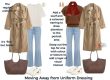
You don’t need to swear off sales. Some sales are genuinely how sensible people buy good clothes. I love a sale; it’s just that I know what actually works and what I need so if I happen to stumble upons something on sale that meets all my criteria (see below) then why pay full price? And I’m happy to purchase full price when I see something I really love, and I know I’m going to wear and keep for a long time, like this jacket below.

You just need to answer the item question and the transaction question separately, because the whole system depends on you blurring them into one.
Cover the first number. Literally, with your thumb if you have to. Look only at what they’re asking now, and ask whether the garment is worth that, to you, today. If $59 is a fair price for this dress, it’s fair whether or not $120 was ever printed above it. If it isn’t, the crossed-out number doesn’t rescue it.
Ask the full-price question. “Would I buy this if it weren’t reduced?” If the honest answer is no, then it isn’t the dress you want. It’s the discount. And a discount is not a thing you can wear.
Distrust the clock, on principle. Any purchase a countdown is rushing you into is, by definition, one you weren’t sure enough about to make calmly. Treat urgency as information about the seller, not the stock. Nearly everything comes back, restocks, or turns up elsewhere, and the few things that don’t were rarely the loss they were dressed up as.
Add the friction back yourself. If your card makes spending painless, put the pain back by hand. Wait a day. Walk a lap. Leave it in the online basket overnight and see if you still want it in the morning. The retailer spent a great deal of effort removing your pause. Reinstating it is the single most powerful thing you can do, and it costs nothing but a night’s sleep.
The saving they’re selling you is a comparison. What you can actually wear is the item. Learn to look at the second thing and quietly ignore the first, and you’ll spend less, own less, and love far more of what’s in your wardrobe.
Next time a tag shows you a crossed-out price, cover it with your thumb before you decide anything, and notice how differently the real number reads on its own.
Have your own style criteria to run every purchase by.
Before you buy, make sure it fits all your style criteria.
- Is it a colour that makes you glow with health and vitality?
- Does it reflect your style recipe?
- Is it a style that is in harmony with your body and makes you look fabulous?
- Is it a fit that is comfortable?
- Will it fill a genuine wardrobe gap?
- Does it go with at least 4 other garments that I already own?
- Does the fabric feel lovely to the touch?
- Does it suit your current lifestyle?
If the answer is no to any of these questions, no matter how big the discount, leave it in the store.
If you don’t know your answers to these questions, don’t shop until you develop your personalised style criteria – you can do that through my 7 Steps to Style program, and that style education will save you a fortune over your lifetime.


Such an important article! I have created the habit of putting anything that catches my eye in the “wishlist”. Then I sit on it for a few days. It’s amazing how few of the items I ever end up purchasing once I’ve had time to think it through!