







I had a question from Margie recently that I suspect a lot of you will relate to. She’s a Classic style personality living in Texas, where summer temperatures sit in the high 90s to low 100s Fahrenheit, which is roughly high 30s to low 40s Celsius for everyone else. She wanted to know: how do you stay looking pulled together when it’s that hot?
Honestly, Margie, I feel you. Parts of Australia get there too. And when you’re a naturally elevated dresser, someone who loves the blazer, the layered necklace, the carefully considered finishing touch, that kind of heat is a style crisis in slow motion.
Here’s the reframe that changes everything.

1. Let your hot-weather clothes do the heavy lifting
In winter, we build interest through layers. The scarf, the jacket, the interesting knit over the top. That’s easy. But when it’s 40 degrees, the last thing you want is anything extra touching your body. So instead of adding interest on top of your clothes, you need to find clothes that have the interest built right into them.
Think of it this way: your summer wardrobe needs to work harder as individual pieces, so you never need to add a thing.
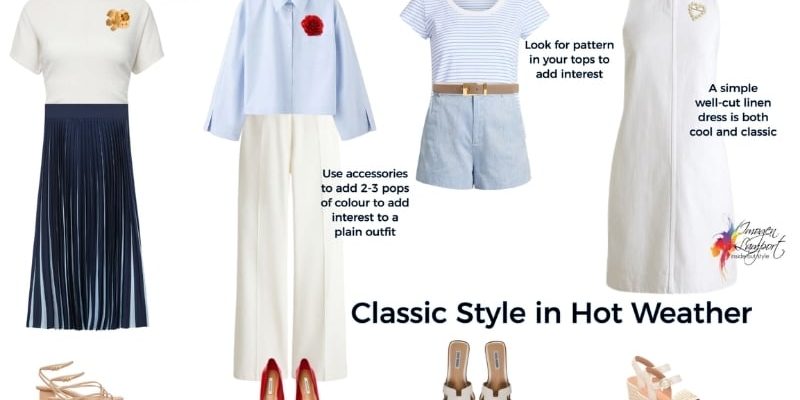
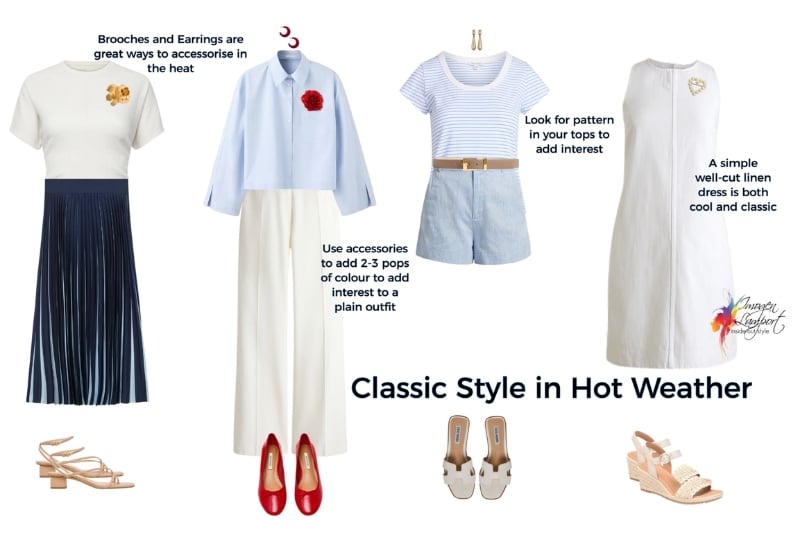
 What does “built-in interest” actually look like? It can be interesting construction at the neckline (so you get the dressed-up feeling without a necklace sitting hot against your skin), decorative detail woven into the garment itself, pattern or print, colour (not just neutrals, actually wear what works for you), or fabric texture. Eyelet fabric is a perfect example; those little cutouts do double duty: they add visual interest, and they breathe. Anything with an interesting weave, texture, or pattern built into the cloth itself can make a plain silhouette feel considered and intentional.
My own hot-weather t-shirts all have either interesting construction or a print that makes them interesting on their own. Nothing else needs to be added.
2. Reconsider the dress
I want to make a case for the dress as the ultimate hot-weather garment, especially for Classic style personalities.
A dress is, in itself, a complete and polished outfit. One decision, done. But there’s also a physical comfort argument: when it’s truly hot, a waistband that has to be fastened and held up is actually more restrictive than a dress that simply skims the body without that tightness at the midsection. A floaty dress with no waist construction can feel significantly cooler than even a pair of linen shorts with a buttoned-up waistband that fits snugly to your body.
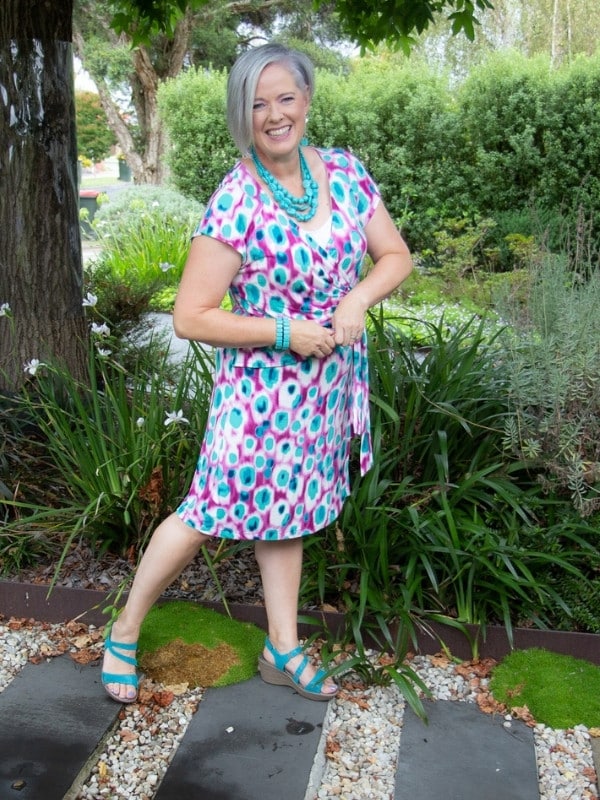 The question to ask yourself is: can you find a dress that suits your personality AND has that built-in detail we talked about? Because if you can, you have an outfit that requires nothing else. That’s the goal.
3. Rethink your accessories, don’t abandon them
Earrings are still your friend in summer. The key word is lightweight. I’ve been loving a pair of hand-crocheted flower earrings I bought from an artisan; they weigh practically nothing, they go with everything in my colour palette, and they add that finishing touch without the heat factor of a necklace lying against your neck.
 And here’s one I’ve been using a lot this summer: brooches. Brooches are genuinely back (they never really went away, but they’re having a moment), and pinning a brooch at the neckline gives you that elevated, Classic-style feeling without anything hanging around your neck in the heat. It’s a small shift with a surprisingly big payoff.
Wear a brooch, not a necklace. You will thank me by the end of summer.
 The underlying principle
If you love a polished, elevated aesthetic, hot weather isn’t asking you to abandon your style. It’s asking you to find it in a single garment instead of building it up through layers and additions. The interest, the colour, the detail, it all still needs to be there. It just needs to live in the clothes themselves.
Shop accordingly. When you’re browsing summer pieces, ask: does this work on its own? Is there something here that makes it interesting without anything added? If yes, buy it. If it needs a necklace, a jacket, and a scarf to look like you, leave it on the rack.
Your summer wardrobe should be doing the work, not you.